Wednesday, August 18, 2010

Here & There


I just returned from a relatively long trip to U.S. Not as if I went for the first or second time, but I realized again that there are certain issues- "aamra vs ora" issues, which never cease to be different. It is purely cultural- it is impossible and unfair to comment whether any one side is better than the other. A neutral observer standpoint is the best position to have. So, here is my treatise on some fundamental cultural differences between India and U.S. I am sure you guys will have some more to add from your personal experience.

1) Left vs right: fundamental confusion- while getting in cars, driving on roads and walking on sidewalk. We keep to left, in U.S. the motto is keep right. Number of times I went to the wrong side trying to get in to the front seat in the car, and came close to colliding with pedestrians while walking on the sidewalk. And so far i did not have to drive, that would have been another terrible confusion because of the left hand driving. Someone told me- "if you think you are doing it wrong, that's the right thing to do!"

2) Greeting strangers: Everyone greets everyone, when face to face. Thats the polite thing to do- acknowledge the fellow human being. In India, we never or rarely greet strangers, even when traveling alone together in an elevator. And if it is oppposite sex, niobo noibo choh! However, there is a flip side. The greetings are generally routine and if any non-standard reply is given, thats recipe for disaster. Example- a standard greeting would be "hello- how are u doing today?". Now, if you take that to your heart and start saying "glad you asked. how well u think I can be in a recession hit economy? You know, my brother is in Detriot and today he just finished his 67th application without an interview call", that will traumatize and confuse the greeter for weeks and will make him miss the metro for which he was running top speed. Possibly to avoid such eventuality, some people pre-empt the situation by auto-completing the reply. So the greeting goes as "hello. how are u doing today morning? good!!" and he walks off :-)

3) Keep it "short": In a touristy place like Washington DC, half the people on the road might be in off-white shorts in summer. That includes men and women of all ages, and of course children and young adults. Looks good, looks smart, looks comfy, but also looks "different" to Indian eyes.

4) Museums- telling the America story: What a tectonic difference in the attitude towards museums as an institution. The administrators (example Smithsonian Institution, which runs 19 different museums in Washington DC area) consider museums as a vehicle of telling the America story, and organize them with tremendous passion and imagination. The museums are almost interactive, compared to the bureaucratic, cut-and-dry approach of most government controled museums in India. Smithsonian (www.si.edu) also runs 9 research centers and the national zoo, takes hundreds of citizen volunteers, conducts hundreds of workshops and festivals every year in an effort to integrate the common population to to its activities and share the knowledge it continues to acquire about art, culture, history and science. It is not about how much money is spent- it is about how to think differently and creatively. I have nothing but complete admiration for museums in America.

5) Civic sense, discipline, respect for others: No one spits on the road, people and cars wait for the other person or car to move ahead, nio one honks on the road. Quite unthinkable in most situations in India. I have my theory for this. Competition and scramble here results from scarcity of resource. If you are polite and do not rush to be ahead in a queue, you might not get a seat in a train. If you do not elbow out the driver beside you to squeeze in to the small space, you will not move ahead for a long time. If, like in U.S., there was an assurance that the last person in the queue will get a fair share of the "bread", here it would have been exactly as things are in U.S. Does this make sense?

6) Naked man, cool cyclists, independant handicaps: In summer, you will find men, good looking and decent otherwise, running all over town in nothing but shorts, dripping in sweat. I was told, "we really strip down in summer". Way to be, there; unusual, in our eyes. Cycling is fun, and people take it as a serious weekend activity or even as a major sport. Traveling along Beartooth Highway (www.beartoothhighway.com) in Montana, I saw group of cyclists riding up from an elevation of 5000 ft at the base of Red Lodge to 10000 feet at the summit, for a distance of about 50 miles. I was told that they are doing this, so that they can then zip down the mountain curves at exhilarating speed. And these were common men, sometimes quite senior in age. Lasdtly, the people with disability are far more independant, moving around the city in wheelchair without expecting any assistance. The infrastructure on the road is such that they would not need any. The sidewalks slope down gently on the road, so that the wheelchairs can move without any difficulty. Wonderful sensitivity of the system, to make sure no one is left behind.

7) Water from the tap: When was the last you checked in to a good hotel, and drank water from the bathroom tap? You would do it all the time in U.S. Public water sources are considered very safe, and hotels would laugh if you ask for drinking water bottle/pitcher in your room. I still pause at this, even after many years of travel there.

8) Light switch work in opposite direction: Here- down- on; up- off. there- just the opposite. how about that?

9) Food portions: Huge is an understatement. A plate is usually too much for a single individual. Doesn't happen often in India, whatever be the price of the plate.

10) Do it yourself: Almost everywhere, you would miss the "support" that you are used to in India. In gas station, you fill your own gas- not a soul to help. In hotel, you haul your own bags to the room and push a cart on your own. At home, you do all work, mow your lawns if possible, wash your car, shove your snow.

11) Not exactly a dog's life: dogs are very important part of society. Pet grooming is multi-billion dollar business. Owners happily carry dog poop from the road back in to house for disposal. To be fair, the dogs also seem much more well-behaved than their Indian counterparts (this may evoke strong reaction)!

12) "Smooch" nahi tio kuch nahin: Propensity for PDA (public display of affection)- very high. :-)

Those, my friends, are my top "here vs there" issues! Neutral observations, no value judgments. Let me know what you think.


Tuesday, June 8, 2010

Woman at the wheel- just a visual

This blog is only about a picture.

Recorded live, by yours truly, from a balcony last weekend. No value judgement about women's driving skills, no personal bias, no quoting from German woman professor Claudia Wolf's research on parking skills of men and women (http://www.dailymail.co.uk/sciencetech/article-1237383/Men-really-ARE-better-parking--thats-woman-professor-talking.html). I am swiping off any hint of smile with a dark handkerchief as I write this. Yes, I giggled when I saw the scene unfolding under my eyes last Saturday, the 3-min sequence being as below:
  • a new sedan car with windows rolled up come under the balcony (it is a wide end of a blind lane)
  • tries to turn around (takes one round of backing up unless the car is a maruti)
  • ends up on the edge of the road where the edges slope slightly to ensure water drainage
  • stops, rolls slightly, stops precariously close to the garden fence of the house ahead, can't back off (no dearth of space at the back)
  • a teenager steps out of the car and goes near the bonnet, touches it to push the car back, startles and takes his palm off because the ambient is 37 degrees and the bonnet is 40
  • his father come out of the left front seat and the duo PUSHES THE CAR BACK using their handkerchiefs as gloves (at this point i whip out my cellphone and start recording)

For a moment I thought the car battery was dead, but then as soon as the car came in the middle of the road width I could see a pink sleeve in the driver's seat :-) Then the car moves smartly forward from that safe position, when it does not require backing up anymore. The father-son duo get in to the car and the mom briskly drives off. Seeing the drive away, no one would believe that a few seconds ago the lady was struggling to back up on a 5 degree slope and rotate the steering 30 degree to the left to back the car up to the middle of the road. I realized then, moving forward and moving back are two entirely different ball games.

I am not trying to say anything here. It is just a visual. Get mad at me, or sit back and enjoy. Cheers!

Wednesday, May 5, 2010

Alternative Strategies to Deal With Effects of Global Warming

Hmmm. GW has undeniably arrived. According to the estimates by IPCC, Earth's average surface temperature has increased by 0.74°C during the period 1901-2005. A study done by researchers in University of Pune on long-term temperature changes in four largest cities of India during twentieth century threw up some significant results. It established that Annual Mean temperature (celcius) in four cities increased by the following levels over last 100 years (1091-2001): Delhi 0.2 Kolkata 0.99 Mumbai 0.6 Chennai 0.56
The summer and winter mean temperatures in Kolkata have increased by over 1.2 degrees. Part of the phenomenon can be explained by rapid urbanization, but the effect of larger climate change cannot be ruled out. Any man on the street will tell you that summers are much more unbearable, winter chill has vanished and monsoon has shifted/become unpredictable (no matter what weather office says about "normal" rainfall and "monsoon has arrived" every year).

IPCC reported that since 1961, global average sea level had risen at an average rate of 1.8 mm/yr. The rate of rise has been much faster in the last decade. Sea level is projected to rise by up to 2 meters at the end of the current century. That's half of one floor level in my house! So? Time to think of strategies to deal with it. Here is my twelve-point "alternative strategy" to deal with climate change, in a jocular vein:

At Community Level (hypothesis: a critically ill patient needs drastic treatment methods):
  • Promote horse riding as a healthy alternative to cars (till the time fuel cell powered cars are widely available) for reaching work place and social dos. Side effect- parking problem resolved; potholed roads will be a breeze under horses feet; only conservancy department need to work extra hours to clear some dung; however these can be fed in to a bio-digester to generate bio-methane again- clean fuel for free- double whammy.

  • Ban ACs, let people discover living in natural ventilation (ACs consume twice as much energy than its nearest competitor in equipment category). Side effect- healthy people; lighter electricity bills. Saunas go out of business though :-(

  • Make use of solar energy compulsory in households. Have concept of voluntary loadshedding targets. Give tax breaks to those who opt for higher duration of loadshedding.

  • Promote uniform height standards for city structures- let air flow for all. Those who want to live in higher floors may not be allowed walls on four sides and water may be carried in buckets from the third floor onwards. Then no problem. Higher floors will become like ride in bus roof in districts- lower ticket price!

  • Have paradigm shift- make planting trees and rejuvenating forests more significant achievement than creating industries and creating a new satellite town.

  • Constitutional amendment to make a bandh per month a fundamental duty of every state government. Lower greenhouse gas load assured for that day. Side effect-productive employees next morning; clean air reducing health costs of the nation.

At Personal level (hypothesis: incremental improvements and soft targets don't work):

  • Don't bathe like a bison, save water (water and energy has strong nexus- maximum energy bill for a city authority is spent on electricity bills). Side effect- more fresh water left behind for your future generations

  • Walk, cycle or ride a horse to work (make a style statement- yeah!)

  • Reduce dependence on equipment. Take out cars, ACs, washing machines and other energy guzzlers out of your life equation. Side effect- tremendous increase in disposable income; game changer strategy in the chinese checker of one-upmanship with Mrs. Khanna next door.

  • Put kitchen waste in bio-digesters and use the gas for cooking; use solar water heater and solar cookers. Then call up your cooking gas dealer who used to frustrate you for all these years with late delivery and yell at him to heart's content without worrying about repercussions.

  • Instead of dogs, keep cows as pets. The manure is a tremendous source of methane. With a back-yard digester, you can even sell gas to your neighbour. Side effect- healthy families enjoying unadulterated milk; packaged health drinks go out of business though :-(

  • Learn swimming- if sea level rises by 6+ feet, you will have to swim from one room to another and paddle while in potty. Be prepared.

Now that you have read my treatise on climate change and possibly getting mad at me, read more factual information about climate change- you cannot deal with what you don't know about. The problem is more serious than you think it is. Depending on others to make a difference won't do. If a few of these strategies are implemented from each category, we don't have to worry about global warming for an extra hundred years.

Any one sponsoring me to the next UN climate change conference to make a presentation? :-))

Thursday, April 8, 2010

Loadshedding- Stray thoughts in and about darkness

Sondhe bela loadshedding- gorome barandai dariye thakte thakte kichu stray chinta ke ektu japte dhortei ekta chehara niye nilo. Picked up a pen and grabbed a paper- voila- it is a writing!! Not sure whether a prose or a poetry. Doesnt really matter. Gorome matha ta geche- me and poetry? Now I realize that when chichen is barbecued, the brain gets fried first :-) Anyway, since there is no better place to stash these ramblings, here it is, in your face. Face it, if you will, and dont blame/criticize/praise/provoke me. I have no intention of going back to this or follow through in any other way.

Due to lack of Bengali keyboard translator in my computer, I am writing in English script- this writing is 90% bengali:


Ondhokare ki bhalo dekha jai?
Ki jani- oprocholito bhabe dekhar obbhesh chole geche
Thik bujhte pari na.
Aabcha aloi kichu notun drissher michil
Samner barir melancholic lok'ta,
Je onno somoye aatkaath bondho kore boshe thake
Se dekhchi barandai eshe bosheche.
Pasher barir je janla ta konodin khole na
Seta sonkuchito bhabe khule gelo.
Jara dekhche, tader dekhchi na
Kintu tader dekha ta dekhte pacchi.
Mone pore, Bombay Mail'er sleeper class er janla diye ondhokaar dekhtaam
Mile'er por mile ghono nishchiddro chap chap ondhokaar
Only interrupted by occasional flicker of village lanterns
Ondhokaar er ekta nijossho roop aache
Beshikkhon takale nesha dhore jai.
Ondhokaar onek kichu dekhai- dhoirjo dhore dekhte hoy.
Akaser tara, purnima'r alo, ityadi...
Jodi ghotonachokre chokhe pore jai
Bidyut-kotripokkho ke ekta sonkhipto dhonnobaad deben!!


Ondhokare ki bhalo shona jai?
Pasher barir tukro kotha
Jegulo nagorik sobbhotaar nitya poribeshe kane aashe na
Segulo ki kore shunte pacchi?
Onek ratre train er awaj, jahajer bashi shona jai keno
Diner bela kokhono bhebe dekhechen?
Munna'Bhai er Circuit hoyto bolbe, "yeah Ether'ka loccha hai bhai-
Aandhere mein light waves sound waves ke sath panga nehi leta hai"
(http://www.tu-harburg.de/rzt/rzt/it/Ether.html)

Shudhu ki Physics? Feelings noy?
Nagorik sobbhotar chora aloi
Mon ki bikkhipto hoy na?
Drishti, srobon ki sonkhipto hoy na?
Dristi'r bhongi, sroboner prokhorota, chintaar poridhi,
Somporker ontorongota, prokriti'r mormo-
Prosarito hoy ondhokaare
Songe, "Pyar ke side effects" er moto sonkuchito hoy aapnaar electic bill:-)
ebong carbon footprint...
Jatiyotabadi karone rokto nahoy nai dilen,
Bishwo ushnayoner itihaas e aapnaar batanukool deho-nisrito
k-phonta kled'bindu'r obodaan
sonar okkhore lekha thakbe :-))
Bhebe dekhun, gontobbo bihin byasto podocharonai
zero-displacement sweating method'er
Ekta chomotkaar bikolpo byabostha kintu
Aapnaar hater muthoi chole elo!

Jaak, bhalo dekhar udahoron swarup
Ami amar ondhokaar sombondhe chinta ta ke
ondhokaar e ekjholok dekhei japte dhore phelechi-
Alo thakle ei kaaj ta motei partaam na.

Bhalo shonaar practical ta baki roilo-
Porer baar aapnaar songe
Loadshedding er ondhokare dekha hole
Ei bhabogombhir kobita ta aapnake shonabo :-))
Tarpor, hoyto, just hoyto-
Aaapni dekhben, ami shunbo??

Tuesday, March 23, 2010

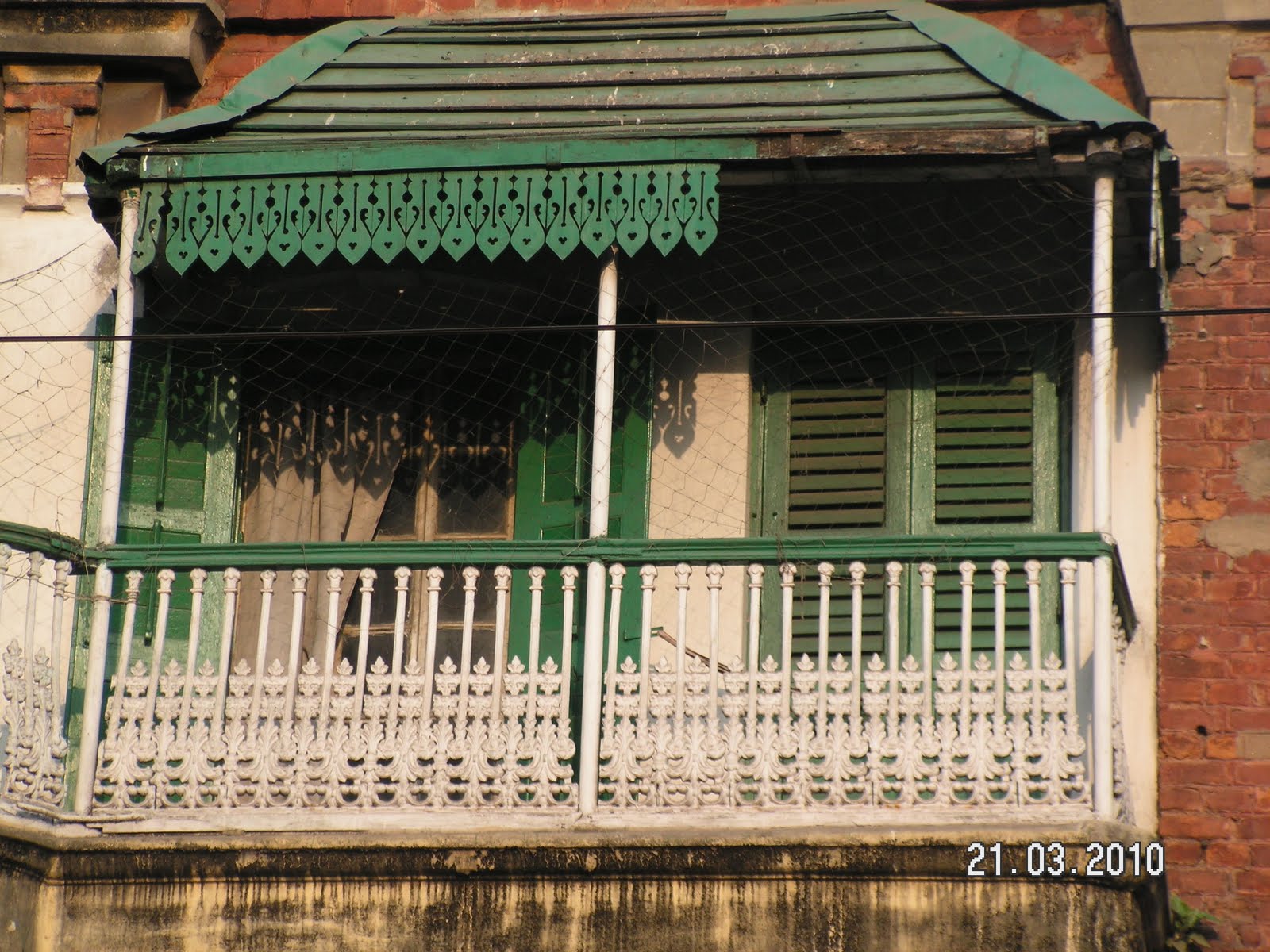
Poetry in Iron- The Charm of old Kolkata Balconies

Rabindranath Tagore wrote in his description of "Library"" "Somudrer sohosro botsorer kallol jodi keho emon koriya badhiya rakhite parito je se ghumaiya pora shishutir moto chup koriya thakito, tobe sei nirob moha-shobder sohit gronthagaar'er tulona hoito". And I offer my own crude translation of the same here: If anyone could capture the roar of the sea for a millennium in such a way that it would stay silent as a sleeping child, then that silence, pregnant with deafening decibel, could be compared to a library. I take liberty to modify this stratospheric analogy to say the iron railings of the houses in colonial Kolkata are pregnant with the entire history and heritage of the city. These represent a microcosm of the architectural, social and economic history of the city from 18th to 20th century. Too profound? Lets discuss!

I don't remember when I started getting fascinated by these exotic protuberances, also known as balconies, often from dilapidated and neglected structures in the older neighborhoods of Kolkata. Millions of people have passed under and even stood nonchalantly on these, most without caring to look, let alone appreciate. That included me of course, for the most part of my life. Maybe my first appreciation for this well-kept secret of Kolkata is a corollary of my liking for traditional houses in older parts of Kolkata. The moment you care to look up and appreciate the magnificent mansions that dot several parts of north, east (say Beliaghata) and part of south (say Bhowanipore) of Kolkata, you can't help notice the majesty of the balconies which look back at you with almost surreal charm. The architecture is typically hybrid between European and traditional Indian architecture. Remember, colonial Kolkata was clearly divided between the Native and the White areas. My objects of fascination are typically the houses of the rich Indian community in the Native areas. Most of these were constructed between mid-1700 and early 1900.

Now, when I look at the balconies of the old mansions, apart from the ornate architecture of the structure itself, what attracts me most is the balcony railing. Most often, these are made of iron, unlike our modern houses which typically have mild-steel (MS) or wrought iron railings. My initiation to the material named "cast iron railings" happened when I was scanning the construction material market and demolition sites in 2003 for construction of my house in Kolkata. By that time, I had already bought a substantial quantity of "demolition material" from a palatial mansion on Suburban Hospital Road and therefore got a taste of how good old materials can be. Martin Burn company bricks were like gold, Burma teak wood door and window frames were strong as ever, floral design floor tiles needed just one polish to shine like a newly minted coin again. I could not get the cast iron grills for staircase and balcony/roof railings from there. I checked the new material market and the price differential with MS material and waiting time (for manufacturing on order) was beyond my affordable limit- so I settled for what everybody does- mild steel bars and strips. But the fondness for the intricate designs and the old-world charm offered by cast iron stayed with me all this while, only to re-surface when I now go out occasionally on early morning dates with the old ladies that I fancy!

Now here's your treatise on metallurgy- to help you understand what kind of an animal "cast iron" is. Cast iron arrived in early 19th century. It is one of the earliest forms of iron extracted from ores, having a higher carbon content (2 to 4 percent) compared to modern construction materials like mild steel. It also contains varying amounts of silicon and manganese and traces of impurities such as sulfur and phosphorus. It has to be "cast" in sand moulds and cannot be forged (beaten to shape when hot) and it is brittle. It is however very good with compression load, and most importantly, it does not rust at all. Cast Iron architecture was a prominent style in the Industrial Revolution era (late 18th century) when cast iron was relatively cheap and modern steel had not yet been developed. It had both structural use (bridges) and architectural use (pillars, railings). Allow me to insert a quote from Rudyard Kipling here:
"Gold is for the mistress- silver for the maid
Copper for the craftsman cunning at his trade
“Good” said the Baron, sitting in the hall,
“ But, Iron- Cold Iron, - is master of them all”.

The skilled craftsmen of Bengal, possibly employed in the early foundries of Howrah (this area was famously known as Sheffield of India for its engineering industry) casted some of these masterpieces. The foundry industry in Howrah is the birthplace of the Indian engineering industry. In fact, the fame of steel from India is mythological. It is well captured in the words of the Arab Edrisi (12th century) who commented: "the Hindus excelled in the manufacture of iron and it is impossible to find anything to surpass the edge from Hinduwani or Indian steel". It is mind-boggling to think how these intricate designs were created in moulds in which hot molten iron was then poured for casting. I believe a large quantity of intricately designed cast iron architectural materials were also imported from Britain during that period. The wealthy families of Kolkata, who stayed in the important neighbourhoods of colonial Kolkata used them. The ornate style of cast iron railings fitted perfectly with the Victorian style of construction of these buildings.

I have traveled around the city for months, taking pictures of these absolute beauties. The photos were mostly taken between 5 am - 8 am when I could drive through the congested neighbourhoods with relative ease and not having to worry about one-way streets and unauthorized parkings. So I had the sun working either absolutely in favour or against my amateur photographs.

I have seen several beautiful cast iron architectures in the residential houses, but the place with the most extensive use of intricately designed and passionately maintained cast iron railings is the magnificent Pareshnath Jain Temple, located to the North East of Kolkata at the Badridas Temple Street. The temple is dedicated to Pareshnath, who was the 23rd Jain Tirthankar, and was built way back in the year 1867. The railings used in the temple premises and some cast iron benches and chairs used in the temple precints are simply awesome.

I thought of listing my favorite "top ten", but realized that it is stupid to give any such list since I probably have missed many and don't know many more that lie in those and other areas. I am also not sure whether the historical handicap and the unintellectual appreciation by a "Southerner" of a small visual aspect of the houses that are seeped in more important glory of the owner's past will be pardoned by those whose houses I mention and those whose I dont. So I refrained from listing any. But I can assure that I will keep looking and keep the flag of dogged affection flying for every new "discovery" that I make. The poetry in iron- the elegant, intricate, timeless, charming cast iron railings in the balconies of colonial Kolkata.

I will stop here, and let you judge. You can start from a sample of pictures given below:


Note: Please do not reproduce any part of this without permission.

Tuesday, February 23, 2010

The Charm of early mornings in Kolkata


I have to admit- this is one of my secret fascinations. I have been exploring this for a while- scratched at the surface only so far. A city which bursts at the seams and strains every sinews during the day presents a surprisingly different picture in its relative moments of privacy- say Sunday mornings, between 5-8 am. The one way traffic rules don't come in to force till 8 am, which, coupled with thin traffic on the road makes driving a relaxed experience. Some of my favorite beats include a drive down the river Ganga, starting with the northern end at Bagbazar Ghat and going all the way up to the base of the Howrah Bridge. The ghats come alive in the morning, offering a slice of life that is normally obscured from view during the day. For example, you could see boats laden with tons of straw anchoring at the Bagbazar Ghat; a "kusti akhara" (Indian wrestling arena) at Mullick Ghat and one of the largest wholesale flower markets at the same place. The flower market is a riot of bright colors where with a bit of bargaining you could buy a bunch of 50 roses for $2 or less..

Even without buying, it is an interesting experience just to walk through the market. I have rarely seen Kolkata citizens visiting the place as tourist, but every time I go I see some foreigners visiting the flower market. I know that this place is in the informal word-of-mouth list of things-to-do-in-Kolkata among them. Is someone from the tourism department listening? It is original things like this, linked to the personality of the city that outsiders come to see.


The other locations that I love to drive are along Central Avenue (the Park Street of yesteryears), Bidhan Sarani, and several lanes that branch off from it- such as Muktaram Babu Street (most famous address here is the Marble Palace).


These have some charming buildings and dilapidated palaces still standing. You need to have the morning peace of mind to stop the car suddenly and look up to admire these fascinating beauties bejewelled with the most ornate wrought iron grills, splendidly designed windows and the Corinthian pillars. I am thinking of joining one of the few walking tours that are conducted by local organizations, often led by heritage conservationists and architects, to explore this a little better. I am also trying to motivate some of my friends staying in North Calcutta to wake up from their royal slumber early in the morning to accompany me. Most of them have certainly retained a piece of zamindari style and attitude in their genes!

Other good areas to drive through are the "White area" of old Kolkata- a few square miles west of the river Hugli (Chowringhee, Dalhousie, Maidan areas). I cannot help admire the British urban planning and architecture every time I drive through these areas.


No morning tour of Kolkata is complete without a food stop. Some of my favorites include a small shop near Marble Palace serving five small kachoris and aloo-sabzi in a sal leaf plate. This helping has to be followed by hot jalebis. There are a group of street dogs on that road who would not touch a morsel of the kachoris or biscuits which you might throw at them, but will lap up every piece of jalebi which you decide to offer them. Other competitors in this food category is Maharani at the other end of town- in the south- near Deshapriya Park. Same menu- here the regular patrons are the morning walkers of Dhakuria Lake who feel guilty of shedding so much calories and make an honest effort to make up on their way back home :-) If you are more adventurous, you could try the "telebhaja" shops near bagbazar (a national morning food in that side of the world). The attractions include out-of-the-world fuluri, dal-bora, alur chop, beguni, peyaji (no translations available for any of these). If you are in that side of town, you could polish off your breakfast with rasagollas (several different sizes, all heavenly) and/or madhu-parka (a cross-breed between icecream, sandesh and mishtydoi). And I am not telling you here what gifts to mankind are available in this part (only) in the evenings (subject of a separate blog). Lastly, if you are among the unfortunate ones who carry a red flag about fried food, you could head for the early morning Chinese breakfast on Tiretta Bazar near Poddar Court. A small group of Chinese sell strictly home style chinese breakfast items between 6-8 am there.. In this by-the-chinese-for-the-chinese affair, you could find various categories of broths, fish balls, steamed pao with a variety of fillings, spicy chinese sausages. You could carry home prawn chips, dried greens, strings of sausages and home-made soya sauce. The place is losing its character with other kinds of sellers crowding the chinese out; but if you visit within the next few years you might still be able to catch up with the food and experience.

As the clock strikes 8 am, the traffic cops take position and one way rules come in to force on most roads- it is time for me to head home, or to slip back in to my householder routine by stopping at the Manicktala market to buy a good, fresh bekty that would yield to succulent chilly fish cubes; or other special categories that would not be available in the local markets. And thus the day begins. What preceded this was the "zero period", as we used to call in school!

Wednesday, January 27, 2010

Greatest Act of Faith in the world- Kumbh Mela 2010


All my bags were packed, and finally I was ready to roll. Talking about a Sunday in Jan 2010; heading for Maha Kumbh Mela 2010 in Haridwar, Uttaranchal in the Himalayan foothills of Northern India. This would be my first travel in a concept series stretching in to next several years, broadly titled "festival and religious tourism" to explore the soul of India. I was a mixed bag of excitement, apprehension, caution, adventurism, spirituality- all rolled in to one. I thought I planned well and was in good shape, till I almost missed the train as I did not read the departure time printed on the ticket and presumed a time which was few hours behind the actual! I was 90 minutes away from the station and 150 mins away from my home (where my luggage was) when the devastating revealation dawned in. A mad scramble by my family members and well-wishers, one group carrying my luggage and another carrying me in a car, converging from different directions in the rail compartment few minutes before departure, saved a huge public relations disaster for me. So much for my fine planning!

Like a true timorous traveler, I began with a packing list that soon expanded to look like Barfi's list of magic in the film Gupi Gayen Bagha Bayen by Satyajit Ray! The list contained essentials like woolens, camera, dry food, reading materials, chargers, flashlight, medicine, swiss knife, ATM card; modern-day lifestyle disorders like hand-sanitizer and portable water filtration bottle; sundry ones like reading material and extra bag; unneccesary ones like extra clothing. Tickets and hotel bookings were done well in advance, and confirmation/PNR numbers noted down separately in purse, as you would expect if you knew me.


I had an interesting array of co-passengers on most legs of my journey. I always believed that experiencing the soul of India starts with rail travel. My conviction got reinforced all the way during this trip, even from within the sanitized confines of air-conditioned coaches. For the onward journey, my co-passengers included a young Punjabi gentleman who kept unusually glued in to his I-pod throughout and was one of my quietest co-passengers ever. There was also a young mother with her 2-year old child who had an incredible "yeah kya hai" and "papa/nana/nani... kahan hai" syndrome. The mother and the accompanying maid tirelessly and affectionately answered the unending queries relating to mundane objects such as seats, bags and window frames; twice for each question as every answer they gave was followed by a questioning "huh?" by the child. The inquisitiveness of the 2-year old sounded nice initially, till the question-answer session started circling in my head like a swarm of bees. Only comic distraction was provided by an elderly couple occupying the coupe. The man, dressed elegantly in a dark blazer and polished shoes, started burping loudly and confidently, completely out of context (not after any meals or whatever). This continued till late in the night, when I overheard the dutiful wife advising the gentleman to drink some water!! The book titled "Amrita Kumbher Sondhane" by Kalkut written a few decades back about his experience of visiting Kumbh Mela served as the perfect apetizer for the coming few days of experience ahead. During my return journey again, I shared the coupe with some wonderful co-passengers, including a young North Indian couple with a bright 2-year old kid and an elderly doctor from Bihar traveling with his wife, daugther and a charming 3-year old grandson. As soon as i boarded the coach, the 3-year kid asked "tumhara naam kya hai?" i said- tomato. He burst in to the cutest giggle which stayed between us all through the journey. Doctor saab was the most mild-mannered, cordial, jovial and witty person that I met in a long time. We talked about the improving healthcare situation in Bihar and the constraints under which government doctors have to function. When the train was getting frustratingly standstill for hours not too far from his destination, he started cracking jokes such as "rail should only schedule departure timing, arrival should be printed as per railway's convenience and passengers own risk" and "aise chalega to ojha-log aake puja path karne lagenge". When sub-standard food was served, he narrated a joke- "a customer called for the manager to report about an insect that was found in his food. The waiter said manager has gone out to have his lunch (in a more hygienic place)". His demeanour eased the frustration and made the tiring journey more tolerable.

The core part of my travel to Haridwar was a mixed experience. As a first-time traveler to the place, it was love at first sight. It has all the vibes of a holy Hindu pilgrimage town. Ganga Ji (reverentially addressing the holy river as per local custom), emerging from the Himalayan mountain range in to the plains here with fast-flowing, emerald-green water is the center of existence of this town. Geographically, Haridwar (Altitude:292.7 meters; Latitude :29.58 degree north; Longitude: 78.13 degree east) lies at the foot of the Shivalik range of the Himalayan mountain range. Legend goes that when lord Shiva sent Ganga to quench the thirst of the people, she extricated herself from His matted locks and descended to the plains at Haridwar. It is one of the seven holiest places according to Hindu mythology. Ganga river, about 2,510 km (1,560 mi) long, rises in the Gangotri Glacier, situated among three Himalayan mountains all more than 6,706 m (22,000 ft) high. After descending 2,827 m (9,276 ft), or an average of about 11 m per km (60 ft per mi), Ganga flows to the plains at Haridwar, 253 km (157 mi) from its source and 312 m (1,024 ft) above sea level. From Haridwar it continues south and then south-east in its journey towards the sea at Bay of Bengal.

The traditional Hindu society seemed to come alive in the place. Faith, following, simplicity, sharing and tradition ("parampara") seemed to be some of the key values associated with Haridwar. Even the businesses that thrived on the tourism seemed to conduct their business with a certain amount of service and devotional mentality. The florist making the leaf floats for the ritual offerings seemed as if he was readying the offerings for himself. I saw food stalls distributing food free to poor at certain times of the day. The shops in the Bazar seem to be quoting fair price with maximum 10-20% margin for bargain. I did not see any coersion for donations or offerings. There seemed to be an intrinsic faith in human goodness that threaded the interactions between people. Hindu religion expects pilgrims to donate the maximum as per their ability- a traditional societal mechanism to re-distribute wealth. Here everyone seemed happy to contribute- to the Trust that undertakes the upkeep of the Har Ki Pauri bathing ghat and the temples therein and to the poor.

The aarti that happens at Har Ki Pauri and is a major tourist attraction is very nice, but I expected it to be a bit more ritualistic. It turned out to be somewhat choreographic, with a recorded background song playing and quite short. I had somehow imagined that it had a bit more flourish. But is a wonderful sight seeing the floral offerings and camphor lamps floating on the river after the aarti.
Food is certainly a highlight of my trip. Forceful vegetarianism has never been more pleasurable. I enjoyed every meal that I had, whether it is at Vaishnav Bhojonalay or Chotiwalas. Mohan Ji Puri Wale at Har Ki Pauri stood out as "first among equals" and was a standard stopover thrice a day- either for hot kachori plate (Rs. 28/-) or a desi ghee ka halwa (Rs. 15- for a 120 gram plate) or for sweets such as Chandrakala (Rs. 10 per piece). I also brought back "pedas" from Asli Mathura Ji Ki Dukaan in the bazaar, and they were simply awesome! Ten hot jelebis for a princely price of Rs. 10 (250 gms; this is minimum that you can buy!) from Raju Bhai Jalebi Wale was simply heavenly. Tea at stalls is always with plenty of milk, and prepared on order. When I asked a tea stall owner whether he had tea ready, he asked back in return- "are you from Kolkata"?

Accomodations on Upper Road (I stayed on one) and also on the bazaar lane till up to Vishnu Ghat seemed perfect. It is a short and interesting walk up to the Har Ki Pauri. the few ones with river view are more expensive. The paddle rickshaws are plenty, convenient and cheap. Haridwar being a small town, this mode of transport seemed just perfect. On my way in, one stretch of the road was closed and my rickshaw-walla unhesitatingly picked up my luggage on his shoulder, parked his vehicle and walked me up to the hotel. I was touched and gave him some more money which he did not ask or expect but accepted smilingly. This paradigm shift from negotiation to trust formed the core of my experiential learning in Haridwar.

I met a few interesting people at the Ghat- "hamsafars" in quest of divinity or experience. There was this Greek boy traveling alone whom I met in a tea stall; a French documentary filmmaker staying in Rishikesh for a month and the travel coordinator of a Bengali family- completely dissatisfied with the lack of crowd around the holy bath day- whom I met, predictably, at Mohan Ji Pooriwale's shop! The only thing I missed is the crowd of saints- none of the "akharas" were in place by the second bathing day on which I went. the crowd, although large, was nothing compared to a Kumbh Mela crowd I am told. It was just pure coincidence that I met with one Maharaj who turned out to be a wonderful person to talk to. His name is "Sri Sri 1008 Sri Shanta Ashram Dandi Swami Ji Maharaj". He was very well read, well traveled and well versed with modern socio-political developments in the country and we discussed about various issues over a very frugal meal. He blessed me at the time of his departure and very kindly invited me back next month at Haridwar when his camp would be set up and also to Prayag where is is based for a fair part of the year. Meeting with him and talking to him was one of the highlights of my trip.

Photography was a challenge- managed to get some from official and semi-official locations and timings :-) It is allowed in the evenings but not during the day. I completely agree with the principle. However, there were a horde of people with media passes and they were allowed to shoot- that seemed double standard. To see the faith, devotion and submission of the thousands devotees was an touching experience for me. This is what I traveled to see- what attracts millions of people to the river and to the ritual. I returned with my question but with a yearning to go back again. And probably again. To be part of (did I say part of?) the "biggest act of faith in the universe".