Showing posts with label travel. Show all posts

Wednesday, October 31, 2012

NOLA Rocks!


A quaint city with loads of history and distinctive influence of Europe, Caribbean and Africa, New Orleans (NO) of Louisiana state (LA)- NOLA as affectionately called by the local population- is a charming place for visitors.  Located in the south-central shore of United States, this place is the favorite landfall point for many of the strongest cyclones and hurricanes which develop in the Gulf of Mexico.  The most famous in the recent history was Hurricane Katrina in 2005, which wrecked havoc of epic proportion.  More recently, the Cyclone Isaac in September of 2012 also caused some damage, and people were evacuated from homes.  My colleague was telling me that she opted for the option of evacuating to Houston rather than staying put at the risk of staying without power for days, low food availability and flooding.  At the time of cyclones and hurricanes, one big worry of the residents is whether the roof of the house with hold!  Apparently, there is also a phase of law and order issue during such times. 


It was a short flight from Houson, but it was late and when I landed at the Louis Armstrong airport it was past midnight.  The airport is quite close to the city center, and there are options of taxi which commute for a flat fee of $33 to anywhere in the city center and airport shuttle which charge $20 but hops from one hotel to another, so if you are the last one out you may be have been sitting in the (comfortable) mini-bus for over an hour for the short ride.  Both options are easy to locate and are efficient means of transportation.  

I was delighted when my cab stopped at my designated hotel- Astor Crowne Plaza on Canal Street & Bourbon.  It looked aesthetic and in the heart of the city.  It was past 1 am but the surrounding was abuzz with activity.  Burly and loud people speaking in heavy Southern drawl could be intimidating initially, till you can relax, lower your guard and start forgetting that you are an outsider.  I realized soon that everyone quickly becomes an insider in New Orleans.  
   
Next morning, my work took me to The U.S. Customs House.  The huge building with solid exterior of grey Massachusetts marble and cast-iron entablature spanned a full block.  As I stepped inside, I was immediately impressed by the collection of old marine gadgets displayed all around, the intriguing inner corridors with huge doors enclosing the office spaces.  It had a jail-house ambience and an overall spooky feeling inside.  Indeed, my colleague said that there are confirmed stories of ghosts residing in the building, and the presence have been felt by many who stayed back late.  I later learnt that this is one of the oldest and most important federal buildings in the southern United States and one of the major works of architecture commissioned by the federal government in the nineteenth century.  It is now designated as a National Historic Landmark.  The grand Marble Hall in the center of the building was described as “the finest business room in the world”.  Audubon Butterfly Garden & Insectarium, the largest free-standing American museum dedicated to insects, is now located in this building.
New Orleans was founded as part of the French colony of Louisiana in 1718.  New Orleans was given to the Spanish in 1763 following the Seven Years War.  The Americans gained control of the colony following the 1803 Louisiana Purchase.  New Orleans’ economy in the nineteenth century was similar to other southern cities- based on selling cash crops such as sugar and tobacco. By 1840, newcomers whose wealth came from these industries turned New Orleans into the third largest metropolis in the country.  In today’s world, port and maritime activities, engineering industries and most importantly tourism constitute most of the city’s economy.  Port of New Orleans on Mississippi River is one of the busiest in the country, moving 500 million tons of cargo every year.  The city has created a wonderful niche for itself as a convention city.  The New Orleans Convention Center is one of the largest venues available in United States for trade shows, hosting very large exhibition and conferences on themes ranging from automobiles to funerals.  The show on the latter theme was organized by National Funeral Directors Association, and my colleague was telling me that with coffins and tombstones lying all around, it was not an event for the faint-hearted!  The reason for my visit too was WEFTEC, which is America’s largest water related trade show organized by the Water Environment Federation and had over 1200 exhibitors.  Each such event brings over 10,000 visitors to the city for an average of three days; thereby keeping the hotels, shops and restaurants and other tourism establishments busy for several days in each month.  The heritage French architecture; exotic French, Spanish and local Louisiana cuisine; art; Jazz music and most importantly the “wildness quotient” of the city is a magnet for business visitors and tourists alike. 


New Orleans is a small city of 907 sq km and little over 300,000 population, which shrinks after every large natural disaster and grows again within a few years.  But if Calcutta’s city center of Dalhousie-Esplanade area was curved out as a separate city, there would be many similarities with New Orleans.  The most striking similarity is about the heritage architecture and the ornamental iron castings which adorn the balconies of the French era houses in the famous French Quarters area.  I spend a large part of my weekend daytime in taking pictures of the houses and the balconies in particular.  The intricate craftsmanship of the iron castings used in the balconies was a visual treat to my eyes, particularly in the curved balconies of the houses on corner plots.  The designs were mostly neutral, such as a bunch of grapes with leaves.  And having documented the iron casting designs in Kolkata extensively in the last three years, I can now say with authority that the repertoire of designs of the iron castings found in Kolkata is much larger than what is found in New Orleans.  The style of casting is similar but I did not find any design which is common between Calcutta and New Orleans.  However, the iron casting used in Marble Palace owned by the Mullick family in Calcutta (designed by the French architect Antonio Rinaldi and completed in 1785) is very similar to the style of casting used in New Orleans.


The architecture of the old houses otherwise is typical but not hugely impressive.  None of the houses are too big.  The other points of similarity with Calcutta include proximity to river (Mississippi), narrow roads, lots of people merrily crossing the road, much higher proportion of honking than is normally found in American cities, plenty of shops, several poor people, passion for food and trams.  Calcutta can learn much from New Orleans in preserving trams as a means of public and tourist transport.  Here the trams are single compartment, heritage-looking but modern interiors, noiseless, high-speed, moves on dedicated tracks in selected stretches and integrated with bus transport under the common umbrella of Road Transport Authority (a common bus-tram combination ticket can be purchased).  The stops provide safe boarding and aligning facilities for passengers, and tickets are collected by the driver (often a lady) in a ticket vending machine, which even prints a ticket for change due if any and which can be used for any future travel.  I really hope and pray that Calcutta learns from New Orleans, Frankfurt and other such cities which have proudly preserved and used trams as clean and efficient means of urban mass transit. 


The “wildness quotient” of the tourist part of the city deserves special mention.  Several people have told me, “this is New Orleans- you can pretty much do what you want”.  I got a taste of this when in my very  first morning, I saw a girl breaking out in to a full-throated, trance-like “Hare Rama Hare Krishna” song and dance as she was passing by an Iscon Group singing along the sidewalk. 
 

But the full magnitude of this statement will not be evident until one visits Bourbon Street during the weekends- the main artery of the French Quarter area and the magnet for tourists seeking all-time nightlife high.  And this was a normal weekend- the revelry index shoots many times higher during the carnival season climaxing during Mardi Gras in February-March.  My hotel- Astor Crowne Plaza- was at the entry point of this road; so I could soak up the life of Bourbon Street over the full seven nights of my stay.  When the city’s streets were designed by the royal engineer in 1721 and the streets were being named after French royal houses and Catholic saints, Bourbon Street paid homage to France's ruling family, the House of Bourbon.  In 1788, a major fire destroyed 80 percent of the city's buildings.  The Spanish rebuilt many of the damaged buildings, which are still standing today.  For this reason, Bourbon Street and the French Quarter display more Spanish than French influence.  Chances are, you will be greeted by a jazz and brass band playing at the corner of Bourbon and Canal Streets.  This “To Be Continued” jazz and brass band was formed by a group of young boys in 2002, and became immensely popular.  The upper end of Bourbon Street near Canal Street is home to many of the French Quarter's strip clubs. These include Rick's Cabaret, Temptations, and Larry Flynt's Barely Legal Club.  Among the other tourist attractions are bars, restaurants and souvenir shops.  


A part of this street also caters to New Orleans' thriving gay community. Cafe-Lafitte-In-Exile is the oldest gay bar in the country. I got some pictures of weirdly dressed people in this area. 


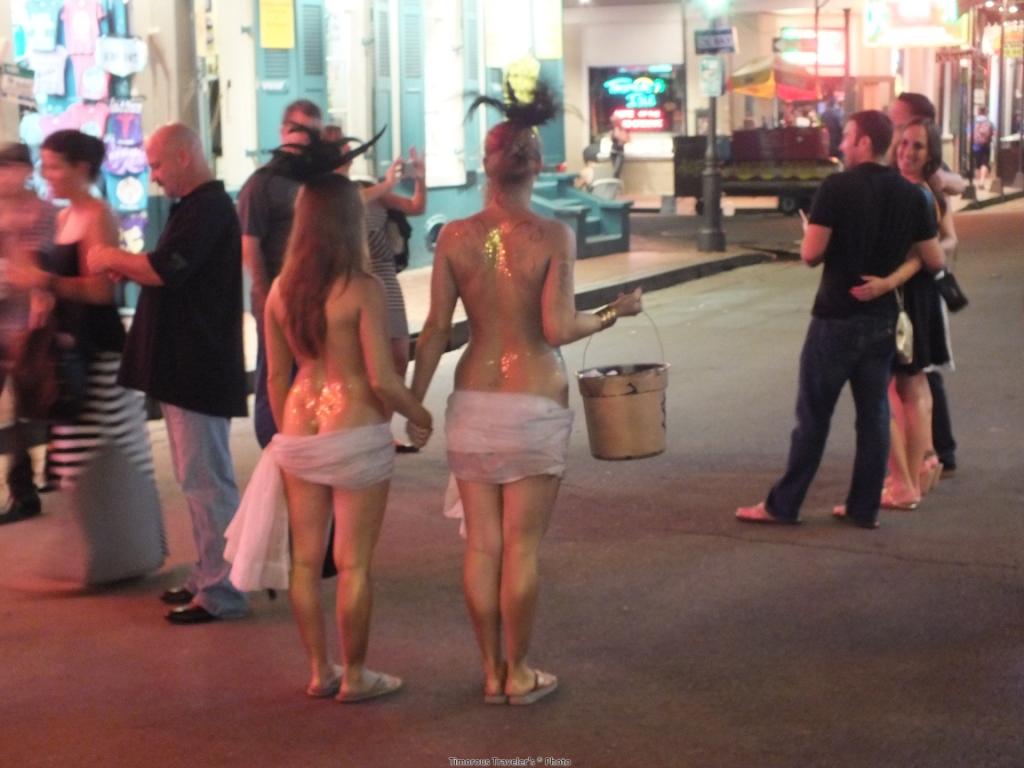
It is fun to walk in Bourbon Street in the evening- the crowd is in celebratory mood, many walking with a super-large container of drink.  We came across two girls, young and good-looking,  who wore practically nothing but body paint of the logo of the wildly-popular New Orleans Saints team and were walking the Street to collect tips.  Needless to say, tips were raining on them and they were also happily posing for photographs.  We could also see the Mardi Gras spirit in action- the custom of throwing trinkets from the balconies to the people passing below.  Some girl groups were quite insistent about the "Throw Me Something Mister", and the men on the balconies negotiated well and managed to have some of the girls flash before they showered the girls with trinkets.  To capture the full spectacle, one needs to visit on the date of Mardi Gras which is 46 days before Easter.  During the 12 days preceding Mardi Gras, more than 60 parades and hundreds of private parties, dances and masked balls are annually scheduled in the metro area. Fat Tuesday is a legal holiday in New Orleans, a day when half the town turns out in costume to watch the other half parade!
 
 
New Orleans was the birthplace of Jazz.  It was considered an expression of freedom, of jubilation.  The music form evolved from within, and quickly flourished through the creative geniuses of Buddy Bolden, Nick LaRocca, Louis Armstrong and several others.  One of the more distinguished aspects of New Orleans culture is the jazz funeral- a practice which traces its roots back to Africa.  The city has many jazz clubs- some of the more famous ones are House of Blues and Bombay Club in French Quarter area.  We heard that there is another area- the Frenchman Street- is quaint and vibrant with jazz music.  This was our chance to see another part of the city outside the routine French Quarter, so we hopped in to a cab and after a short ride reached what looked like a residential neighborhood.  The street was lined with several restaurants, clubs and pubs- each advertising the live performances scheduled during the week.  It was Monday and relatively quiet.  We checked out the Blue Nile Club, but they did not have a performance on that day.  But we found that Maison on 508 Frenchman Street rocking with music and bustling with clients.  We managed to get a table and settled down.  The tables were full, the music was soulful, the musicians were lively and the crowd was discerning- applauding every piece of good performance.  At times, the young lady who was the lead musician stepped down from the dais and walked up to the tables to collect tips- the guests contributed generously.  The good food and drink tasted even better in the cheerful ambience.    


No discussion on NOLA is complete without a note on food and drink.  The cuisine here is distinctive and robust, unlike most places in U.S.  The food follows two broad likes- Cajun and Creole.  Cajun is country-style food, a combination of French and Southern cuisines and consists of heavy, one-pot dishes, like Jambalaya (sausage, vegetables and a variety of meats and/or seafood) or crawfish étouffée, served over steaming rice.  Creole food is created in New Orleans with European and African roots.  The French influence is strongest, but the essence of Creole is found in rich sauces, local herbs, red ripe tomatoes, and the prominent use of seafood, caught in local waters.  It is associated with the old-line kitchens of New Orleans, where generations of traditions are carried on today.  The most popular one is Gumbo- okra simmered for hours in a stock made as rich as possible using a variety of meats, onions, celery and bell peppers. Served over rice, variations include seafood gumbo with shrimp, oysters and crabmeat, or chicken gumbo with andouille sausage.  Both foods make liberal use of chopped green peppers, onions and celery.  The other popular dishes are Red Beans and Rice, Po Boy (long, submarine-style French bread piled high with meat such as roast beef, catfish or oysters), Shrimp Creole (freshly peeled shrimp), Muffuletta (sandwich filled with salami, ham, provolone and olive spread).  Alligator meat is quite popular- supply chain assured from the swamps surrounding New Orleans.  I passed the incitement to try it- I am told it is tender and tasty.  I loved all the places we ate in, but I remember with particular fondness the Red Fish Grill on Bourbon Street- a traditional, family-owned restaurant serving authentic and fresh New Orleans cuisine with style and pride.  The food in Farmers Market was fun too.  The coffee shops and confectioners are also very much part of the food experience.  Café Du Monte on Decatur St. across Jackson Square is the pilgrimage among the coffee shops, being the original French Market coffee stand serving cafe au lait and beignets (fried dough coated with powdered sugar) since 1862.  Praline (almonds coated with cooked sugar and cream) reigns supreme among the confectionery products.  Being endowed with a traditional Bengali sweet tooth, I simply loved the Pralines.  Much like food, the drink options in New Orleans is also wild, robust and cheerful.  Hurricane is one of the most popular.  It is a sweet, juice-filled bright red rum drink and served in a tall glass.  Apparently, the drink derived its name from the shape of the iconic glass resembling a hurricane lamp.  The other popular drink (apart from beer) on Bourbon Street is named Hand Grenade.  The proprietors keep the ingredients of this neon green drink a secret, only calling it the most powerful cocktail on Bourbon Street.  It comes served in a custom plastic yard glass, tinted green and shaped like a grenade at the bottom.        


Overall, New Orleans is a complete fun city, with loads of character.  It embraces the serious travelers and revelers with equal warmth.  The mix of fun, food, architecture, music, art ensures there is something for everyone.  Very few cities in U.S. can match up with the unique personality of this quaint city.  The waves of history have etched indelible marks, and have enriched the city and its population with something new, something better and something different.  NOLA just rocks!  


Tuesday, February 22, 2011

Iti-Punoscho

Ever since I read William Dalrymple's "Nine Lives: In search of the Sacred in Modern India", I have been fascinated by one of the nine events he experienced- the Theyyam in Kerala. The more I studied about this custom in "Google University", the more I was fascinated and wanted to experience it myself. This fitted perfectly with my new-found love of religious and festival tourism. My agenda is similar to Dalrymple's- experience the event as an observer without being judgemental, have some opportunity for photographic documentation, and come back with enough material to write a blog on it. So, when I had a reason to be in Bangalore in February, I decided to add a weekend and go up to northern Kerala see Theyyam. I researched extensively and found help from unexpected quarters. That set me up for a lifetime opportunity to experience Theyyam- well, almost. Read on.

What is Theyyam:
Theyyam is a popular Hindu ritual form of worship of North Malabar in Kerala state, predominant in the Kasargod and Kannur Districts, and parts of Wayanad and Kozhikode. It is a living Dravidian cult with several thousand-year-old traditions, rituals and customs. The performers of Theyyam belong to the indigenous tribal community. The ruling landlord communities like the Nambiars were patrons of Theyyam. This is unique, since only in Kerala, do both the upper-caste Brahmins and lower-caste tribals share an important position in a major form of worship. The term Theyyam is a corrupt form of Devam or God. Different branches of mainstream Hindu religion such as Shaktism, Vaishnavism and Shaivism now dominate the cult of Theyyam. Two major Theyyam deities of Vaishnavism are Vishnumoorthi and Daivathar. All other categories of Theyyam deities can be classified under Shaivism or Shaktism. The Goddesses like Rakteshwari, Chamundi, Someshwari, Kurathi, and the Gods like Vishnumoorthi are propitiated in sacred groves & house-hold shrines, locally called "kavu". The performance takes place in an open theatre. A performance of a particular deity according to its significance and hierarchy in the shrine continues for 12 to 24 hours with intervals. The chief dancer who plays and personifies the deity of the shrine has to reside in the rituals and is generally called ‘Kolam’. The performance is always preceded by preliminary rituals. After this the performer will retire to a temporary structure to be made up and costumed. When the moment comes, he will enter the shrine to complete the ancient and complex process that has already begun edging him out into an extraordinary otherness. The most sacred and powerful element of the costume, the mudi or headdress, is put on once the artist has been seated on a sacred stool in front of the sanctum. After this comes the actual moment of "becoming" the deity, the moment of crossing the line, as he stares into a small hand-held mirror. It is at this point that, almost imperceptibly, he slips into another state of being, his eyes widening as they focus not on his own reflection, but on the enigmatic features of a divine being. This is the moment of fusion, the defining moment known as "mukhadarshanam", or the seeing of the face. It is the moment when a mortal becomes a god. In the background, folk musical instruments like chenda, tuti, kuzhal and veekni are played in a certain rhythm. All the dancers take a shield and kadthala (sword) in their hands as continuation of the cult of weapons. Then the dancer circumambulates the shrine, runs in the courtyard and continues dancing there. The Theyyam dance has different steps known as Kalaasams. Each Kalaasam is repeated systematically from the first to the eighth step of footwork. There are different patterns of face-painting. Mostly primary and secondary colours are applied with contrast for face painting. It helps in effecting certain stylization in the dances. A performance is a combination of playing of musical instruments, vocal recitations, dance, and peculiar makeup and costumes. The stage-practices of Theyyam and its ritualistic observations make it one of the most fascinating theatrical arts of India- text quoted from Wikipedia & http://www.vengara.com/

Some Theyyams use nearly 50 or 60 feet high long crowns or Mutis made out of arecanut tree and bamboo splices. These crowns are supported by long bamboos which are held by several helpers to keep the balance when placed upon the head of the player. The Thottam or the song related to the particular Theyyam deity is recited by the player and by the singers in the background. Of over 400 varieties of Theyyam performed, the most prominent one are those of Raktha Chamundi, Kari Chamundi, Muchilottu Bhagavathi, Wayanadu Kulaveni, Gulikan and Pottan- http://www.mapsofindia.com/maps/kerala/performing-arts/theyyam.html

Karimchamundi Theyyam is one very rare Theyyam because of its scary nature. It is performed in the regions of Perumba river. Earlier the Theyyam festival of Karim Chamundi required the sacrifice of a goat. Now this Theyyam performance has an act of killing chickens by biting in the neck and plucking off the head and throwing it in the air. With dark coloured face paintings the Theyyam performed at midnight is frightening. Women and children are not permitted to watch the Karim Chamundi Theyyam. Two Karim Chamundi Theyyams which I could identify this year are as follows:
Start: January 27, 2011
Venue: Azheekode Elamkarumakan Kshethram, Azheekode, Kannur
Start: January 22, 2011; End: January 26, 2011
Venue: Myladathadam Elangarumakan Kshethrolsavam, Azheekode, Kannur

My destination for Theyyam was Kannur (or Cannanore) and my base camp for Theyyam visit plan was Bangalore, so I will give details which I worked out for my trip, hoping that it benefits others who might want to witness this great event in the next season (Jan-March) or beyond.

Location of Kannur: Kannur is on the National Highway 17 (NH-17) connecting Kochi and Mumbai. Two airports- one at Mangalore in the north and one at Kozhikode (Calicut) in the south — are about 100 kilometres away from Kannur. Road distance of Kannur from Bangalore is about 340 km and from Chennai it is about 600 km.

Transportation alternatives from Bangalore to Kannur, apart from driving down, are as below:
1) Trains- 16527/16528 Cannanore Express from/to Yesvantpur station (I booked on this, easier to get tickets) & 16517/16518 Kannur Express (from/to Bangalore SBC). Takes between 13-15 hrs (rail distance much longer than road), but both are overnight trains departing between 8 & 9 pm.

2) Buses:
Karnataka SRTC Buses (Rajhansa- non-Volvo):
http://ksrtc.in/; departing from Bangalore Bus Depot; journey time 9-10 hrs
Contact: KSRTC Majestic- 080-2226 9508; KSRTC Satellite- 080-2675 6666

Kerala Road Transport Corporation- Buses leave from Satellite Bus Staion in Mysore Road, Bangalore; arrive at Majestic/Bangalore SBC Railway Station. Advance booking counter at Majestic Bus Staion- the online booking does not seem to work:
http://www.keralartc.com/
Kerala SRTC: Control Room: Landline- 0471-2463799; Cell: 9447071021
Kerala SRTC- Kannur: 0471-2463799; 094470 71021

Bus fares: Rs. 250-350/-

Stay Options:
1) Malabar Residency (http://www.malabarresidency.in/)- (this is where I booked)
Thavakkara Road, Kannur-670 001, Kerala, S. India
Ph: (91) 0497 - 2765456, 2701654, 2701655; Fax: (91) 0497 – 2765456
E - mail: malabarresidency2004@yahoo.co.in
Contact: Shaji, Room Division Manager (094970 41118)
Rate: Rs. 1200 +12.5% tax – 10% discount = Rs. 1215/night for standard room (Feb 2011)
2) Ganga Residency-
http://www.gangaresidency.com/ (my travel advisor suggested this)
Near Talikkavu Temple, Kannur 6700001. 300 meters from station, 200 meters from Bus stand. Tel: 095266 08951/0497 2712079; Email: gangaresidency@in.com Charges Rs. 900-1200 per night (Feb 2011). Staion pickup available.
3)Pranav Beach Resort-
http://www.pranavbeachresort.in/ (read about this in a blog)
Beach Road, Palliyanmoola, Alavil, Kannur 670008. Tel: 0497 3207926/2741148; 09387478285; Email: pranavbeach@rediffmail.com; Contact: Mr. N.P. Venugopalan; “We have non-airconditioned independent cottages in the tariff range of Rs.800/- to Rs.1000/- per day and air-conditioned cottages for Rs.1600/- per day.”- Feb 2011]

Theyyam Options:
Full calender of different Theyyam performances available at the following websites:

http://www.theyyamcalendar.com/
http://www.theyyam.org/pages/newsdesk/10000theyyamcal04.asp
http://www.kaliyattam.com/theyyam.php
http://www.vengara.com/theyyam/theyyamcalendar.htm

These websites also have some great pictures of Theyyam performances. Note that Theyyam dates change every year.

Some great Theyyam videos with narration:
http://wn.com/kannur_theyam

The Theyyam that I planned on visiting: Mykeel Sri Karimkuttysasthan Temple, Pulimparamba, Taliparamba, Kannur (http://www.mykeel.in/)- 22 kms from Kannur. This was provided to me by the most helpful and passionate person dedicated in promoting Theyyam- Santhosh, and his group of friends- who developed the site: www.vengara.com in their effort to promote Theyyam in a selfless way. I remain indebted to him for helping me out with my travel plans and giving me full support and confidence all the way. Thank you- stranger friend!

Now, if you are wondering why I have not used any pictures but indulging in this "textual atyachar" through a long-winding travel research on Theyyam, the reason is I pulled out of the trip at the last moment. Mat pucho kyu. I didn't go. But, I will. Sometime soon. Iti-Punoscho :-)

Till then, if you are interested, keep researching with me and imagining yourself to have transcended in the middle of a pre-Vedic ritual at midnight where a dancer with elaborate make-up and costume believes that he is "God" for that time and enacts a complete mythological episode for hours with frenzied energy, repeatedly dives in to smoundering ember in complete oblivion of the world around him. That person, in a week, will go back to his daily chores- maybe as an agricultural labor or restaurant waiter or jail warden, as in the case of Hari Das- one of the most famous exponents of Theyyam and central character in Dalrymple's episode on the subject. I end by quoting him about the experience of Theyyam from his interview with the Outlook magazine in October 2009:
"I always get very tense, even though I have been doing this for 26 years now. It’s not that I am nervous of the god coming. It’s more the fear that he might refuse to come. It’s the intensity of your devotion that determines the intensity of the possession. If you lose your feeling of devotion, if it even once becomes routine or unthinking, the gods may stop coming...It’s like a blinding light...When the drums are playing and your make-up is finished, they hand you a mirror and you look at your face transformed into that of a god. Then it comes. It’s as if there is a sudden explosion of light. A vista of complete brilliance opens up—it blinds the senses...That light stays with you all the way during the performance. You become the deity. You lose all fear. Even your voice changes. The god comes alive and takes over. You are just the vehicle, the medium. In the trance, it is god who speaks, and all the acts are the acts of the god—feeling, thinking, speaking. The dancer is an ordinary man—but this being is divine. Only when the head-dress is removed does it end...Suddenly it’s all over, it’s gone. You don’t have any access to what happened during the possession or the performance. You can’t remember anything that happened in the trance. All there is, is a sensation of relief, as if you’ve offloaded something

Saturday, September 4, 2010

Me & Montana

I have a new love :-)

And I am not joking. I am in love with Montana- the wilderness state of North America. Located in North-western part of the country and covering an area of 146,316 sq miles (slightly larger than Germany and 12% of India), Montana shares its entire northern border with Canada and is bound by North Dakota and South Dakota in the east, Idaho (and Rocky Mountains) the west and Wyoming in the south. The state is predominantly rural, with large deposits of minerals like coal and oil (it is described as the Saudi Arabia of America). The largest cities here are Billings, Great Falls, Missoula, Bozman, Helena, Butte-Silver Bow and Livingston. Only three among these have population over fifty thousand, and none above one lakh (one hundred thousand, as described in U.S.). The population density of the state is 6.2 people per square mile! Coming from the city of Kolkata with a population density of over 64,000 per square mile, it was a huge cultural shock for me as I was driven around the vast open stretches of land and see the emptiness all around. Most places beyond the cities are devoid of any human settlement or even large animals. It is called the “Big Sky Country” for a good reason indeed. Wherever I went, the vast open blue dome was there for us, bordered on the horizon with green mountains. I stayed in three cities in four days, and drove about 800 miles in those days, which gave me a good perspective of the place and its people.

First, the pace of life is slower and people are extremely nice and friendly. They love to talk, are not in a hurry, and extremely polite. Sometimes it was even difficult to end a conversation politely and hang up the phone. Even at the airport, the usually stern looking airline staff and the even sterner TSA Officers scanning people and luggage never appeared daunting. When I settled down in the staircase to tie my shoe-lace after the security check, one TSA Officer told me nicely- “you could use the chair?” Many more such small gestures from local people touched my heart. Front and center of my local experience was my friendly colleague and his wife who were my travel partners for all these four days.

People here are just used to travel long distances. At least three company representatives, including two ladies, drove 3 hours each way just to have a 1-hour meeting with me. And remember, in Montana, the speed limit is higher- 75 miles per hour. My colleague was fresh as a daisy even after driving 14 hours on the day we went in to Yellowstone National Park. As I said, I rode about 800 miles in my three-day stay in the state.

Montana is bitterly cold for five months of the year. Half the state lies over 4,000 feet above sea level. Generally, the first snow of the season coats the higher mountain elevations in Montana in September. Occasionally the snow will also reach the lower elevations, although the snow will not stick around long. The winter recreation (skiing, snow mobile) season generally extends from late November through March. Annual snowfall varies from quite heavy, 300 inches, in some parts of the mountains in the western half of the State, to around 20 inches at some locations. Most of the larger cities have annual snowfall within the 30 to 50 inch range. Temperatures can range from 50 degrees above zero to 50 below, but averages generally run from 20 to 35 degrees above zero, with mostly sunny skies. Winters, while usually cold, have few extended cold spells. Between cold waves there are periods, sometimes longer than 10 days, of mild but often windy weather. The snow can get as high as 5-6 feet and covers all areas from mountaintops to driveways. I am told it is good for the local animal and agricultural farms, since the melting snow is the only source of water for farming and animal husbandry. The state sees thunderstorms- many of the ones that occur during the summer, particularly over the mountainous areas, are considered dry thunderstorms. These are the most deadly of storms, since they produce huge amounts of lightning that spawn wildfires- while not dropping any rain.

I arrived in Billings in south-central Montana on a Saturday evening, and I had the Sunday free before I began work on Monday. My colleague arrived the same day, and the plan was to have meetings with companies in Bozeman in south western Montana on Monday. Transportation method was of course to drive the distance. So, it was decided that we would drive through the Beartooth Highway- described as “the most beautiful drive in America”. The Beartooth Highway is the section of U.S. Highway 212 between Red Lodge, Montana and Cooke City, Montana. It traces a series of steep zigzags and switchbacks, along the Montana-Wyoming border to the 10,947 ft (3,337 m) high Beartooth Pass. The approximate elevation rise is from 5,200 ft (1,600 m) to 8,000 ft (2,400 m) in 12 mi (19 km) in the most daring landscapes. Because of heavy snowfall at the top, the pass is usually open each year only from Memorial Day in late May through Labor Day in September.

We started from Billings at 6:30 am and started driving towards the west. As we were leaving Billings, we passed by the city jail and my colleague told me a story of the jailor who was caught in a restaurant having a dinner date with one of his lady prisoners! In about an hour, we drove up to Red Lodge which is a small town and a base camp for Yellowstone tour from the eastern side. We loaded up on gas there, since we were told by the hotel staff that gas anywhere beyond this point would be costlier. We saw a deer ambling along in front of one of the houses- apparently, it is common sight.


Immediately after, the road started climbing up the mountains. However, the slope of the road was gentle. Interestingly, we could see groups of bikers (cyclists) and motorcyclists from Red Lodge, and we found them all along the route. The cyclists were traveling up all the way up the top, which we figured out after we talked to some of them at a viewpoint stop. They were of all ages, and I was amazed at their enthusiasm and stamina. Thinking of cycling from 5,500 to 9,000 feet would not occur to me in my wildest imagination. And when I learnt that their motivation of doing this is to zip down the mountain curves after they reach the summit, I admired their free spirit even more! It was certainly not easy, and we could see some of them struggling up the slope. However, the group was being covered by a SUV which carried spares and supplies. The motorcyclists were enjoying themselves and the sweet sound of their machines- dressed in proper gears and enjoying the mountains as they rode past us. After driving 21 miles, we first stopped at Rock Creek Vista Point, where we realized that we were already at elevation of 9000 feet. The place offered a panoramic view of the Beartooth Mountains, Hell Roaring and Silver Run Plateaus. The Custer National Forest is also located in this area. The place offered excellent photo opportunity, with scenic backgrounds and thoughtful tourist viewpoints overlooking the mountains. After starting from there, the road rose further and the picture-postcard mountain landscape started unveiling before our eyes. There were glaciers on the northern flank on almost every mountain and lakes all around. Some glaciers had reddish tinge, which I was told comes from grasshoppers that are frozen in the snow. We could even touch the snow at some locations on the roadside.
The road continued to climb as it crosses into Wyoming. At this point, the slopes tapered in to a plateau, with an elevation of 10,900 feet. The views were expansive, south across the canyons carved by the Clarks Fork, north into the Absaroka-Beartooth wilderness. In the wilderness, a narrow pyramidal spire is profiled against blue sky. This is the Bear's Tooth- Na Pet Say in the language of the local American Indian community - from which the mountains take their name. I literally felt I was at the top of the world. Needless to say, we clicked several pictures before resuming our journey again. The roads started descending from this point, and we passed by forest areas and several lakes with crystal blue water. We stopped by one to feel the water- however as soon as we stepped out of the car, we were swarmed by mosquitoes. Fortunately, the American mosquitoes are not known to carry malaria, dengue or other diseases.
Sixty-four miles from Red Lodge, after crossing back into Montana, the Beartooth enters Cooke City. Originally a gold-mining camp, Cooke City is now the northeastern gateway to Yellowstone National Park. It has a toy town look, with a population of 140 only! The local chamber of commerce runs a small but informative visitor education center that is manned by two local ladies. They were very nice and gave us helpful information about the park. We made a small contribution in the tip box, which helps to cover the cost of running the place. It was noon and we are some food there to get ourselves ready for the Yellowstone entry. Just a week before our travel, four grizzly bears attacked a campground half mile outside Cooke City and killed four persons who were sleeping in the campground. Everyone was still discussing the incident when we arrived. That prepared me to think of grizzlies for the rest of my day at Yellowstone.


Within four miles of Cooke City, we reached the Yellowstone National Park entrance. The entry fee is $25 per car and it is valid for seven days. As we entered, wide open grasslands bordered by mountains in the horizon greeted us. Yellowstone is world’s first national park, established in 1872. The Park covers an area of 3,468 sq miles (about 12 times size of Singapore). Approximately 96 percent of the land area of Yellowstone National Park is located within the state of Wyoming. Another 3 percent is within Montana, with the remaining 1 percent in Idaho. The Park sits on the Yellowstone Plateau, at an elevation of 8000 feet, and is bounded on all sides by mountain ranges. The park is 63 miles (101 km) north to south, and 54 miles (87 km) west to east. Rivers and lakes cover 5 percent of the land area, with the largest water body being Yellowstone Lake. Yellowstone Lake is up to 400 feet (120 m) deep and has 110 miles (180 km) of shoreline. At an elevation of 7,733 feet (2,357 m) above sea level, Yellowstone Lake is the largest high altitude lake in North America. Sub-alpine forests comprise 80 percent of the land area of the park; most of the rest is grassland. We took a relatively short northern loop inside the Park, in which we entered through Cooke City, went up to Tower Roosevelt (about 40 miles) to Canyon Village (19 miles) to Norris 12 miles) to Mammoth Hot Springs (21 miles) and exited from there. To drive through the bigger loop would require us to drive an additional 105 miles, which our time did not permit.

Within 10 minutes of entering the park, we could see a lone bison, and got excited about the viewing. My colleague reacted calmly, reminding me that I would see hundreds of them in the next few hours. Soon enough, we could soon see herds of bison out in the grassy wilderness. But our first major viewing was that of a grizzly bear, walking in a downhill slope, again on grassland, within about 60 feet of the road. We were one of the first to see it and stopped our car, to be joined by many other excited tourists. The forest ranger came in immediately, advising people to stay calm, maintain distance, stay near the cars and keeping a watchful eye on the overall situation. My colleague was very excited and he told me that a grizzly viewing opportunity is extremely are, and he has not seen one in spite of coming to the Park several times as a local resident. The bear had a cinnamon colored body and a black snout, and was apparently about two year old- just an early age of starting to live separately from the mother. It seemed to have mild temper and did not get bothered by the human presence in its surroundings. After taking some snaps, we moved on.

We then passed through an area which witnessed a devastating forest fire in the 1980s, that wiped out a major part of the vegetation. The forest is now regenerating itself. We then ran in to some kind of a traffic jam. The reason was soon evident- a large bison was standing patiently by the roadside, offering a fantastic photo opportunity to the tourists as they drove past slowly. We were not denied of the photo opportunity either, and got a great chance to take a close look at the American bison. It had a heavy fur coating which helps it to deal with the brutal winter of the place, and seemed to be much more docile than the Indian bison which are known to attack unprovoked (a forest ranger in Gorumara National Forest showed me a hole in his jeep’s body metal that was caused by a bison charging and hitting the jeep with its horn). Next, we again came up against a crowd that gathered to watch a family of 3 grizzly bears- mother and two cubs- in the grassland that sloped down from the high road. To see four grizzlies in a day is considered so rare that my friend started saying my presence was the lucky charm for him! We moved on and saw an elk in close range. In between the wildlife viewing, we saw some amazing geological formations. The Yellowstone River, going in to a magnificent waterfall, was a treat to watch. We could also see the caldera and the clear formation of the volcanic rocks. The viewpoints are strategically located to offer a great panorama of the key locations. From those locations, I really felt I have been transported back in time to when giant dinosaurs used to roam the area and volcanic eruptions shaped and reshaped the landscape. Indeed, the highest number of dinosaur fossils, including the first and also the largest fossil of T-Rex, have been found in Montana, which is known for its “Paleo treasures”! The Maiasaura nests found at Egg Mountain have been hailed as one of the most important discoveries ever for dinosaur biology. Apparently the Jurassic Park movie is based on a scientist that worked in one of the areas of Montana. The state has a Dinosaur Trail (www.mtdinotrail.org), dotted with several museums that offer tourists a sneak peek in to a world 150 million years back. Throughout Yellowstone, there are visible evidence of geothermal activity, with several hot springs and geysers dotting the landscape. About a thousand known geysers exist worldwide, roughly half of which are in Yellowstone National Park. A geyser is a spring characterized by intermittent discharge of water ejected turbulently and accompanied by a vapor phase (steam), and is found in volcanic areas. The most famous among the geysers is Old Faithful, which has a eruption height of 105 ft to 185 feet, and an eruption frequency of 45-125 minutes. In fact the Yellowstone area is part of the largest volcanic system of North America, and has been termed a “supervolcano”. Due to the volcanic and tectonic nature of the region, the area experiences between 1000 and 2000 measurable earthquakes a year.

We stopped at Crystal Rocks for a photo, and almost had as close encounter with a fourth grizzly. As I stylishly posed on a rock for my colleague to shoot a photo, the forest ranger came running and sternly told us to get back in to the car immediately. Why? Because a grizzly is within 300 yards! We scampered back in to the car and drove off. That might have been my last photo!

Our last stop in Yellowstone was at Mammoth Hot Springs in the north-west corner of the Park. Mammoth is a large limestone hill that has been created over thousands of years as hot water from the spring cooled and deposited calcium carbonate (over two tons flows into Mammoth each day in a solution). Algae living in the warm pools have tinted the travertine shades of brown, orange, red, and green.


I would love to go back to Yellowstone during the winter, when the park is frozen in snow but at its pristine best.


As we exited from the Park, we went through a beautiful stone arch gate that proclaimed Yellowstone’s claim to fame though a simple inscription- the first national park of America, created through a Congressional Proclamation in 1872. At the top of the gate is inscribed in large font- “For The Benefit & Enjoyment of The People”.

The emptiness surrounding the structure made the edifice more majestic and poignant. We moved on, after taking one last picture of the beautiful structure in the middle of emptiness. But by then, Yellowstone has been etched in my memory for ever.

Wednesday, August 18, 2010

Here & There


I just returned from a relatively long trip to U.S. Not as if I went for the first or second time, but I realized again that there are certain issues- "aamra vs ora" issues, which never cease to be different. It is purely cultural- it is impossible and unfair to comment whether any one side is better than the other. A neutral observer standpoint is the best position to have. So, here is my treatise on some fundamental cultural differences between India and U.S. I am sure you guys will have some more to add from your personal experience.

1) Left vs right: fundamental confusion- while getting in cars, driving on roads and walking on sidewalk. We keep to left, in U.S. the motto is keep right. Number of times I went to the wrong side trying to get in to the front seat in the car, and came close to colliding with pedestrians while walking on the sidewalk. And so far i did not have to drive, that would have been another terrible confusion because of the left hand driving. Someone told me- "if you think you are doing it wrong, that's the right thing to do!"

2) Greeting strangers: Everyone greets everyone, when face to face. Thats the polite thing to do- acknowledge the fellow human being. In India, we never or rarely greet strangers, even when traveling alone together in an elevator. And if it is oppposite sex, niobo noibo choh! However, there is a flip side. The greetings are generally routine and if any non-standard reply is given, thats recipe for disaster. Example- a standard greeting would be "hello- how are u doing today?". Now, if you take that to your heart and start saying "glad you asked. how well u think I can be in a recession hit economy? You know, my brother is in Detriot and today he just finished his 67th application without an interview call", that will traumatize and confuse the greeter for weeks and will make him miss the metro for which he was running top speed. Possibly to avoid such eventuality, some people pre-empt the situation by auto-completing the reply. So the greeting goes as "hello. how are u doing today morning? good!!" and he walks off :-)

3) Keep it "short": In a touristy place like Washington DC, half the people on the road might be in off-white shorts in summer. That includes men and women of all ages, and of course children and young adults. Looks good, looks smart, looks comfy, but also looks "different" to Indian eyes.

4) Museums- telling the America story: What a tectonic difference in the attitude towards museums as an institution. The administrators (example Smithsonian Institution, which runs 19 different museums in Washington DC area) consider museums as a vehicle of telling the America story, and organize them with tremendous passion and imagination. The museums are almost interactive, compared to the bureaucratic, cut-and-dry approach of most government controled museums in India. Smithsonian (www.si.edu) also runs 9 research centers and the national zoo, takes hundreds of citizen volunteers, conducts hundreds of workshops and festivals every year in an effort to integrate the common population to to its activities and share the knowledge it continues to acquire about art, culture, history and science. It is not about how much money is spent- it is about how to think differently and creatively. I have nothing but complete admiration for museums in America.

5) Civic sense, discipline, respect for others: No one spits on the road, people and cars wait for the other person or car to move ahead, nio one honks on the road. Quite unthinkable in most situations in India. I have my theory for this. Competition and scramble here results from scarcity of resource. If you are polite and do not rush to be ahead in a queue, you might not get a seat in a train. If you do not elbow out the driver beside you to squeeze in to the small space, you will not move ahead for a long time. If, like in U.S., there was an assurance that the last person in the queue will get a fair share of the "bread", here it would have been exactly as things are in U.S. Does this make sense?

6) Naked man, cool cyclists, independant handicaps: In summer, you will find men, good looking and decent otherwise, running all over town in nothing but shorts, dripping in sweat. I was told, "we really strip down in summer". Way to be, there; unusual, in our eyes. Cycling is fun, and people take it as a serious weekend activity or even as a major sport. Traveling along Beartooth Highway (www.beartoothhighway.com) in Montana, I saw group of cyclists riding up from an elevation of 5000 ft at the base of Red Lodge to 10000 feet at the summit, for a distance of about 50 miles. I was told that they are doing this, so that they can then zip down the mountain curves at exhilarating speed. And these were common men, sometimes quite senior in age. Lasdtly, the people with disability are far more independant, moving around the city in wheelchair without expecting any assistance. The infrastructure on the road is such that they would not need any. The sidewalks slope down gently on the road, so that the wheelchairs can move without any difficulty. Wonderful sensitivity of the system, to make sure no one is left behind.

7) Water from the tap: When was the last you checked in to a good hotel, and drank water from the bathroom tap? You would do it all the time in U.S. Public water sources are considered very safe, and hotels would laugh if you ask for drinking water bottle/pitcher in your room. I still pause at this, even after many years of travel there.

8) Light switch work in opposite direction: Here- down- on; up- off. there- just the opposite. how about that?

9) Food portions: Huge is an understatement. A plate is usually too much for a single individual. Doesn't happen often in India, whatever be the price of the plate.

10) Do it yourself: Almost everywhere, you would miss the "support" that you are used to in India. In gas station, you fill your own gas- not a soul to help. In hotel, you haul your own bags to the room and push a cart on your own. At home, you do all work, mow your lawns if possible, wash your car, shove your snow.

11) Not exactly a dog's life: dogs are very important part of society. Pet grooming is multi-billion dollar business. Owners happily carry dog poop from the road back in to house for disposal. To be fair, the dogs also seem much more well-behaved than their Indian counterparts (this may evoke strong reaction)!

12) "Smooch" nahi tio kuch nahin: Propensity for PDA (public display of affection)- very high. :-)

Those, my friends, are my top "here vs there" issues! Neutral observations, no value judgments. Let me know what you think.