Showing posts with label Kolkata local experience. Show all posts

Wednesday, August 24, 2011

Unsung heros- clay idol makers of Kolkata


Kumortuli. The name of the place in Bengali language means a potter's quarters. But the potters of this place in the last few generations have transcended the traditional boundaries of pottery to become artisans and creators, re-creating Hindu mythology through idols. Their creation is a freeze of the most dramatic moment of a mythological episode or a portrayal of the divinity of Hindu Gods and Goddesses in their traditional form. The explosion of nonchalant creativity that unfolds in front of the eyes of the uninitiated in a visit to this place, particularly in the busy idol-making sessions such as August-October, is mind-boggling. Like several other bloggers, photo-journalists, heritage conservationists and Kolkata-lovers, I am a big fan of this place. My interest in this place ties in very well to my larger interest in Kolkata's history, heritage and people-centric experience which makes this city unique in the milieu of other mega-cities of the world. I hereby devote this blog to the wonderfully talented artisans and craftsmen of Kumortuli area in Kolkata.

Dr. John Holwell was an employee of the English East India Company who was appointed Zamindar (landlord and tax-collector) of the Twentyfour Parganas District of Bengal. He later became a temporary Governor of Bengal (1760) as a successor of Robert Clive and was a survivor of the Black Hole tragedy of Calcutta in June 1756. When the British started building Fort William in 1758, he allotted ‘separate districts to the Company’s workmen.’ These neighborhoods in the heart of the Indian quarters acquired the work-related names – Patuapara (locality of traditional painters) Suriparah (the place of wine sellers), Collotollah (the place of oil men), Chuttarparah (the place of carpenters), Aheeritollah (cowherd’s quarters), Coomartolly (potters’ quarters) and so on. The potters of Kumortuli, who fashioned the clay from the river beside their home into pots to be sold at Sutanuti Bazar (later Burrabazar), managed to survive in the area. Gradually they took to making the images of gods and goddesses, worshipped in large numbers in the mansions all around and later at community pujas in the city and beyond. I found a wonderful research on the history, tradition and its significance and practices of Kumortuli artisans and clay images of West Bengal done by Dr. Jim Robinson (DPhil, Oxford University)over three months at site in: http://www.clayimage.co.uk/

Today's Kumortuli comes accross as the unreserved compartment in an otherwise reservation-based long distance train. The main settlement is along Banamali Sarkar Street in north Kolkata. The western boundary of the place, marked by the river, has remained largely unchanged; while the other peripheries have changed quite dramatically in the last three centuries. The urban sprawl of Kolkata is clearly evident all around the settlement of the 150-odd artisan families. The Kumortuli modernization project, worth Rs.260 million, planned under the Jawaharlal Nehru Urban Renewal Mission, is moving at a slow pace. According to the project blueprint, the urban authority will construct houses for the artisans over five acres of land in the Kumortuli area on the ground-plus-three-floors pattern. It will also build an art gallery for artisans to showcase their artefacts. Currently, some artisans have been relocated to a temporary space in a warehouse. But many artisans are still operating from their decrepit quarters, often spilling in to the streets and living under leaking roofs. They make the idols for a variety of festivals round the year, but Durga Puja in October is the most important event. Kumortuli images are generally ordered well in advance and there a few for off-the-shelf sale. Nowadays, Kumortuli’s clientele has extended to North America, Europe, Africa and even Australia, among the Indian communities living there.


I like to visit the temporary workshop on Rabindra Sarani, since it provides a great view of the works by various artisans under one roof, and it is possible to see the images in various styles, stages of finish and even components. For example, you will find a number of the heads- all looking exactly the same, which are probably cast in moulds and left to dry. It is unique to see semblance of mass production in an otherwise skill-based operation. But about 80 percent of the work is still hand-made by the artisans. Depending on the time you visit, you will either find the artisans either creating the skeleton by typing stacks of hay to a simple bamboo structure; or putting the first layer of clay to resemble the flesh and giving the idol a basic shape, or the clay being shaped for the final form with great care and being blow-dried on some occasions. Closer to the finish time, you will find the idols and their obedient animal follower being draped in fineries and painted with great care. An intriguing ritual of collecting the first clay sample from a prostitute's courtyard is still followed today in spirit. The priest himself is mandated to go for this important aspect of the ritual, and the most auspicious method of collection is to beg it from a prostitute and have her hand it over as a gift or blessing. The fitting finale is the day of Mahalaya, a week before the commencement of the Puja, when traditionally the eyes of the idols are drawn. I have read descriptions of artisans creating the idol of famous family-organized pujas at site meditating for hours in front of the idol with closed eyes and then suddenly with a swift stroke of the brush the third eye of the Goddess is drawn, as if with divine inspiration and the idol comes alive from that moment.


While the budget for the Kolkata Durga Pujas have multiplied manifold, thanks to the zeal of the sponsors to be seen and/or heard to the millions of prospective consumers, the price of the art churned out by the artisans have not gone up in any proportion beyond the normal inflation rate. In other words, the power of market forces which has bankrolled the individual puja organizers with unbelievable amounts of money (sometimes reported as over Rs. 2 million for a single puja organizer from a single sponsor) has not rubbed off its sheen on the economic condition of the artisans. Be it the idol makers, be it the traditional drummers (called Dhaki's- a puja is not worth its name till the sound of this instrument fills the air) or the thousands of craftsmen who painstakingly put together the marvelous structures (called Pandals). They are still mostly piece rate producers. "Darkness under the lamp"- an age-old proverb and still very valid. I cannot help think that in some other societies of the world, these craftsmen would have been the real celebrities of the event, not the fat cat organizers/the Very Improtant Persons who patronize and inaugurate the pujas.

Gobindaram Mitra, one of the famous residents of this area, was one of the earliest Indian officials under the British rule and earned a reputation for his wealth and extravagance. He was a tax collector for the East India Company. He was one of the earliest patrons of Durga Puja in Kolkata, and his celebration was marked with lavishness and extravagance. The entire image of goddess Durga was wrapped in gold and silver leaf. Thirty to fifty maunds (one maund is about 37 kg) of rice was offered to the deity, a thousand Brahmins were fed and given gifts. Mitra had a sprawling house at Kumortuli spread on 50 bighas (around 16 acres) of land. He also built a famous temple known as the Navaratna Temple, which became famous as the Black Pagoda. the Temple had a tower of 165 meter high and served as a navigational aid to the European sailors till it was destroyed in a major storm in 1737. Banamali Sarkar, after whom the main street of Kumortuli area is named, was also a wealthy resident of that area, famous for his palatial house that was the subject of urban folklores.


Last year, I visited when the idols were being finished. My lasting visual from that trip was the Asur (demon) being dried with a blow-torch; and my favorite Himalayan lion (who carries Goddess Durga on his back in her fight with the demons) being draped with pieces of towel, which will be painted to perfection as the animal's skin. My first visit this year was in end-August. I had two visitors in town, new in India and visiting Kolkata for the first time. We visited the workshop when the idols were in their median stage of creation. They could see abundance of semi-finished clay structures and artisans working to finish this stage before they move on to the painting stage. For the un-initiated, it is hard to believe that these creations are done to be destroyed only after four days of worship. I visited a week later and loved the walk during daytime along the streets of Kumortuli and watching the clay being kneaded with rice husk (which gives strength to the clay), potters painting some of the smaller idols and the excited photographer groups (seemed like photography school students) happily clicking away every bit of visual available. I also greatly enjoyed talking to some of the artisans. I plan to go back on the day of the Mahalaya next week, to see the drawing of the eyes on this auspicious day.

Note on how to reach- the nearest railway station to Kumortuli is the Sovabazar Metro. Sovabazar Ferry Ghat (alongside the Hugli river) is also close by. I like to walk down from the Sovabazar Metro Station, take a turn along Rabindra Sarani and enter Banamali Sarkar Street on the left or keep walking straight towards the temporary shed.

Kumortuli is a must-see for any visitor to Kolkata, particularly for the period of August-October. But first, the residents of Kolkata must be more aware of what happens there; how much skill, hard work, devotion and perfection is required to present the majestic idols in front of millions of viewers and worshippers; and what the city has done (or not done) to improve the quality of life for the artisans. Citizens must be proud of the artisans of Kumortuli, and their fellow-artisans in other fields of traditional creativity who work to make the Durga Puja of Kolkata such a memorable event. If we consider Durga Puja a cornerstone of "Bangaliyana" and the sponsors consider the carnival that goes around this so-called religious event as manna for economic blessings, then it is time everyone pays attention to the men who create the magic and nourish the soil which holds the roots of this giant tradition.

Tuesday, March 23, 2010

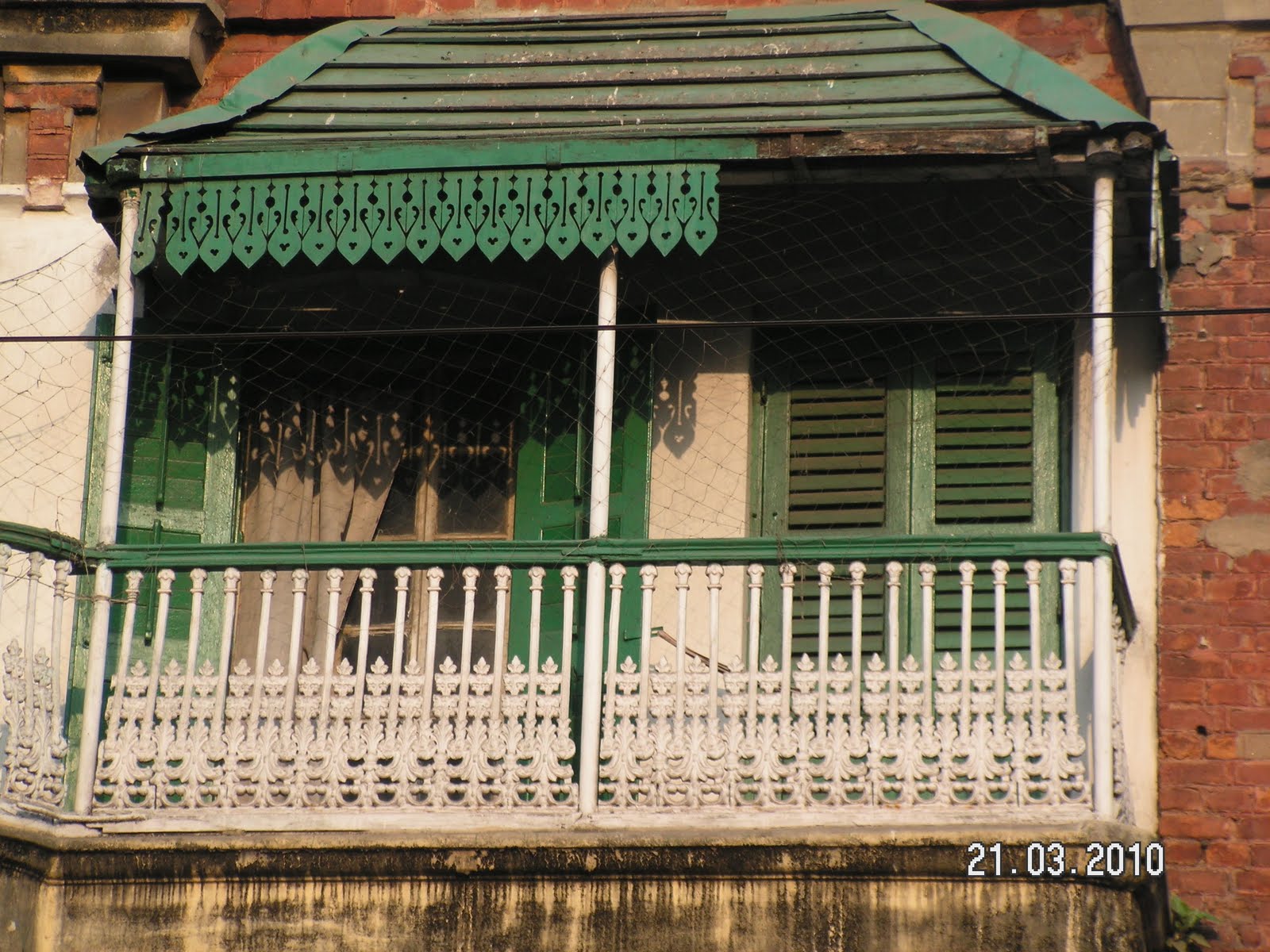
Poetry in Iron- The Charm of old Kolkata Balconies

Rabindranath Tagore wrote in his description of "Library"" "Somudrer sohosro botsorer kallol jodi keho emon koriya badhiya rakhite parito je se ghumaiya pora shishutir moto chup koriya thakito, tobe sei nirob moha-shobder sohit gronthagaar'er tulona hoito". And I offer my own crude translation of the same here: If anyone could capture the roar of the sea for a millennium in such a way that it would stay silent as a sleeping child, then that silence, pregnant with deafening decibel, could be compared to a library. I take liberty to modify this stratospheric analogy to say the iron railings of the houses in colonial Kolkata are pregnant with the entire history and heritage of the city. These represent a microcosm of the architectural, social and economic history of the city from 18th to 20th century. Too profound? Lets discuss!

I don't remember when I started getting fascinated by these exotic protuberances, also known as balconies, often from dilapidated and neglected structures in the older neighborhoods of Kolkata. Millions of people have passed under and even stood nonchalantly on these, most without caring to look, let alone appreciate. That included me of course, for the most part of my life. Maybe my first appreciation for this well-kept secret of Kolkata is a corollary of my liking for traditional houses in older parts of Kolkata. The moment you care to look up and appreciate the magnificent mansions that dot several parts of north, east (say Beliaghata) and part of south (say Bhowanipore) of Kolkata, you can't help notice the majesty of the balconies which look back at you with almost surreal charm. The architecture is typically hybrid between European and traditional Indian architecture. Remember, colonial Kolkata was clearly divided between the Native and the White areas. My objects of fascination are typically the houses of the rich Indian community in the Native areas. Most of these were constructed between mid-1700 and early 1900.

Now, when I look at the balconies of the old mansions, apart from the ornate architecture of the structure itself, what attracts me most is the balcony railing. Most often, these are made of iron, unlike our modern houses which typically have mild-steel (MS) or wrought iron railings. My initiation to the material named "cast iron railings" happened when I was scanning the construction material market and demolition sites in 2003 for construction of my house in Kolkata. By that time, I had already bought a substantial quantity of "demolition material" from a palatial mansion on Suburban Hospital Road and therefore got a taste of how good old materials can be. Martin Burn company bricks were like gold, Burma teak wood door and window frames were strong as ever, floral design floor tiles needed just one polish to shine like a newly minted coin again. I could not get the cast iron grills for staircase and balcony/roof railings from there. I checked the new material market and the price differential with MS material and waiting time (for manufacturing on order) was beyond my affordable limit- so I settled for what everybody does- mild steel bars and strips. But the fondness for the intricate designs and the old-world charm offered by cast iron stayed with me all this while, only to re-surface when I now go out occasionally on early morning dates with the old ladies that I fancy!

Now here's your treatise on metallurgy- to help you understand what kind of an animal "cast iron" is. Cast iron arrived in early 19th century. It is one of the earliest forms of iron extracted from ores, having a higher carbon content (2 to 4 percent) compared to modern construction materials like mild steel. It also contains varying amounts of silicon and manganese and traces of impurities such as sulfur and phosphorus. It has to be "cast" in sand moulds and cannot be forged (beaten to shape when hot) and it is brittle. It is however very good with compression load, and most importantly, it does not rust at all. Cast Iron architecture was a prominent style in the Industrial Revolution era (late 18th century) when cast iron was relatively cheap and modern steel had not yet been developed. It had both structural use (bridges) and architectural use (pillars, railings). Allow me to insert a quote from Rudyard Kipling here:
"Gold is for the mistress- silver for the maid
Copper for the craftsman cunning at his trade
“Good” said the Baron, sitting in the hall,
“ But, Iron- Cold Iron, - is master of them all”.

The skilled craftsmen of Bengal, possibly employed in the early foundries of Howrah (this area was famously known as Sheffield of India for its engineering industry) casted some of these masterpieces. The foundry industry in Howrah is the birthplace of the Indian engineering industry. In fact, the fame of steel from India is mythological. It is well captured in the words of the Arab Edrisi (12th century) who commented: "the Hindus excelled in the manufacture of iron and it is impossible to find anything to surpass the edge from Hinduwani or Indian steel". It is mind-boggling to think how these intricate designs were created in moulds in which hot molten iron was then poured for casting. I believe a large quantity of intricately designed cast iron architectural materials were also imported from Britain during that period. The wealthy families of Kolkata, who stayed in the important neighbourhoods of colonial Kolkata used them. The ornate style of cast iron railings fitted perfectly with the Victorian style of construction of these buildings.

I have traveled around the city for months, taking pictures of these absolute beauties. The photos were mostly taken between 5 am - 8 am when I could drive through the congested neighbourhoods with relative ease and not having to worry about one-way streets and unauthorized parkings. So I had the sun working either absolutely in favour or against my amateur photographs.

I have seen several beautiful cast iron architectures in the residential houses, but the place with the most extensive use of intricately designed and passionately maintained cast iron railings is the magnificent Pareshnath Jain Temple, located to the North East of Kolkata at the Badridas Temple Street. The temple is dedicated to Pareshnath, who was the 23rd Jain Tirthankar, and was built way back in the year 1867. The railings used in the temple premises and some cast iron benches and chairs used in the temple precints are simply awesome.

I thought of listing my favorite "top ten", but realized that it is stupid to give any such list since I probably have missed many and don't know many more that lie in those and other areas. I am also not sure whether the historical handicap and the unintellectual appreciation by a "Southerner" of a small visual aspect of the houses that are seeped in more important glory of the owner's past will be pardoned by those whose houses I mention and those whose I dont. So I refrained from listing any. But I can assure that I will keep looking and keep the flag of dogged affection flying for every new "discovery" that I make. The poetry in iron- the elegant, intricate, timeless, charming cast iron railings in the balconies of colonial Kolkata.

I will stop here, and let you judge. You can start from a sample of pictures given below:


Note: Please do not reproduce any part of this without permission.

Tuesday, February 23, 2010

The Charm of early mornings in Kolkata


I have to admit- this is one of my secret fascinations. I have been exploring this for a while- scratched at the surface only so far. A city which bursts at the seams and strains every sinews during the day presents a surprisingly different picture in its relative moments of privacy- say Sunday mornings, between 5-8 am. The one way traffic rules don't come in to force till 8 am, which, coupled with thin traffic on the road makes driving a relaxed experience. Some of my favorite beats include a drive down the river Ganga, starting with the northern end at Bagbazar Ghat and going all the way up to the base of the Howrah Bridge. The ghats come alive in the morning, offering a slice of life that is normally obscured from view during the day. For example, you could see boats laden with tons of straw anchoring at the Bagbazar Ghat; a "kusti akhara" (Indian wrestling arena) at Mullick Ghat and one of the largest wholesale flower markets at the same place. The flower market is a riot of bright colors where with a bit of bargaining you could buy a bunch of 50 roses for $2 or less..

Even without buying, it is an interesting experience just to walk through the market. I have rarely seen Kolkata citizens visiting the place as tourist, but every time I go I see some foreigners visiting the flower market. I know that this place is in the informal word-of-mouth list of things-to-do-in-Kolkata among them. Is someone from the tourism department listening? It is original things like this, linked to the personality of the city that outsiders come to see.


The other locations that I love to drive are along Central Avenue (the Park Street of yesteryears), Bidhan Sarani, and several lanes that branch off from it- such as Muktaram Babu Street (most famous address here is the Marble Palace).


These have some charming buildings and dilapidated palaces still standing. You need to have the morning peace of mind to stop the car suddenly and look up to admire these fascinating beauties bejewelled with the most ornate wrought iron grills, splendidly designed windows and the Corinthian pillars. I am thinking of joining one of the few walking tours that are conducted by local organizations, often led by heritage conservationists and architects, to explore this a little better. I am also trying to motivate some of my friends staying in North Calcutta to wake up from their royal slumber early in the morning to accompany me. Most of them have certainly retained a piece of zamindari style and attitude in their genes!

Other good areas to drive through are the "White area" of old Kolkata- a few square miles west of the river Hugli (Chowringhee, Dalhousie, Maidan areas). I cannot help admire the British urban planning and architecture every time I drive through these areas.


No morning tour of Kolkata is complete without a food stop. Some of my favorites include a small shop near Marble Palace serving five small kachoris and aloo-sabzi in a sal leaf plate. This helping has to be followed by hot jalebis. There are a group of street dogs on that road who would not touch a morsel of the kachoris or biscuits which you might throw at them, but will lap up every piece of jalebi which you decide to offer them. Other competitors in this food category is Maharani at the other end of town- in the south- near Deshapriya Park. Same menu- here the regular patrons are the morning walkers of Dhakuria Lake who feel guilty of shedding so much calories and make an honest effort to make up on their way back home :-) If you are more adventurous, you could try the "telebhaja" shops near bagbazar (a national morning food in that side of the world). The attractions include out-of-the-world fuluri, dal-bora, alur chop, beguni, peyaji (no translations available for any of these). If you are in that side of town, you could polish off your breakfast with rasagollas (several different sizes, all heavenly) and/or madhu-parka (a cross-breed between icecream, sandesh and mishtydoi). And I am not telling you here what gifts to mankind are available in this part (only) in the evenings (subject of a separate blog). Lastly, if you are among the unfortunate ones who carry a red flag about fried food, you could head for the early morning Chinese breakfast on Tiretta Bazar near Poddar Court. A small group of Chinese sell strictly home style chinese breakfast items between 6-8 am there.. In this by-the-chinese-for-the-chinese affair, you could find various categories of broths, fish balls, steamed pao with a variety of fillings, spicy chinese sausages. You could carry home prawn chips, dried greens, strings of sausages and home-made soya sauce. The place is losing its character with other kinds of sellers crowding the chinese out; but if you visit within the next few years you might still be able to catch up with the food and experience.

As the clock strikes 8 am, the traffic cops take position and one way rules come in to force on most roads- it is time for me to head home, or to slip back in to my householder routine by stopping at the Manicktala market to buy a good, fresh bekty that would yield to succulent chilly fish cubes; or other special categories that would not be available in the local markets. And thus the day begins. What preceded this was the "zero period", as we used to call in school!