Sunday, September 24, 2017

Romancing Railroads- Chicago to San Francisco on Amtrak


Part 1- The Journey
You are doing it the right way- the train Conductor from Hawaii told me, when I was trying to take a selfie with him at the Grand Junction Station in Colorado and Shawn and Thomas ran in to photobomb my project.  He meant that making friends, knowing people and enjoying the journey is the core spirit of travel in Amtrak long distance trains.  We were talking about the past glory of Amtrak and the vibrancy of the railroad towns some decades ago. 


The station was about halfway in my journey on Amtrak’s Route 5- California Zephyr- between Chicago and San Francisco in June 2017.  The route is 2,447 miles long and takes 52 hours, departing Chicago daily at 2 pm.  A returning train Route 6 starts from Emeryville, CA daily at 9:22 am.   The train travels through 7 states, covering many of the most historic and scenic areas of America’s west.  Some of the stretches are accessible only on Amtrak (or on a Kayak).  It crosses two great mountain ranges- Rockies and Sierra Nevada.  It crosses two of America’s longest rivers- Missouri and Mississippi, and runs parallel to Colorado river for over 250 miles.  It crosses three time zones- Central, Mountain and Pacific time.  It serves two breakfasts, two lunches, two dinners to the passengers in its dining car- not counting the café sales and coffee service.  It provides four categories of accommodation- sitting coach, cozy roomettes, spacious bedrooms and family room.  The rail route is ancient- when it was created in 1869, it made life easier for the fortune seekers heading west, many towards San Francisco for the gold rush.  The train is named after Zephyrus- Greek God of the west wind.  The train runs with 8-9 double decker coaches, some sleeper and some seating, and not counting the occasional privately hired coaches hitched on to the main train.  It stops for 33 stations along the way.  A small crew of 11 on-board staff works timelessly to make the journey memorable.  Train driver and conductor crew change once every 8 hours. 

Considering that the journey is long and I will possibly not do the trip again and again, I booked myself a Roomette.  A roomette is a coupe of two berths, with large window.  It has temperature control, charging point, reading light and music control (which does not work).  It is a cozy accommodation with curtain and door.  Being in the category of First Class Sleeper accommodation, it has special privileges, including free on board meal and beverages, towels and bed linen, evening turndown service, shower room and ample restrooms.  First Class passengers also get access to Metropolitan Lounge in Chicago Union Station and assistance with luggage transportation.  Two rows of roomettes are aligned on both sides of the upper deck in one side of a sleeper coach.  A typical sleeper class coach alignment looks like this (Diagram courtesy: www.craigmashburn.com)-Image result for amtrak sleeper coach layout diagram


Unlike in some countries such as India, Amtrak charges the full room or roomette to one person, irrespective of whether (s)he is traveling alone or in group of two.  So the cost difference for one or two person to travel in sleeper class is only marginally different.  The extra amount is payable towards the cost of food, which is included in the cost of the ticket for sleeper class passengers.  So while the sleeper class ticket costs about three times more than seating accommodation, the difference is partly offset by the cost of the six meals served on board, in addition to unlimited coffee in the mornings.  More importantly, the seating passengers mostly depend on the viewing lounge coach to enjoy the beauty of the route- if they manage to get a seat that is.  But the lounge coach has too much glass on all sides and creates reflection, which spoils the photographs.  The sleeper coach has several other advantages- 24 hr coach attendant who provides clean towels/turndown service/water; wake-up call before designated destination; changing room and shower facility; unlimited coffee and fruit juice from 6 am till 11 am.   


The easiest way to travel between Chicago O’Hare airport to Union Station is by the CTA Blue Line train.  It takes about 15 minutes to board from the domestic terminals, costs $5 and cuts the uncertainties of traffic by transporting you to the Clinton station in 45 minutes flat.  Union Station is 2 blocks away.  However, the escalator is very narrow and there are a few flights of stairs to climb, so if you have heavy bags then taxi may be a better option.  If you have big bags that need to be booked in the luggage van, you need to reach the Union Station , more than an hour in advance.  For Sleeper class passengers, it anyway makes sense to reach early- complimentary beverages and hors d oeuvre is served in the spacious Metropolitan Lounge for the waiting passengers.  If you need transportation assistance for traveling to the coach, that is arranged too.    

Upon reaching my assigned coach, I was greeted on the platform by Ms. T- our coach attendant.  She has a more formal name, but prefers to be called thus and passengers like it too.  My room was on the upper floor.  There is plenty of luggage space in the lower level, which alleviated my anxiety of not being able to check in my big bag since I reported less than 1 hour before scheduled departure.  After some excited walk about to feel the lay of the land, I settled down.  The first day’s travel was unimpressive.  For much of the day, the train goes through the small towns and then the vast agricultural lands of Illinois.  Important towns with stops were Naperville, Princeton and Galesburg.  The latter is also a smoking stop so passengers are allowed to alight and light up on the platform.  Galesburg was an important railroad town and it celebrates the heritage with a display of a Burlington steam engine just outside the platform.  Soon after, 180 miles from Chicago, our train crossed the Mississippi River which also forms the state boundary between Illinois and Iowa.  It is 2320 miles long and is the second longest river in the country.  When the sun had set on the first day at around 8 pm, the train was still ambling across the unkempt forest terrains of Iowa.  Major towns covered are Burlington, Mount Pleasant and Creston.  Meanwhile, dining car staff came and took my dinner reservation and handed over a time allotment slip.  I went in and was charmed by the dining car.  It was laid out in two sections, with the serving area in the middle and lower level.  There were a dozen tables laid out in the car, with four seats in each.  If group size is less than four, train staff put others to fill up the table.  Dinner is by appointment, lunch and breakfast is on first come first serve basis.  Seating is assigned, and if seats are full, the staff maintains a waitlist and call by name.  Being alone, I got a chance to sit with eight different traveler groups in the six meals over three days.  Each group was uniquely interesting.  More about them later.

First night dinner was a platter of seared shrimp served with rice and vegetable medley.  Dessert was strawberry cheesecake.  Choosing dishes from an attractive menu option for every meal was not a piece of cake!  While I was at dinner, my bed was turned down to make it ready for the night.  After some post dinner computer work, I went off to sleep.  There is very little track noise, at least in the upper level.   The gentle rocking only aids in sleep.  I slept well, and woke up when the day was breaking.  I was expecting a breathtaking scenery when I removed the curtains, but was disappointed to see rural Nebraska still.  The train was running late, and while the train was scheduled to enter Omaha in Nebrasaka at 11 pm and enter Colorado through Fort Morgan at 5 am, it was two hours behind schedule.  Omaha (500 mile from Chicago) became famous because Warren Buffet’s Berkshire Hathaway Corporation is based here; and when he comes to chair the company’s annual general meeting in May, over 40,000 businessmen descend on this small town.  Nebraska is very agrarian- I could see herds of cattle, large sprinklers and huge granaries.  I could not take pictures in the first two hours of the morning- my camera was nowhere to be found, and the backrests refused to go up to let me look under the bed.  Only when the coach attendant resumed duty at 7 am and worked her magic, the bed became seat again and the camera was duly found. 


Morning is a perfect time to say a little more about the facilities on board.  The toilets are reasonably spacious, clean, well-stocked with all kinds of paper and soap.  There are four in the sleeper coaches- three in lower level and one in upper.  These are larger and more comfortable than airline toilets, even in large intercontinental flights.  The Conductor rang an alert over the PA system that people should not put anything more than paper down the toilets- the coaches are built in the 1970s, and if a toilet gets clogged the whole train loses vacuum and everyone is stuck.  Fortunately that did not happen during my journey.  There is a large shower and changing room, which is always stocked with fresh towels and bath soaps.  The shower is efficient. 

Breakfast opens at 6:30 am.  If you do not get a seat in the first batch, be ready to wait out in the lounge car for about an hour.  This is a good segway to talk about the Lounge Car, which is adjoining the dining car and separates the sleeper coaches from the sitting coaches.  It is a great viewing gallery with large windows, extra glass on the roof, seating clusters of three with a small table in between.  There is a well--appointed café in the lower level which serves snacks and alcoholic/soft beverages which can be consumed in the lounge.  There is also a lounge with dining room style layout- I think it is a swing space in case there are more passengers to feed.  But the tables were perfect for groups to pursue things they like.  I ordered Amtrak Signature Railroad French Toast, which is served with sausage.  My table-mate was Charlotte from Pennsylvania- a charming woman of 83 years- traveling with her daughter and great grand-daughter. 


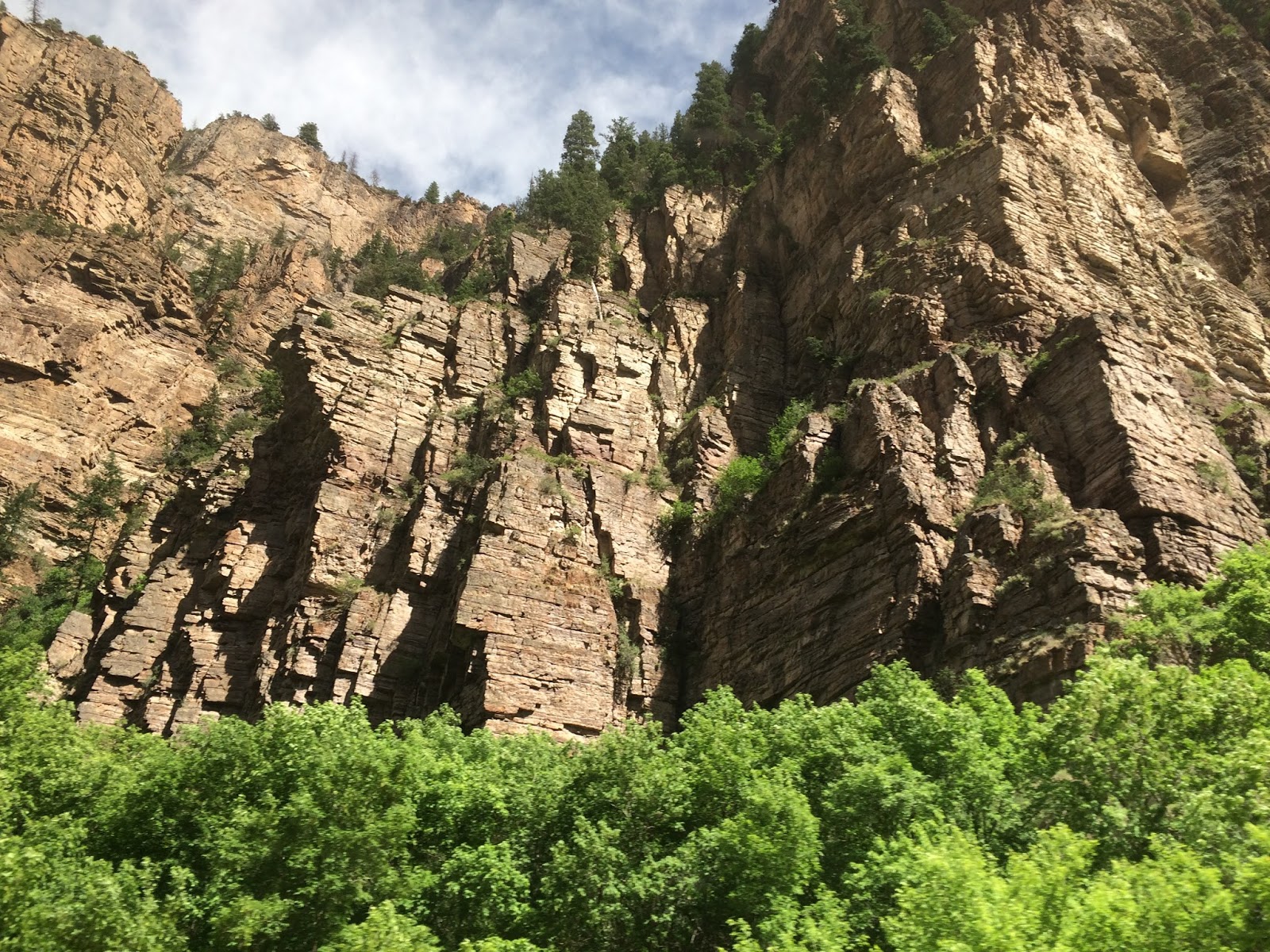
Almost as soon as I finished breakfast, the train stopped at Denver, Colorado.  It was 9:20 am, instead of the scheduled 07:15 am.  This is one of the longer stops where crew change, engine is refueled and windows are cleaned.  After lots of stretching, smoke break and photo sessions, “All Aboard” was announced and we started again.  The next 300 miles is a signature stretch of California Zephyr through the Rockies and along the gushing Colorado river.  Indeed, soon the train started climbing the Rocky Mountains and Colorado rushed in to the train.  In the next two hours, till Fraser Winter Park, I witnessed the steep Rocky Mountains and the gushing Colorado River.  The train passed through 31 tunnels, including the 6.2 mile Moffat Tunnel which transported us across the continental divide.  The train followed the Fraser River through the Fraser Canyon and then runs along the Colorado River for the next 235 miles.  This is one of the most scenic stretches of America that I have seen.  The Fraser Winter Park station in this stretch serves the ski resort nearby.  Between Fraser Winter Park and Glenwood Springs, CO (123 miles), the train passed through spectacular, steep-walled and splendidly remote Fraser Canyon, Gore Canyon and Glenwood Canyon.  I saw a few adventure sports groups riding motorboats and Kayaks on the whitewater rapids of the Colorado river.  Several families got off at Glenwood Springs.  The place is popular with vacation seekers- with ski resorts, biking and backpacking trails and whitewater rafting options.  The train then passed through a few other historic towns such as the mining town of New Castle and wild horse sanctuary city of De Beque for about 90 miles before reaching Grand Junction.  This is where the Gunnison and Colorado rivers meet.  The place is surrounded by mountains.  It was past 4:30 pm instead of the scheduled 1:53 pm.  The train was now getting progressively late. 


The delay however proved to be a boon in disguise.  I got to see America’s wild west in the golden light of the setting sun.  It also helped that my clock was turned back by an hour to Pacific from Mountain time as soon as the train crossed from Colorado to Utah.   The last lap of the train in Colorado and first foray in to Utah was through nature’s playground- the Ruby Canyon.  Wind and water treated the red sandstone as their canvas- creating beautiful landscape with smooth texture mountains in myriad shapes.  The canyon runs for 25 miles between Colorado and Utah till Thompson Springs.  The only access to the canyon apart from rafting is along the rail tracks traversed by California Zephyr.  It became dark soon after the train crossed the canyon.  The list of stops along Utah had places with interesting names such as Green River and Helper.  The latter got its name apparently because apparently the locals used to add “helper” engines to west-bound goods trains to that the trains could negotiate the slope reaching up to Soldier Summit at 7000 feet.  The biggest station in Utah is of course Salt Lake City, which we crossed in the dead of the night. 


Lunch on day 2 was Chicken, Bacon and Cheddar Quesadilla.  I opted for one of the three ACAT (Amtrak Culinary Advisory Team) inspired dishes listed in the menu- vegetarian Asian noodle bowl, followed by vanilla pudding.  The lunch service was relatively poor.  There is no appointment for lunch- I missed the first batch by a whisker and had to wait for nearly an hour till they finished.  That seemed pretty long for a two-course meal.  The few staff serving meals worked hard, but the pressure was starting to tell on their performance.  My table-mate at lunch was served a dish she did not order for.    
The next morning knocked on my window when the train was approaching Winnemucca station in Nevada.  This is a classic cowboy town where apparently the National Senior Pro Rodeo Finals, the Ranch Hand Rodeo Weekend and Mule Show take place.  It is also a designated smoking stop.  After this, the train crossed vast stretches of open space and followed the Truckee river till it reached Sparks and then Reno.  Growing from a small gold mining settlement, Reno economy grew rapidly based on Nevada’s decision to legalize gambling in 1931.     
 The train soon crossed in to California.  I was beginning to lean back in to my seat, assuming that the best is over and I will now pass through familiar terrain.  But California Zephyr surprised me yet again.  Soon after crossing Truckee and Stanford Flats stations, the train started to climb up again.  It was climbing over the Donner Pass to the peak of the Sierra Mountains.  In winter, the Donner Lake area sees over 30 feet of snow.  A tunnel through Mt. Judah is at an elevation of over 7,000 feet.  There are several ski resorts in the area.  At some stretches, the train track was 1,500-2,000 feet above the American River valley on the left side.  The train then had s steep climb-down between Cape Horn and Colfax. 


After crossing the Sierras, from Sacramento till Emeryville through Davis, Martinez and Richmond was sedate.  The last lap along the shore of the San Pablo Bay and then along the San Francisco Bay was very scenic.  We alighted at Emeryville over 2 hours behind scheduled time, and had a seamless transfer to the San Francisco Fisherman’s Wharf on board Amtrak Thruway Bus service.  It was sheer delight to see my friend and his family waiting to receive me at the Wharf.


This was a momentous trip on may counts.  The time investment- nearly 60 hours- was most un-American and un-touristy.  My co-passengers were all American citizens; many of them retired (some ages ago and some never worked); grandfathers and great-grandmothers traveling with family; unemployed adventurous ones; and short distance travelers.  I had memorable interaction with several of them.  The traveler camaraderie was awesome.  The interactions were laced with respectful curiosity about each other.  A separate blog regarding my people interaction will be posted.  The unknowns while planning this trip were many.  Indian travel agents and even tourism promotion agencies have very little idea of Amtrak routes and vacation packages.  Without first hand and anecdotal experience, it is not easy to make the choice and lock the payment.  The cost was high.  My friend had offered me a plane ticket at less than half the cost and one-tenth of the time.  But despite all this, the returns of the trip was sweet and memorable.  I encourage tourists to include Amtrak travel in their itinerary.  There is no better way to see the heart of America and the soul of Americans than traveling on Amtrak.     

Sunday, February 12, 2017

Three 3-line stories

Newton’s Third Law

She was a cellphone addict who typed thousands of alphabets in text and social media messages to express her thoughts.  Quite unknown to her, the cellphone typed a different set of alphabets selected through a complex equivalence formula which went in as verdicts in her book of destiny.  Millions of cellphones, computers and other gadgets are laughing as they secretly print voluminous destiny verdicts for the human race.       

Parallel Universe

Nostalgia of childhood visit with parents pulled him to plan a solo visit to the famous temple after four decades.  The rationalist in him made sure he was not melting in devotion as he was being led in by the priest.  Inside the dimly lit stone built garbhagriha (sanctum sanctorum), as he completed the parikrama (circumambulation of the idol) and faced the Deity, he wept inconsolably and lost control of his actions till he was led out of the premises.  


Iti-Punoscho


Mondays are always stressful after blissfully happy weekends- she briskly walked up the station stairs just in time to catch the downtown bound train.  The next 20 minutes of me-time has been a challenge for the last 6 months- she has been fighting with herself to look away from the window at certain places, and not to check certain things on her cell phone.  He shuffled up a little closer behind her, strained his jet-lagged eyes to make sure it looks exactly as he wanted it to be, and hit "send" on the text message he drafted at the airport- "Palat"


Tuesday, January 17, 2017

Ganga Sagar Mela 2017- through lens of media this year

I read with interest the media coverage and Government reports/ads about the Ganga Sagar mela this year.  Considering how scanty the available information and body of first-hand travel anecdote is about this mega event, I felt this might be useful for future travelers.  The 125 km journey from Kolkata, quite unbelievably, can take up to 12 hours including holdup time at various stages.  It is also one of the more inaccessible venues among important pilgrimages.  This year, it was sort of record attendance at the one-day event at the spot where the Ganga flows into the sea.  Estimated 1.5 million pilgrims visited to take the holy bath and offer prayers at the Kapil Muni temple.  The absence of Kumbh Mela this year swelled the crowd count, and demonetization clearly did not have any effect.  Sadly, 6 people are being reported killed in stampede today (Jan 15) at the Kachuberia Jetty No. 5 and several more injured.  I have observed that chances of stampede is higher at the return journey, since the return crowd builds up in thousands every 15 minutes at the ferry ghat; patience runs thin after the arduous journey to the place; queue runs in to several hours due to lack of adequate ferry service, and the fear of getting stuck for even longer hours during low tide when ferries do not ply (don't ask why, after Rs. 100 million is spent on desilting the ferry route just for this event).

Here is a presentation of how the event looked this year, through the prism of vernacular newspapers.  The national dailies normally do not pay attention to such "unsecular" events.  However, the stampede this year made it "newsworthy", quite tragically.


Wednesday, December 21, 2016

Travelogue- Sinhastha Kumbh Mela- Part 1


“Jab tak kuch kho te nahin hai, kuch milta bhi mahin hain” (you don’t get anything until you lose something).  A simple but profound philosophical observation, stated with a twinkle in his eyes, by an ordinary looking ascetic of Nath community, at a tea stall in Ujjain.  A few minutes ago he came up to me as I was about to take the first sip and asked me to sponsor his cup of tea (chai pilaiye).  It was easy to dismiss him as a beggar.  But being in my third Kumbh, I know such requests for food are common- I usually do a cursory two-second scan of the person and say yes or no.  I am glad I said yes to him.  Hailing from an ashram (hermitage) in Kangaon village near Pune- the place deriving its name because of the ear-shaped turn taken by the Bhima river- he was narrating to me his experience of losing his bag with clothes, prayer accessories and money in a train while going to a temple; his temporary sense of helplessness when he realized it; and then getting almost same set of things as daan from the temple which was his destination for the journey.  The observation was his summation of his experience through this and other life events.  The conversation had started to flow with questions to each other on where we are from.  Upon hearing that I am from Kolkata, he asked a few basic questions on how to reach, and then took an on-spot decision that after the Kumbh he will first come to Kolkata to visit Kali Temple before going to Pushkar and finally going back to his base in Pune.  I was amazed to see the speed, nonchalance and conviction of such an ambitious travel plan.  I have been thinking of going to Pushkar for over three years; and was able to come to Ujjain Kumbh after six months of planning and organization.  But then I am not a traveling ascetic like him; my decisions are clouded by the ““internet” of “things”” that we, urban bred middle class grihi’s, create around ourselves.  It is precisely to touch this other world, “where the mind is without fear and the head is held high, where knowledge is free, where the world has not been broken up in to fragments by narrow domestic walls, where words come from the depth of truth, where the mind is led forward by thee into ever-widening thought and action”, that I go to events such as Kumbh.                         


I prefer to go to such events by train or bus.  The journey to me is as important as the destination.  For the Ujjain trip, I had settled for a practical compromise of flying in to Bhopal and travel the last 100 miles by train.  This 3-hour mid-summer journey in sleeper class turned out to be the perfect prelude to my 2016 Kumbha Mela experience.  My co-passengers were a group of very unassuming Vashnav sadhus from Ayodhya who were heading for the mela.  With a “gamcha” wrapped around my neck, it was easy for me to blend in.  One of them turned out to be delightful when engaged in conversation.  I asked him what are some of the significant religious fairs which as not as publicized as Kumbh.  He suggested I go to Arunachal during Makar Sankranti in January.  Why?  Because the temple of Lord Parashuram is apparently located there; in January there is a big congregation of saints in that area.  The kush used for performing pujas by Brahmin priests apparently come from there.  I had no idea such a place existed.  I asked him where else among such unusual places he went to.  He told me about a 15-day arduous road trip that sadhus frequently undertake as a group in Nepal.  The track is uninhabited, and all food and water has to be carried for the journey along the mountains.  The destination is a place on the bank of Gandak river, where the Salgram Shila (a form of stone with smooth and shiny contour, worshipped as incarnation of Vishnu) is found.  He also invited me to events in Ayodhya where he has his Ashram.  I indeed wanted to go, and noted down his phone number, but to my utter dismay I am not able to locate my travel notebook which contained this and other precious content.  That is one important reason why this blog is delayed too.  But more significantly, I have no hope of finding him ever.  This film does not have a happy ending L


Upon reaching Ujjain, I took a rickshaw to “24 Khamba Sherawali Mata Devi ki Gali” from where, as per instruction of my host, I climbed the “Mahakaal Ghati” (a gentle slope with roads leading towards Mahakaal Temple).  Mr. Alok Rao Gunjal was waiting for me at the first turn.  He took me to his home, which was a old two storied house with number of rooms around a very small courtyard.  His and his extended family stayed here.  I was taken to a ground floor room which was part of Mr. Rao’s 2-room dwelling unit.  The room had a separate entrance, and attached bathroom, but one door connected to the room of Mr. Rao’s.  The room still had several personal belongings of the Rao family, and I realized later that they need to come in a few times in the day to fetch those.  His wife welcomed me warmly, brought glass of water and offered tea.  Being used to completely private accommodations as in hotel, the borderless home stay was initially a culture shock but after the first hour I started liking it.  The camp cot made some noise when I sat on it, but it did not collapse under my weight and the linen was clean.  There were too many openings in to my room, but I am alone and not carrying valuables.  I could put a lock on the iron door but the latch was short and the door would open with the lock intact when pushed!  Everything was very different from what I am used to in my normal life; everything was exactly like what I came to experience in Kumbh.  So I let go of my fear and inhibitions and embraced the situation.  This was anyway intended to be my city camp where I would keep my luggage and rest occasionally.  I had intended to stay in a tent in the camp of a Dandi Swami who had hosted us in the Kumbh Mela in Allahabad.  The idea of a backup accommodation served me well, since I later discovered that due to internal politics among saints over camp site allocation, my Maharaj’s camp was shifted out to a zone which was far removed from the core area of the Simhasth.  So my centrally located home stay accommodation turned out to be a savior.  Mr. Rao is a well-informed local resident who provided me with local newspapers full of Simhasth news and gave me valuable insights over the next four days.


Next day, one thing in my to-do list was to see the pre-Kumbh processions, called Peshwai.  The leading Akharas take out processions to demonstrate their grandeur and importance.  The one scheduled on that day was of the Kinnar Akhara (commune of Bisexuals/Transexuals).  There is interesting background information about this.  There are 13 officially recognized Akharas.  These Akharas are granted recognition and official status in the Kumbh Melas by the Akhil Bharatiya Akhara Parishad (ABAP), which is an apex body of Sikh and Hindu saints.  The concept was propounded by the 8th century philosopher Adi Shankaracharya who first set up seven Akharas to strengthen the Hindu religion and unify devotees practicing varied rituals and customs.  ABAP plays an important role in various religious discourses such as Ram Janmabhoomi issue and interface with the government administration regarding important decisions for Kumbh melas.  Kinnar Akhara was formed in October 2015 with transgender rights activist Laxmi Narayan Tripathi as their spiritual head ('Mahamandaleshwar').  ABAP had denied recognition for the newly formed Akhara.  Another all-woman Akhara which created quite a flutter in 2013 Allahabad Kumbh and was allotted land by the Ujjain administration in the 2016 event also met with the same fate in being denied permission by ABAP for Shahi Snan (joining the elite group of Akharas in royal bath).  Trikal Bhavanta, the woman seer and head of the Pari Akhara announced a dramatic plan for self-burial in protest and dug a 10 ft pit for the purpose.  She however ended up being arrested.  Nonetheless, the Kinnars (eunuchs) decided to go forward with the plans, including setting up their own camp and holding their own Peshwai on the day before the first Shahi Snan.  An image of Ardhnarishwara- an amalgamation of the male-female form in Lord Shiva- reportedly formed the backdrop for the Kinnar Akhara’s main stage in their camp.  They put forward several arguments in support of their stance- the transgenders are saints in real sense of the term because of ingrained asceticism, free from belief in caste, and are mentioned in Hindu scriptures with positions of dignity.  Indeed, the transgenders were once mainstream in Indian social system but lost it in course of time.  In Ujjain, the devotees flocked to see the Peshwai of the Kinnars and also to their camp seeking blessings, indicating that at the core there is still social and religious sanction about the community.  This article by Devdutt Pattanaik provides a deeper insight: http://scroll.in/article/809995/how-a-new-akhara-of-transgendered-people-stole-the-spotlight-at-the-ujjain-kumbh  

    
When I reached the precincts of the Mahakaal Temple, the excitement in the crowd about the approaching Kinnar Akhara procession was palpable.  The police looked tense, and none had authentic information about the exact route of the procession.  I learnt later that the reason of their hassle was that the procession was unauthorized, and they were throwing coins en route which resulted in huge crowd surge, raising fear of a stampede.  The police administration was trying to prevent the procession from coming near Mahakaal temple and Harsiddhi Chowk where a huge crowd was waiting for the procession with eager anticipation.  A member of the audience made a tongue-in-cheek remark that such interest is not seen in the procession of big religious leaders.  I spend half an hour trying to obtain information from police and public regarding the route of the procession, and finally climbed up a watch tower which was set at Harsiddhi Chowk for CRPF for a bird’s eye view.  Soon, there was a flurry of activity and the head of the commune was seen being escorted past the crossing amid heavy police protection.  The rally had been disbanded.  It was an exciting beginning of the 2016 Kumbh mela experience for me.


I had reached two days ahead of the Shahi Snan with the objective of exploring the mela ground in advance.  The size and scale of these events are so huge that it is impossible to have a good experience on the main day if the layout of the place is not explored in advance.  Waking up early, I had walked a few kilometers from my accommodation in to the mela ground, when an old sadhu asked me for directions of Puri Shankaracharya camp.  He was old and frail, and a Dandi Swamy too.  Another such chance encounter with a similar sadhu in Haridwar in 2010 had charted my festival experience destiny; so I do not take such chance encounters lightly.  I had passed by the huge Govardhan Math camp of Puri Shankaracharya Swami Nischalanada Saraswati early on in my route that day.  It would have been ideal for me to give him some cursory direction and let him find the rest of his way, but in the Kumbh spirit of sacrifice and brotherhood, I decided to walk back with him to show him the place.  He told me he came from a small ashram of Uttar Pradesh, and had been wandering around since early morning.  He walked slowly with a slight limp, in obvious pain, and kept muttering “bhangwan dekhenge (God will look after me)”.  I offered him some food, but he said he cannot accept food from any and everyone.  I was allowed to buy him some dry raisins, and he blessed me profusely. 


I spent the rest of my day walking around the city, mela premises and river bank, soaking up the ambience of the event.  I saw a large commune of foreigners queuing up to enter the Mahakaal Temple.  I learnt that they are all followers of www.yogaindailylife.org which was founded by Swami Maheshwarananda Puri of Panchayati Maha Nirvani Akhara in Vienna.  Since 1970 he has been living and working in Europe, and has a large number of disciples.  I saw a dwarf saint who was seating under a tree and many people were coming in to touch his feet.  People we clearing seeing in him the fifth incarnation of Lord Vishnu as a dwarf Brahmin- the Vamana Avataar.  I saw a skinny guy in tight jeans, dancing on the street in a trance without any music anywhere, seemingly high on hallucinating drugs, and then suddenly walking away with sure and steady steps.  I saw innovative water dispensing systems catering to the pilgrims.  I saw free and delicious food being distributed.  I witnessed first-hand the elaborate cleanliness drive of the administration (notwithstanding reports in Times of India about strike of conservancy workers).  I saw disciples huddled together with their Gurus, listening to their spiritual guidance in various camps.  I walked in the Vikram Teela (hillock) where the famous throne of Ujjain’s legendary King Vikramaditya of 1st century BC is believed to be buried.  Madhya Pradesh government has re-created Vikramaditya’s courtroom at this site with a mammoth 26-feet statue of the king seated in his throne, along with life-size statues of his courtroom scholars collectively called nine gems and 32 Apsaras.  I walked by the Kshipra river and was amazed at the elaborate arrangement the administration has put in place in preparation for the mela.  16 bathing ghats were constructed spread over 8.5 km- enough space for 5.8 million people to bathe in a day.  The water flow was augmented by pumping in water from Narmada river, and water quality in core bathing areas was further boosted by series of aerators working tirelessly to oxygenate the water.  Water quality parameters were being displayed real time in electronic board in Ram Ghat.  State disaster management team was keeping a watchful eye from their speedboats, reinforcing the strict vigil being maintained by police and paramilitary force on land.  A real karma-yagna was on in the city.  The people and the administration were ready for the once-in-12-years tryst with destiny.  This is the interval of the celestial alignment when Sun is in the zodiac sign Aries and Jupiter in the zodiac Leo, during which the event is held at Ujjain (Simha in Sanskrit, hence Simhastha Kumbh Mela).   


I also curiously observed the visible presence of Muslims in the periphery of the Mahakaal Temple, which is outside of the mela zone but is a central area for congregation of pilgrims.  Two of them were seen selling Mahakaal temple literature and photos.  Both were from Bohra community.  I talked to another member of the same community in the market area- his shop was selling bags printed with Mahakaal pictures.  He spoke of the communal harmony that existed in the place, and that the spiritual leader of the Dawoodi Bohra community has explicitly instructed community members to devote themselves to the success of the event and welfare of the pilgrims.  I also walked in to the Islamic Information Centre set up by the local unit of Jamaat-e-Islami-Hind and talked with the members therein.  They explained how they are supporting and assisting the event, including advising their community member transport operators not to over-charge pilgrims.  


 With a few hours of rest in my room that night, I was all ready to take another deep dive in to the ocean of experience that is Kumbh Mela in the wee hours of next morning.  I will write about that in the Part 2 of my travelogue.        


Sunday, December 18, 2016

Signifinace of Makar Sankranti and legend of Ganga Sagar

Sagar Island, at the mouth of the river Hooghly in Bengal, where the Ganga river breaks up into hundreds of streams, and drains into the sea, is honored as a pilgrimage site, signifying the spot where ashes of the ancestors of King Bhagiratha were purified by the waters of Ganga. The temple of Kapil muni (sage) at this site is a center of worship. A dip in the ocean-river confluence on the day of Makar Sankranti when the sun makes a transition to Capricorn from Saggitarius in mid-January is considered to be of great religious significance. The small Sagar island of about 200,000 population becomes home to vast fairs, drawing visitors and recluses (sanyasis) from all over the country.

It is important to narrate the legend that is at the heart of the annual congregation at Sagar. King Sagar of the Ikshvaku dynasty ruling at Ayodhya in Uttar Pradesh had two queens, Keshani and Sumati, but neither had a child. Sagar performed severe austerities before his wives could produce sons. But whereas Keshani gave birth to a son called Asmajas, Sumati bore 60,000 sons. Sagar performed the Ashwamedha Yagya (sacrifice) to declare his suzerainty over the neighboring kingdoms. According to the prevalent custom, the sacrificial horse was let loose and allowed to wander into the neighboring kingdoms. If the horse was caught, a battle ensued and the outcome decided the winner. The 60,000 sons of Sagar were following the horse when they saw him enter a cavern where sage Kapil Muni was meditating. Kapil Muni was the son of Kardam Rishi and Daksh's daughter Devahooti. He was Avataar of Vishnu. Not seeing the horse in the cavern, they presumed that Kapil Muni had captured it. They did not kill Kapil Muni as he was a sage but they started disturbing his meditations. Annoyed at being disturbed, Kapil Muni with a curse burnt the 60,000 sons of Sagar. Time passed and later Bhagiratha, the great grandson of Sagar, chanced to come across the bones of his dead ancestors. He wanted to perform the shraddha of his ancestors but there was no water available for the ceremony. Agastya having drunk all the waters of the ocean, the country was passing through a severe drought. Bhagiratha prayed to Brahma, the Creator, to end the drought. Brahma asked him to pray to Vishnu, the Preserver, to allow the heavenly Ganga, issuing from His big toe, to come down to earth. Vishnu when prayed to by Bhagiratha agreed, but asked him to request Shiva, the third member of the Hindu trinity of Gods, to allow cascade of Ganga’s water to fall on his head before it came to the earth as the river. Shiva agreed, and Ganga watered the mortal remains of King Sagar’s 60000 sons liberating their souls once and forever. It is this legend that attracts people to this little island in a remote southern corner of West Bengal. The temple of Kapil Muni, as we see it today, is by no means the spot where the sage meditated. It went under the sea millennium ago followed by the many others built in its place, which subsequently was also swallowed, by the advancing sea. The present one was built only a few decades ago, quite a bit away from the sea. In the temple, three images engraved in stone are displayed, the one in the middle is that of Kapil Muni. The sage is seen in a jogasana; his eyes wide open, looking towards the sea. The idols of Ganga and King Sagar flank Kapil Muni and the horse of the sacrificial yagna stands at a distance.

Makar Shankranti is a very auspicious day as per Hindu calendar. While the traditional Indian Calendar is based on lunar positions, Sankranti is a solar event. So while dates of all Hindu festivals keep changing as per the Gregorian calendar, the date of Makar Sankranti remains constant over a long term, 14 January. Makar Sankranti is celebrated in the juncture of the last day of Hindu Calendar month of Poush and first day of Magha (January 14-15. On this day, the Sun moves from the Tropic of Capricorn to the Tropic of Cancer. According to the Hindu astrology, this is defined as movement of the Sun from Dhanu Rashi (Sagittarius) to Makara Rashi (Capricorn). Rashis are equivalent to the zodiac signs. The movement of the Sun from one zodiac sign into another is called Sankranti. [Picture Courtsey: Wikipedia]

The day commemorates the beginning of the harvest season and cessation of the northeast monsoon in South India. It is known by different names in different regions. While Makar Sankranti is the name in most states, in other states such as Gujarat and Rajasthan it is called Uttarayan (signifying northward movement of the Sun), Maghi in Haryana, Himachal Pradesh and Punjab, Pongal in Tamil Nadu. In Thailand, the day is called Songkran, in Myanmar it is called Thingyan and in Cambodia Moha Sangkran. Apart from a harvest festival is also regarded as the beginning of an auspicious phase in Indian culture. The day marks the end of an inauspicious phase which according to the Hindu calendar begins around mid-December. No auspicious and sacred ritual such as marriage is held during the phase of mid-December to mid-January. Makar Sankranti marks the beginning of the ‘day’ of Gods, while the phase of southward movement of the sun is believed to be the ‘night’ of Gods. From the day of Makar Sankranti, all pending social and religious events are organized with great fervor and fanfare. Most Bengalis like myself look forward to a number of seasonal delicacies and expect a spate of marriage invitations starting mid-January! From a science perspective, this day marks the beginning of warmer and longer days compared to the nights. The significance of the day has been conclusively established through several important episodes of Indian mythology. According to the Puranas, on this day Surya (Sun God) visits the house of his son Shani (Saturn), who is the lord of the Makar Rashi. Though the father and son duo did not get along well, the Surya made it a point to meet his son on this day and stay with him for a month. This day thus symbolizes the importance of the special relationship between father and son. It was also on this day when Lord Vishnu ended the terror of the Asuras (Demons). While taking a dip in Ganga and praying to the Sun is the predominant form of worship on this day, the people of Gujarat, Andhra Pradesh, Uttar Pradesh and Maharastra also celebrate by flying colorful kites. Preparing food at home with the new harvest crop such as rice and seasonal delicacies such as jaggery (sugar extracted from sap of date palm or sugarcane) is the custom in most places. Coconut and milk is also abundantly used for such preparations. Sankranti is celebrated over four days in states like Andhra Pradesh and Tamil Nadu.

Sunday, November 6, 2016

Exhibition- observations

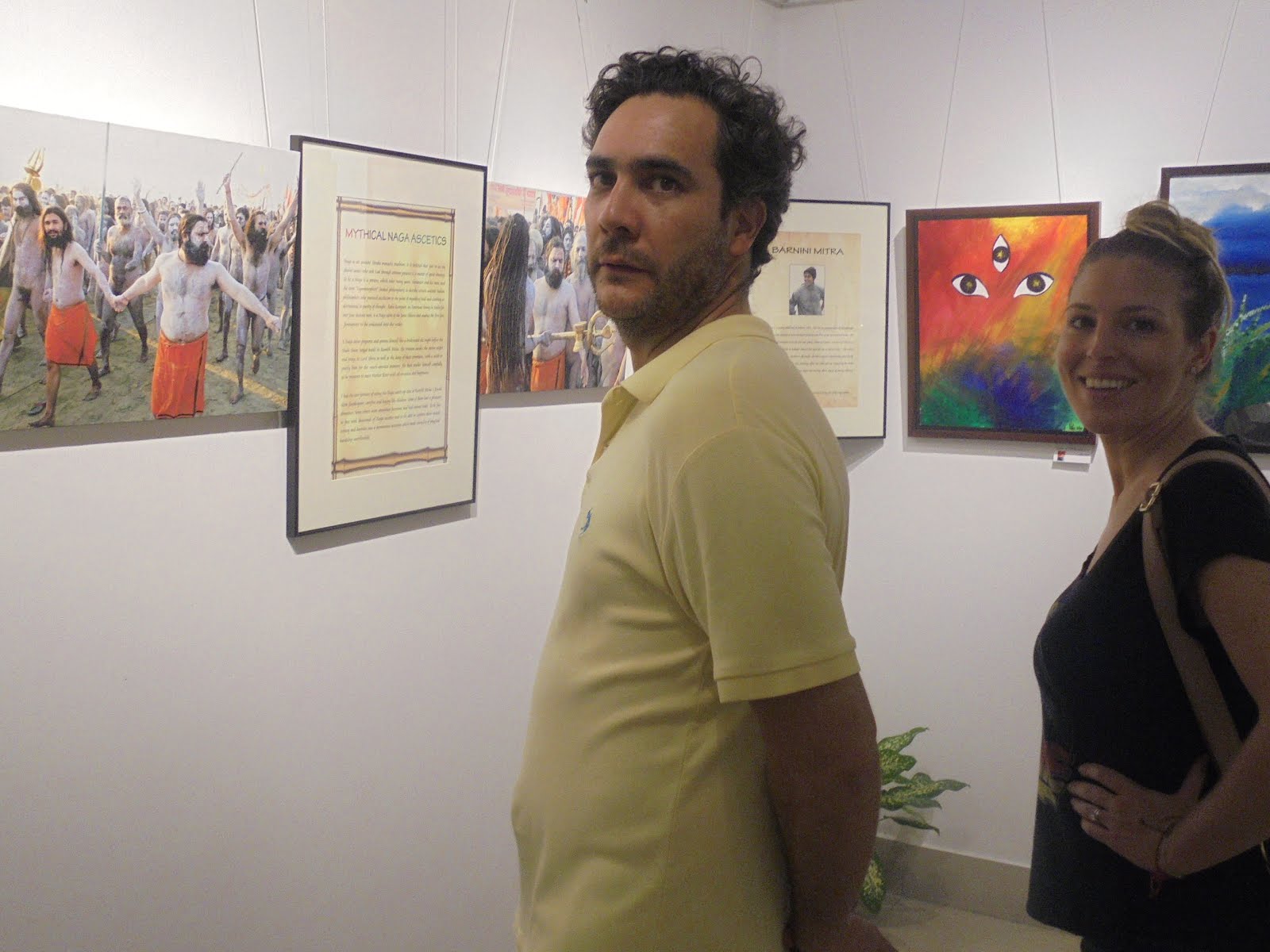
I met a very interesting array of people during our exhibition at the Academy of Fine Arts in October-November 2016.  We had over 2000 footfalls in the seven days of the exhibition.  The overall feedback received from the visitors was extremely appreciative and encouraging.  My daughter’s talent in art was of course the primary purpose and was universally admired.  We were touched by the appreciation from general visitors and honest reviews and tips received from several artists who dropped by.  But I was surprised to see the response to my exhibition of photographs, which in my mind was a filler and a side show.  Several people told us that they have never ever seen such display of the resplendency of India’s religious fairs and festivals in Kolkata.  Unknown people of all ages spent a good amount of time looking at the photos with great interest and reading the narratives I displayed.  I had organized my photos in three categories- long shots depicting the “Ambience” of the events, close up of the “Faces” depicting moods and expressions of people who come to these events, and the mythical “Naga” ascetics.  I had detailed narrative in separate frames for these categories, explaining my thoughts.  People were seen reading those with rapt attention.  Not being much of an art connoisseur myself, I am familiar with the rapid awkward shuffle across the exhibition floor when someone is disengaged with the depth of content displayed in a gallery.  We had a few of such people too; but majority were unusually glued to the photos and write-ups.  Several of them came up and talked to me, some others left their comments in visitor’s book and few others walked out without sharing their views.  A few of the comments read as follows:


  • “photographs mesmerize; the captivating visuals transporting the viewer to real India, sans the mask of urban ‘civilization’ that we have got unfortunately used to.  It raises the Shakespearean dilemma in the viewer’s mind- ‘To Be or Not to Be’ like those natural common people in the photographs”
  • “photographs make me nostalgic”
  • “Been to Allahabad for 6 years but never saw the thing the way the photographer has seen.  Loved it”
  • “the starkness of Naga ascetics recorded by his camera is truly mind-blowing and gives rare insight to his acumen as a candid photographer”


Interest of women in the fairs and festivals was particularly striking.  I talked to at least three lady Professors in reputed academic institutions who displayed a deep passion and experience of traveling to these events, and could connect easily with my photos.  Another group of three unknown elderly ladies came and talked to me at length about the events.  A group of poets from suburban areas spent a lot of time talking to me and my daughter.  Foreign tourists were attracted like a magnet to the photos.  Two American teachers from Woodstock International School in Mussourie accompanying a student talked to me about the events at length; visitors from Mexico, Korea and Europe spoke and left appreciative comments. 


The reaction of fellow exhibitors was mixed.  A senior artist and exhibition organizer liked our unit and took us under his wings.  He provided advice and support during the entire duration of our exhibition.  Another artist and organizer in adjacent hall was overwhelmed when I took my friend as a buyer to his hall and he bought one of the exhibits.  The artist told me later that no one wants to expose their buyers and keeps them under wraps.  A young artist came, walked the show and posted snide comments on our flex and visitors book- we took it as a constructive criticism.  Another young boy, exhibiting his vibrant Krishna-Radha theme canvases at another gallery, was mesmerized about one photo of the facial expression of a rustic old pilgrim.  I had casually clicked the photo at Ganga Sagar mela. 


It seemed that people could instantly connect with the liveliness and spirituality of the events- an opportunity they do not get easily in Kolkata.  A gentleman, claiming to be a film-maker, wanted to do a documentary on the Naga saints and talked to me at length about the way of life of these saints.  But I could hardly conceal a chuckle when he asking his parting question- “So, all of them are from Nagaland?”  In hindsight though, it was not so funny because the awareness about saintliness and mythology based religious events of India is abysmally low in West Bengal.  The reason for this can be debated, though the fact is undeniable.  The insularity of the Bengali community from all-India happenings may be partly responsible.  Bengal became famous for many reasons- show of religiosity is not one of them.  The socio-political discourse prevalent in the state may be another contributing factor.  The media (both vernacular and English) in Kolkata do not pay any attention to such events.  I have carried back loads of Hindi newspapers from the Simhastha Kumbh Mela’s opening days in Ujjain this year, wherein various facets of the event were the only news from cover to cover.  On same days, there would be passing reference to the event in an inside page in the newspapers of Kolkata.  These events become news here when something unpleasant or untoward happens; such as stampede; disease outbreak or crime.  But when such events happen flawlessly with participation of 10-30 million people at a riverbank, that is not news.  Even if it is the biggest human congregation on earth, as in Maha Kumbh Mela in Allahabad, held once every 12 years in the flood plains of rivers Ganga and Yamuna.  Here, a temporary mega-city is created in four months over an area of 2000 hectares, with 770 km of electricity lines; 22,000 street light points and 130,000 private connections; 550 km of water pipeline; 44,000 toilets; 38 hospitals; 13,000 police personnel in 30 police stations; 18 temporary pontoon bridges over the rivers; 3600 extra buses and 600 special trains operating from four railway stations to transport pilgrims.  This is sheer magic.  A team from Harvard University’s South Asia Institute camped for weeks at Allahabad Kumbh trying to study the science behind this magic.  But it does not pass muster with the editors of West Bengal newspapers or national English dailies.  However, launch ceremony of Indian Premier Cricket League with 8 private club teams is considered significant enough for a leading English daily to devote more than half of newsprint space.  The perspective of television channels is the same.  Therefore, the ignorance of the common man about such events is understandable.  But the ingrained quest for spirituality bubbles up when they come face to face with candid photos of faithfuls, vibrant show of faith by commune of Naga ascetics and the magical ambience of these events.


I was deeply satisfied that my photo exhibition met an unmet need of a part of the population of the city.