Monday, September 28, 2020

Covid Lockdown Diary- Observations, Reflections

Winter lingered longer in 2020.  It was early March and weather was still crisp and pleasant.  No heat, no humidity.  The only heat was in the newspaper pages and media channels, with shrill coverage of the CAA NRC protests/counter-protests and Delhi violence.  Morning walks were a delight- spring had arrived and the trees in our neighborhood were a riot red and yellow flowers, when not exploding in lush green leaves. 


Meanwhile, news of an unusual disease, first in China and then in Italy and France, started bubbling up since February.  Media started following it and we started reading it with an arms-length curiosity as explosion of a volcano in Italy.  A highly infectious virus, first detected in Wuhan was killing Chinese people and quickly spreading globally through international travelers who flew from/through China.  First non-travel case in the U.S. was detected on Feb 26.  Till March 10, there were 113K global cases, out of which 81K were in China.  Although 33K cases and 872 deaths were reported in 109 countries by this time, including 9172 in Italy; 7513 in Korea; 7161 in Iran and over 1000 in France/Germany/Spain, it somehow still seemed like an international problem that will not affect us directly.  Our reaction to Covid till mid-March was "oh, no! really? that's sad".  U.S. had 472 cases and India detected 44 cases as on March 10.  My school friends in New York were already afraid and were sharing their anxiety in school chat forum.  We were empathetic, but could not relate to their fear.  Between March 8-15, I had taken 8-10 bus rides, visited crowded market, eaten street food, drank roadside tea, met with friends, visited medicine store inside hospital- all without battering an eyelid.  At workplace however, the inkling of a major global pandemic was there- emergency action plans were being drawn up for work coverage.  Things started becoming strange at our doorstep when on March 19, Prime Minister called for a 1-day people's curfew on March 22, and appealed to citizens to clap and cheer loudly at 5 pm for 5 minutes to thank the healthcare workers.  Little did we know that he was preparing the citizens and the Covid warriors for a long haul.  March 22 saw a level of eerie urban emptiness that defied any recent memory.  Powerful political parties, with all their might and protest angst, were unable to enforce the kind of total voluntary shutdown that India saw on this day.  At 5 pm, millions of citizens also responded to Prime Minister's call and clapped and cheered and beat plates/bells to cheer the healthcare workers.  India also announced ban on all international flights effective March 22.  Still, the depth of the problem did not sink in in the minds of most people and people were taking the flow of events as an eventful aberration in their otherwise monotonous life.  This is possibly because almost no one walking the earth in March had any memory of a global pandemic.  The philosophical, chalta-hain attitude of Indians, coupled with misleading pseudo-scientific claims coming via social media were also to blame.  WhatsApp was buzzing with forwards that seem ridiculous in hindsight- Covid-19 virus does not survive over 27 degree celcius/BCG vaccine of Indians will act as a shield against Covid, and so on.

Anyway, things started unfolding rapidly from there onwards.  Many gasped in disbelief when on March 24, Government of India announced a 3-week complete lockdown from March 25-April 14, which was subsequently extended to May 1 and then to May 17 with increasing level of conditional relaxations in Covid-safe regions as time progressed.  In between, there was social and political turmoil regarding return of millions of migrant workers from rich states to poor states.  Additionally, Kolkata and south Bengal was hit by an unprecedented super-cyclonic storm Amphan on May 20, which brought in its trail unprecedented damage and hardship.  This, when Covid cases were exploding and healthcare system already stretched thin.  At other locations, there were floods and rains and China border posturing menace if nothing else.  We survived all of that, to restart jostling for toehold in buses; to grab the freshest of cauliflower as soon as the farmers cooperative truck downloads its consignment in the makeshift morning stall in the sidewalk; to continue doing the work that of us do.  Students have  started online classes, maids and workmen are being allowed back in households; food establishments are limping back to business.  Many in our circle of family, friends and colleagues have been infected; many recovered and some unfortunately have succumbed.  At the time of writing this article, India has 6 million infected and 95,000 dead.  This after 6 months of the onset of pandemic.  Quite likely that several times more people were touched by the virus asymptotically, and cause of death of some more people were Covid as well.      

Reflections

Despite all criticism, some for valid issues, overall the Government of India and state governments did absolutely amazing work in face of unprecedented challenge.  Government and workers in all categories fought with chin up, stiff jaw and dogged determination.  The spirit of entrepreneurship, laced with patriotism, was also in full bloom.  I think there is much here that we can look back and be very very proud of.  The continuously rising recovery rate and the falling fatality rate are the two significant achievements which mask several other significant achievements in inner layers.  Some are listed below:

  • PPE- In early March, WHO spoke of a global shortage of personal protective equipment (PPE).  At that time, India had zero manufacture of PPE and entire requirement was being met through imports, mostly from China.  In September, India has 111 manufacturers with a manufacturing capacity of 187,000 PPEs per day.  It is a $1 billion industry in India now.  
  • Testing capacity- From a capacity of mere 10,000 tests per day in early April, on September 27 India conducted a record number of over 1.2 million tests- a stunning 120 fold growth.  This took the total number of such tests conducted to over 63 million, and counting.  
  • Laboratory infrastructure- From only 52 accredited Covid testing labs in March, India now has 1,773 laboratories- 1,061 in the government sector and 712 in private sector.  
  • Kit manufacture- India has a manufacturing capacity of 1 billion RT-PCR kits.  Manufacturers have surplus stock, and government has allowed limited export in recent months.  Globally there is still a big shortage and the market is expected to be over $5 billion.   
  • From vaccine manufacturer to vaccine developer- Indian drug companies are already major manufacturers of vaccines developed by international pharma companies, for distribution worldwide.  India supplies more than 60% of vaccines supplied to the developing world.  Serum Institute of Pune is world's largest vaccine maker.  But this time, 4-6 Indian pharma companies are also in the race for Covid 19 vaccine development.  Planning the logistics of the vaccine delivery is another mammoth task.  No other nation has the size, complexity, socio-economic status variation and geographical spread as India.  States have been told to submit their detailed plan for vaccine distribution to the Government of India by mid-October.      
  • Ventilator- At the start of the pandemic, the stock of ventilator in the entire country was around 47,000.  Ventilator manufacturing capacity went up from about 300 per month from 8 manufacturers to over 30,000 from 16 manufacturers.  This, coupled with shift in treatment protocol, has resulted in excess capacity in the country.  Soon, Indian companies will be competing with global giants in the international market for this high end healthcare equipment.  
  • Overnight creation of healthcare infrastructure- Hundreds of thousands of bed capacity was added almost overnight.  Delhi started a 10,000 bed new Covid hospital temporarily.  Religious places, railway coaches, stadiums were converted to temporary hospitals/safe homes rapidly.

Other important collateral gains during Covid time, that are going to last-

  • Huge boost to cleanliness- Covid achieved what Government's flagship project Swach Bharat Abhijan (Clean India Mission) aimed.  What could not be done by massive awareness campaign costing $500 million, was done magically by Covid.  Hygiene became a way of life all across the country. 
  • Clean air- As of 2019, 21 of the 30 cities with the worst PM2.5 pollution levels globally were in India with five cities in the top 10 in the national capital region of Delhi.  Across Indian cities, a 20%-60% reduction was witnessed in the 68-day 4-phase lockdown periods for PM2.5, PM10, SO2, and NO2 and 10%-60% increase in daytime ozone concentrations.  CBCB published a report titled 'Impact of Lockdown on the Ambient Air Quality', which sates that PM2.5 reduced by 24 per cent during the pre-lockdown phase and further reduced by almost 50 per cent during the lockdown phases as compared to levels observed during 2019.  The grinding halt of vehicular traffic and sharp drop in industrial pollution are the obvious reasons.  People from Punjab started getting clear view of the Himalayan mountain range 200 km away.  Great details are available in https://ccapc.org.in/policy-briefs/2020/aq-changes-lockdown  This once-in-lifetime air quality study opportunity without human activity presents tremendous insight to scientists and policy makers.  Eventually, climate change will kill more people than Covid-19.    
  • Digital acceleration- The digital payment mindset has received a huge boost.  India has been a notorious cash economy, even after demonetization.  Since the beginning of lockdown in late March, Government distributed around $5 billion in cash benefits to citizens, entirely through digital payments.  RBI data shows that India is now clocking around 100 million digital transactions a day with a volume of $67 billion- a five-times jump from 2016. Even the elderly have mastered the art of paying online and buying daily essentials in cashless payment mode.
  • Social empathy- India seems to be giving and caring and sharing than ever before.  In the early part of the lockdown, social, political and Hindu religious organizations were a the forefront of distributing food and essentials to the marginalized sections of the society.  It multiplied after the super cyclone hit.  Many people are trying to make themselves useful to others in some way.
  • Recognition of existence of invisible migrant workers- Only when large number of fearful poor people tried (or were nudged) to return home, the governments realized there were that many migrant workers in the country.  Various estimates have put the number of migrant workers in India between 0.3 million to 30 million.  The exporting and importing states realized during Covid that they have no idea of the number of inter-state migrants.  In future, maintaining of biometric-based log of migrant workers, as well as adherence to one nation-one ration card policy will be advisable for tracking.
  • rejuvenation of time-tested Ayurvedic principles- Suddenly India seems to have been transported to the Vedic age- people eating all kinds of leaves, herbs, roots and plant extracts.  People are also eating fruit, milk; drinking herbal extracts and practicing several ayurvedic techniques of doing water/oil cleaning of nostrils; practicing breathing techniques to calm the mind.  Homeopathy is not too far behind too- amazing to see people gulping down arsenic laced solution based on recommendation that Arsenic Album medicine is useful for preventing Covid.
  • Family bonding- For notoriously feudal minded urban Indians, doing household chores together as family was unthinkable.  For everything, there is the ubiquitous mashi in the east/bai in other regions- part time lady workers who would come daily to sweep/wipe/wash/clean/cook.  The excuse was convenient when both were working.  Even if one was at home full time (I have to be carefully gender neutral here!), most often (s)he would be the director type, supervising and orchestrating all the action rather than doing all the song and dance by self.  As a result, the families were thrown at the deep end of the pool when suddenly 4-6 hungry and anxious people were locked inside home 24X7, with no maid and no Swiggy.  3 full meals plus snacks on daily basis for months, in addition to all other household chores?  A true OMG situation.  However, from chaos emerged new order.  Men rose to the occasion and women shined as always.  The kitchen sink, the floor mop and the chopping board had a new boss.  Food habit changed.  Weighing machine started smiling after a long time.  Families had lunch together after ages.  People fell asleep happily tired.  Urban India has been trying to ape the Western world for a few decades now- they suddenly became truly American or British quite by accident.                   
  • Digital learning- This got a huge boost during Covid.  Schools scrambled to put train teachers on Zoom/MS Teams/Google Classroom.  Students mostly loved online classes as it gave them a sense of freedom and a less rigorous academic environment.  Some school students found the digital environment empowering enough to challenge the teachers with their own point of view on the topic in a very university-like manner.  The examination-based academic evaluation process had a tectonic shift too.  Schools are resorting to various new and hybrid models ranging from open book format to on camera examination.  This shake-up of a cozy solidified system of one-size-fits-all was welcome and much needed.    
  • Non-exam based selection process- For students seeking admission to college/university and not through all India competitive examination such as JEE or NEET, Covid brought a huge shift in mindset of both students and institutions.  After pondering for weeks on how to proceed, when the exam-based selection process has been rendered infeasible, institutions discovered new method of evaluating the applicants.  For art and design students, some did portfolio evaluation followed by virtual interview; some gave creative assignment that needed to be completed in 24 hours and uploaded in institute server; some did just interview over Zoom.  The shakeup of the selection process was useful in removing the cobwebs in some way.        
  • Work-from-Home principle established- Suddenly, the employers found enough confidence in employees working from home, and were pleasantly surprised to see that it was working beautifully.  The online systems such as Office365, digital platforms such as Salesforce and meeting apps such as MS Teams or Zoom are robust and reliable.  Productivity has not gone down noticeably.  In fact, after a few months employees are complaining that workload has become more than business as usual.  The IT companies, who already allowed work from home, exceeded themselves to announce that most employees will work from home for the next one year.  In April, Directorate General of Training announced "Work from Home guidelines during the COVID-19" for half a million employees of Government of India.  This statement from Department of Personnel & Training in May sums up the experience- “Many of the ministries/departments in Government of India have successfully managed and rendered exemplary results in combat against the ongoing pandemic outbreak during the lockdown period by leveraging e-office and video conferencing facilities of National Informatics Centre (NIC). This was the first-of-its-kind experience in the Government of India”   This also had huge collateral benefit- urban mobility reduced dramatically, saving fossil fuel and resulting in clean air.  

The above is not to suggest that there has not been hardship and negative impact of Covid-19.  Of course there has been.  Societies have been scarred, economies have been battered, lives have been ruined.  But those news and analysis is all over the print, AV and social media.  Someone introduced a lesson plan in journalism class- bad news sells much better than good news.  And the students have taken that lesson most seriously.  So my observations and reflections are on the less reported aspects of the Covid-19 induced lockdown.  The effects are still unfolding, including on me.  A most momentous event in the recent history of mankind.  

ॐ सर्वे भवन्तु सुखिनः
सर्वे सन्तु निरामयाः ।
सर्वे भद्राणि पश्यन्तु
मा कश्चिद्दुःखभाग्भवेत् ।
ॐ शान्तिः शान्तिः शान्तिः ॥

Om Sarve Bhavantu Sukhinah
Sarve Santu Niraamayaah |
Sarve Bhadraanni Pashyantu
Maa Kashcid-Duhkha-Bhaag-Bhavet |
Om Shaantih Shaantih Shaantih ||

Meaning:
1: Om, May All be Happy,
2: May All be Free from Illness.
3: May All See what is Auspicious,
4: May no one Suffer.
5: Om Peace, Peace, Peace.  


Monday, January 27, 2020

Ardh Kumbh Mela- Allahabad- 2019

I had no plans of visiting the Allahabad Ardh Kumbh in 2019.  I had a very satisfying trip in the Purna Kumbh there in 2013.  However, destiny had other things in mind.  Since January this year, the social media started buzzing with fascinating aerial shots of the expansive mela grounds, and the magical ambience therein.  Eventually, when a school friend from Lucknow sent some photos and video of the mela and the lavish tent city coming up, I had to succumb.  Choice was clear- if I go it has to be one of the grand Shahi Snan (royal bath of the saint communes) days.  The two upcoming dates were Mauni Amabasya on February 4 and Basanta Panchami on February 10.  I chose the Mauni Amavasya, also because I had visited the 2013 Kumbh on the same auspicious day.  It seems the biggest congregation- 3 crore pilgrims out of the month’s total of 10 crore pilgrims had visited the Mela on that day of 2013.  A scramble provided waitlisted train tickets.  Air India was operating special flights from the newly built Bamrauli airport of Allahabad, and I booked my return on a direct Air India flight.  From 2013 experience, I knew the railway station becomes a war zone of returning pilgrims on such heavy rush days.  Last year, there was a stampede and an overbridge collapse on the day after Mauni Amavasya. 


The next challenge was to decide on accommodation.  From past experience, I know that the location of the accommodation can make or break the Mela experience.  There is no good online or offline map of the mela area and the adjoining city area, which was a major hindrance in planning.  Google Map is clueless about the details of this temporary mega city.  In hindsight, I can advise travelers looking for hotels and booking blind to choose accommodation in Jhusi or Daraganj but never in Arail.  A Bharat Sevashram doctor and Kumbh Mela enthusiast dug out a map published in local Hindi daily Amar Ujala’s online version- to my great surprise that was the most detailed and authentic map of the Mela which I could find.  An A3 size printout of the map was a great resource in my hands when at the event.  Unless there is local guidance, it is very difficult to decide what is a good area to stay that will not require miles of walk to be at the core mela area.  This year, a new feature and lure of the mela is luxurious “tent city”, where 4,200 onsite tents have been set up on PPP basis, equipped with modern facilities.  Until this year, only UP Tourism had luxury swiss tents on the mela ground.  It is tempting to be there, but the costs are high for a solo traveler.  The prices range from Rs. 3500 (per person, sharing)-Rs. 25,000 (per tent) per night.  After reaching the mela, I visited the tent city location and found that that it is in Arail, which is a remote, cut off location on the other side of Yamuna with no easy access to the Sangam area.  There are only two pontoon bridges of over 2 km length, separated by a distance of 1.5 km, connecting the tent city to the main area.  On peak days, the bridges are one way and may even be closed for those wanting to reach the main sangam area.  Someone in Google commented after the event, “The place is too far off from kumbh hub and needs to be avoided at all cost.”  Based on the insight of Amar Ujala map, I booked myself one homestay in the Cheoki area within a kilometer of the mela sector 17 area.  For redundancy, I booked another basic pilgrim’s accommodation at the Bharat Seveshram Sangha camp inside the mela premises in Sector 5 area.  The two accommodations were almost at the two ends of the mela, separated by a walking distance of 6 km.  One was offsite but had the comfort of 4 walls and good bathroom.  Other was onsite, but had very basic living arrangement and bathroom facility.  I split my stay between the locations, and walked a few times between the two.  It helped me to have an immersive experience of a large swathe of the vast mela ground.


This is a good Segway to describe this year’s Kumbh Mela.  The event is spread over an unprecedented 3,200 hectares around the confluence of the rivers Ganga and Yamuna- where the mythical subterranean river Saraswati is also believed to meet.  This is the biggest ephemeral city of the world that is built to last for only 7 weeks.  Some of the key features of the temporary city are as follows:

-        2,80,000 electricity connections to camps

-        40,700 LED light posts, 175 high mast lights

-        1.030 km of low tension electrical lines and 105 km of high tension electricity lines

-        125,000 chequered plates used for construction of 141 km of road; another 105 km of service road

-        Total 35 sq km (3200 hectares) Mela area divided in to 20 Sectors

-        Over 20,000 police personnel in 58 police outposts; 11,000 sanitary workers; 122,500 toilets; 11 hospitals and 35 health outposts; 2,100 medical and paramedical staff

-        1795 pontoons built and used to construct 22 temporary pontoon bridges over Ganga and Yamuna; the longest being 2.5 km.

-        150 km of drainage pipeline and another 850 km of drains.  Ponding and bio-remediation treatment sites constructed

-        800 km of water pipeline, 200 water ATMs, 150 water tankers, 100 handpumps, 5000 stand posts to provide 24X7 water to the pilgrims 

-        4200 premium tents set up on PPP basis for high end tourists and visitors; free public accommodation with 20,000 beds for general pilgrims

-        It cost around Rs. 4,000 crores to build this temporary city to host the 55-day mega event        

I arrived Allahabad by train on Saturday, February 2nd, two days before Mauni Amavasya day, and first checked in to my homestay at Sangam Vihar, Havelia, Jhusi area.  Mr. Chandrasekhar, who runs Oga BNB ((https://www.ogabnb.com/)- a local AirBNB type platform, was very helpful in answering my questions before and after the booking.  When I arrived near the location, the homestay owner came and picked me up and took me to the house.  It was a unique day to arrive- Modi government announced its last budget before 2019 General Elections, and Hindi newspapers were struggling to maintain front page coverage of both a significant budget and the mega event of Kumbh Mela. 


It was an interesting accommodation- a private room on one side of the 1st floor courtyard, smack in the middle of other rooms occupied by members of a large family.  The children were playing in the courtyard and the ladies with “ghunghat” (traditional head cover) were running around doing household chores.  The ladies take turn cooking the dinner for the octogenarian head of the family- after his meal is cooked, others enter the kitchen to cook for the full family.  I was served a very nice simple dinner of roti dal sabzi for that night, for which I do not think they even charged me.  The room was basic, in an inner alley, and the toilet, at the other end of the courtyard, was dedicated for me during my stay.  They tried hard to make me happy, but I was straining at the leash to hit the mela ground and embarked upon the journey after a few hours of rest.  The accommodation was near Pontoon Bridge 20 (Chakra Madhav Pipa Pul)- about a kilometer from Sector 16, which was a few kilometers from the Triveni Sangam and Akshyay Bat area- the core of the Mela.  My host, very kindly, dropped me in his motorbike to my second accommodation at the other end of the Mela- The Bharat Sevashram Camp in Sector 5 near Pontoon Bridge number 5 (Harishchandra Pipa Pul).  I staked my claim in the shared tent and reviewed the Camp facilities.  I also queued up for the free lunch served for all the camp resident pilgrims.  My co-boarders in the tent were a guy of my age from Kolkata and an elderly gentleman from Jamshedpur- both loyal Bharat Seveshram devotees.  Me and my younger tent-mate went for an evening stroll- walked from there till Triveni Sangam and from there I walked back to my homestay accommodation.  The walk was about 10 kilometers in 3 hours.  My average walk in the next three days was between 12-15 km/day, to explore the nooks and corners of the 35 square kilometer Mela area.


Kumbh Mela in Allahabad is an incredibly huge affair.  It is impossible to explore all of the 20 sectors even in 3-4 days time.  For most of the travelers, this is not an issue because the prime purpose is to go to the Sangam, take the holy dip, do Satsang in the camp of their Guru and return to base.  The challenge is for journalistic travelers like myself, the Timorous Travelers, who want to soak it all but does not really care about the dip at the right place and time.  No public transport is allowed inside the mela premises.  However, the ambience was sullied and polluted by the huge number of vehicles belonging to the hundreds of influential Akharas.  This many number of vehicles, kicking up dust and pushing the pedestrians to the edge of walking streets was detrimental to the spirit of the event.  But anyway, my tip for any traveler like me is to tone up your leg muscles before the event and get a good pair of walking shoes and an additional slipper for wet areas.  Also be ready for tolerating dust and smog, that hangs heavy over the ground in the evenings.  The Kumbh melas in Haridwar and Ujjain is different since those venues do not use this much of open ground.  I have not been to the Nasik Mela yet.
I had a fantastic experience in my three days at the Kumbh 2019.  I will talk a few important anecdotes, before making this a photo blog and let my pictures do the rest of the talking.

THE BATH FIASCO- On the second night, Bharat Sevasharam Sangh was to take all pilgrims to the Sangam for the holy dip in the river, when the Amavasya sets in.  I usually do not get a chance to take a dip, as I travel solo and I do not have anyone to safely keep my belongings when I go to the river.  Also since I am not personally religious, it does not matter a lot to me.  This was one good opportunity for me to let go of myself in the milieu of faithful.  The auspicious timing was on Feb 4 from 2 am onwards.  The Ashram authorities told all of us to deposit all valuables with them and be ready at midnight.  About 100 of us started at midnight with great fervor towards the Sangam- a 3 km walk from the Camp.  Josh was high and procession was orderly as we snaked through the mela streets led by the Bharat Sevashram flag.  However, as soon as we neared the vast open area of the Sangam, all  hell broke loose.  The crowd swelled, and soon we were confronted with a bigger rush of pilgrims coming out of the bath and heading back.  The procession was in disarray.  The ground was clayey and feet was sticking.  Some went forward with the Maharaj carrying the flag.  Me and my two tent-mates stuck together for a few hundred meters.  But the surge of returning pilgrims broke us apart soon.  My slipper got stuck in mud and I could not find it.  Any more effort to look for it could have led to me coming under feet of pilgrims.  I gave up and decided to return.  I shouted out to my tent-mates that I am turning back.  On way back, I found several other slippers, but all were of the same foot for which I had my own!  In the cold winter night, at 2 am, I walked back barefoot over ice-cold iron plate for the 3 kms to my camp.  In hindsight, Bharat Sevashram’s plan to beat the crowd by going early (2 hours ahead of the most auspicious time) backfired.  Police’s crowd control system was not in place, and we ended up in a free for all.  And Bharat Sevashram did not have enough of its own volunteers to ensure a smooth snan for its own devotees.  My tent mates returned two hours after me, crestfallen.  They managed to reach the water, but in the melee one lost his mobile and the other was physically exhausted.  It would have been so much better if we went on our own in the morning.  But again, hindsight is always wiser.  Overall, Bharat Sevashram was a disappointment—both in terms of quality of accommodation and this mismanagement of the holy bath.  However, the Sangh has long standing reputation in providing stellar service to pilgrims in all major religious congregations.       


Bharat Sevashram Health Unit
 
The lock on our tent door


My tent mates


Getting ready to go to Sangam at midnight of Feb 3-4

On way to Sangam


Facing the crowd at Sangam


COLLATERAL GAIN- MEETING WITH POLITICAL PLAYER:  After reaching back to my camp at 2:30 am, I let go of my tired body in the bench of a tea stall near our camp, ordered tea and lit a cigarette.  From nowhere, came a man with flourishing turban, and started speaking with me about mela arrangements.  The discussion quickly veered in to politics and was getting interesting.  I kept encouraging him to speak with leading questions.  He soon admitted that he is the spokesperson of Bharat Bikas Abhiyan Trust- part of Priyanka Gandhi’s team, and he is collecting feedback on behalf of Congress Party at the mela, and also doing some campaigning.  Hearing his passion about the leadership of Ms. Gandhi and seeing his unwavering faith that her leadership will swing the upcoming national elections in favor of the Congress, I requested him to give his predictions in form of a recorded sound byte, to which he readily agreed.  I do not have to explain that his smug conviction sounded utterly hilarious after the results of the election was announced a few months later. [Had to trim the interviews to meet the 100 MB size requirement of the blog site]
 

LESSON LEARNT: Never go to the VIP tent area in Arail between pontoon bridges 20-22 on the peak days.  If you are staying there, come out early and stay in the Mela main land for the rest of the day.  I walked in to that sector to explore the VIP camps and almost got stuck and would have lost many precious hours.  Note that the pontoon bridges are made one-way on all peak days for better crowd management.  So I walked in to the VIP tent sector via Pontoon bridge 20.  The river is really wide here and the bridge is nearly 2 km long.  Once I reached the other side, I realized I was stuck.  The police has closed the return bridge 22 (which is a km away from bridge 20) and I am stuck in that sector which is cut off from all actions going on in the main Mela area on the big day.  My heart sank.  Police was strict and would not listen to any pleading from me and a few other desperate souls.  I did not give up and hung around.  Soon came a group of foreigners- the main inhabitants of this VIP tent area.  They would not take no for an answer from the police, who was also more lenient on them.  Finally, a senior ranking police officer decided to let them go.  I was lurking around, and I was allowed to pass too.  We quickly walked across the 2.2 km longest pontoon bridge 22 on the Yamuna built for Kumbh Mela and was delighted to land back in the bustle and din of the main mela arena.

Crossing to Arail to see VIP tents- walking in to a trap

VIP tents from a distance

Returning via 2.2 km Pontopon Bridge 22 over Yamuna- the longest

Because of these foreign guests, I also got permission to return to main Mela area


KINNAR AKHARA: Interesting dynamic unfolding about inclusion of Kinnars (transgenders) in the fold of Hinduism.  Rishi Ajay Das, a Zoology graduate and transgender himself and Laxmi Narayan Tripathi, transgender activist (fought for the rights of third gender in supreme court and other forums) had organized a huge kinnar sammellan in Ujjain to press for their rights to join Hinduism.  They have formed the Kinnar Akhara and has been trying hard to get it recognized as the 14th clan of Hindu saint commune (traditionally there have been 13). In the Ujjain Kumbh Mela in 2016, the Kinnar Akhara was allowed a five acre plot for the first time despite opposition from the Akhara Parishad.  In Allahabad Kumbh, the Juna Akhara invited the Kinnar Akhara to join the Shahi Snan (royal bath of the saint communes) for the first time.  The Kinnar Akhara was a place of great interest.  I walked a few kilometers to visit the place.  It was vibrant and welcoming, spread over a big area.  The kinnars were dancing in an enclosed arena and the Mahamandaleshwar was seated at the center of the arena.  The place was abuzz with curious visitors.  Someone was smearing the forehead of interested devotees with sandalwood paste and stamping Jai Shriram on it.  I offered my forehead for the easy opportunity to display my affiliation. The long walk to visit the Akhara was worth it.


THE VIP BABAS: Alongside traditional saints, Kumbh Mela is experiencing an increase in the number of VIP Babas, who are pompous in their demeanor, lavish in the décor/amenities of their camps and conspicuous by the number of foreigner devotees.  In Ujjain Kumbh, I saw Golden Baba decked up in 14 kg gold heading for the Shahi Snan.  Thankfully, he was expelled by the Akhara Parishad for the 2019 Allahabad Kumbh.  Reportedly he was also detained after creating a ruckus about it.  In Ujjain, I also visited the air conditioned camp of Pilot Baba, who was seated surrounded by foreign devotees.  Pilot Baba was reportedly Wing Commander in Indian Air Force and flew fighter planes in 1972, 1965 and 1971 wars.  He met with an in-flight accident in 1996, after which he renounced material life and embraced saintliness.  He teams up with Yogmata Keiko Aikawa.  In Allahabad, Pilot Baba's camp was super lavish.  It was teeming with foreign devotees, had a retinue of Volvo buses lined outside, and had a giant LED screen projecting the pearls of wisdom that Baba was distributing during his congregations.  The other VIP Baba who never fails to attract attention through his personal charishma and the dazzle of his female devotees is Swami Nithyananda.  I must admit, the ghee-soaked free halwa that I had at his camp in 2013 Allahabad Kumbh has also created a softness in my mind for him.  However, the Kumbh administration denied him space in the 2019 event, in light of under-investigation rape case against him.   


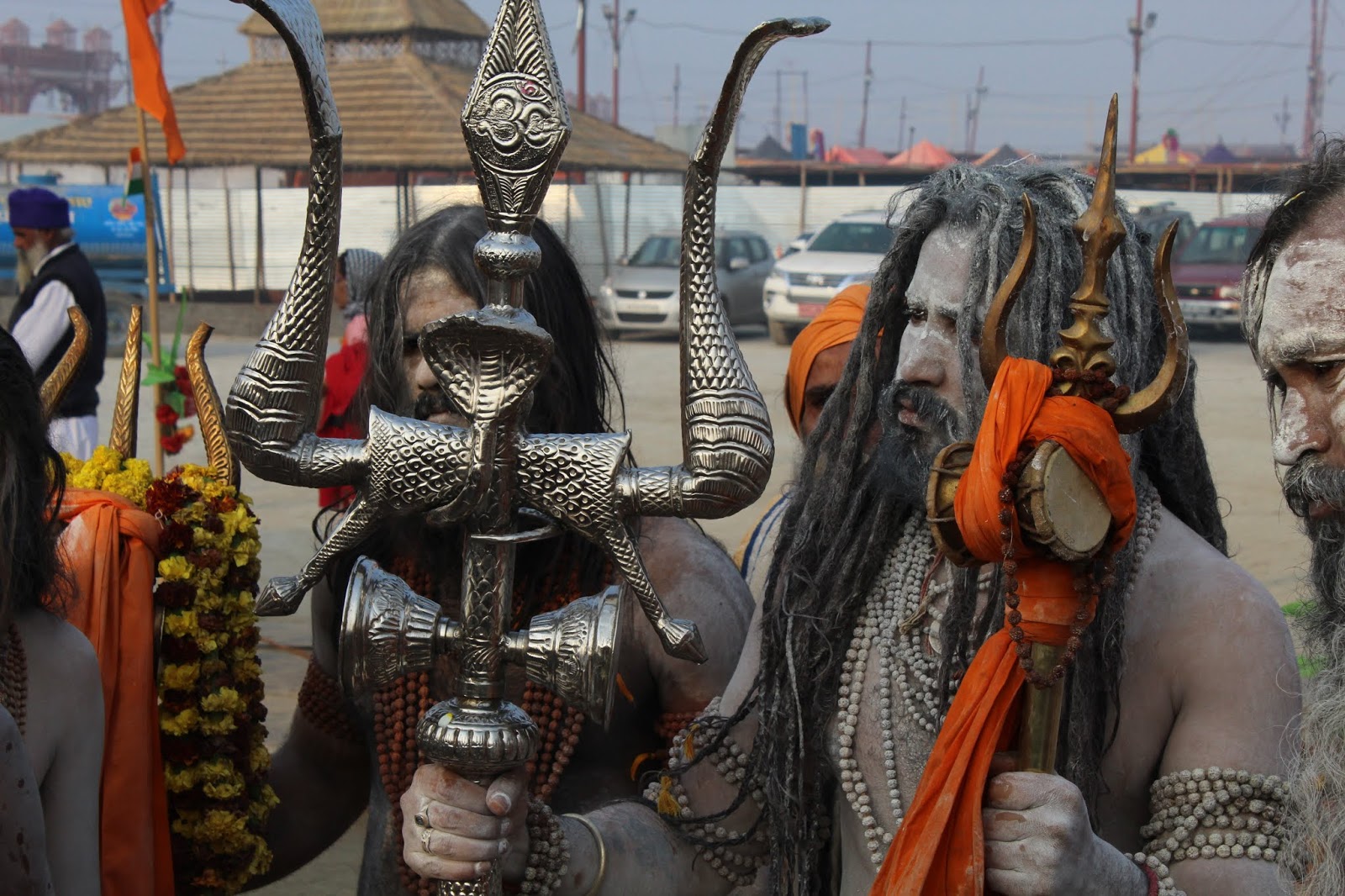
BEST EXPERIENCE: Watching the Shahi Snan procession of the various religious denominations.  This is always my highlight of Kumbh, and I spare no effort to be at the right place at the right time.  I went in to Nirmohi Akhara when they were returning, and watched several other saints and denominations go towards Sangam with their followers amid pomp and splendor.  I went inside the Niranjani Akhara and witnessed the unbridled  joy of the saints of the commune as they returned from a successful Shahi Snan (royal bath) on the auspicious occasion of Mauni Amabasya.   


RAM MANDIR: Clearly, building the long-pending Ram Mandir in Ayodhya, for which the saints and devotees have waged a century-long battle, was a looming theme in the Kumbh Mela.  It occurred in the tea stall chats and hoardings and in the consultations of the Akhil Bharatiya Akhara Parishad which coordinates the activities of the 13 major denominations of Hindu saints and ascetics.  Worship of stones for building the temple were held in the camp of Shankaracharya Swaroopanand Saraswati of Dwarka Peeth.  


I leave it to my photos to tell you the rest of the story of my travel.  Many of these are about the MELA AMBIENCE.  One of my passion at these events is to take photographs of FACES of the saints and devotees.  Possibly I seek saintliness in the milieu of millions of so called saints.  Did I find any?  I will let you decide from some of the photos.


The hardcore pilgrims have a skill of carrying their belongings on their head- hands free

Charity and service to pilgrims is a part and parcel of Kumbh Mela

 
And we worry bout accommodation!


Queue to see the Akhshay Vat (immortal banyan tree)- said to be blessed by Lord Rama to last till the existence of mankind


The entire administration is soaked in spirituality during the days of the Kumbh Mela


And here's Timorous Traveler...

Leaving Bharat Sevashram...had to walk 6 km to catch a transport to go to airport
 

Just after jailbreak- returned to main Mela arena after being marooned in Arail.