Saturday, January 13, 2018

Ganga Sagar- Timorous Traveler's travel tips!

2018 Update:


I had written a lot about travel logistics from my last trip to Gangasagar.  This year, it is simple.  Posting a brilliant website, but hidden as a well-kept secret.  It is almost timeless- very little changes year to year.  A great resource for travelers researching on how to go to this momentous event.  Here it is:  http://74.50.58.66/gangasagar/help/archive/2.pdf


And here is a narrative from my trip few years ago:


I spent an enormous amount of time researching the travel logistics for the Ganga Sagar trip. Very little authentic information is available. Officially, the place is 124 km from Kolkata. But anecdotal travel time estimates varied between 4-10 hours. This is because it is not one continuous journey. The first phase of the journey is to the ferry point. One can avail the bus services of State Transport Corporations or private transport operators from Howrah Station / Outram ghat / Esplanade, Kolkata to reach either Lot No. 8 or Namkhana. The distance from Kolkata to Lot No. 8 is 94 KM and the distance from Kolkata to Namkhana is 108 KM by road.


The government bus service to Lot 8 is best- charges Rs. 60; seating assured; travels non-stop till destination. More than 500 buses are deployed to carry pilgrims. One can also avail the local train services from Sealdah south section by availing down Kakdwip Local/Namkhana Local to alight (i) at Kakdwip railway station and then proceed to Lot No.8 by rickshaw van or by walking. The distance from Kakdwip railway station to Lot No.8 is 6 KM by road or (ii) at Namkhana railway station and then avail the Launches from the nearby Jetties. Then you have to board a ferry, which takes about 45 minutes to cross the vast Muriganga river. The vessels from Harwood point are larger and more frequent. From Namkhana, the wooden launches ply. Fare is Rs. 40-60. Private vehicles are not allowed to cross the ferry from Jan 2 till Jan 17, except without specific prior permission. At other times, the rate for crossing a car is Rs. 260. Except from Namkhana and Harwood Point, there is also a direct ferry service available to Kachuberia from Haldia; but such services are suspended at the time of Mela. The ferry takes you to the northern end of this Sri-Lanka shaped island, to a place named Kachuberia. From there, the Ganga Sagar, which is at the extreme southern end of the island, is 30 km. At normal times, this can take about 45 min. Bus fare is Rs. 30 and a reserved taxi/car will cost around Rs. 500. It is tempting to add up these estimated travel times and arrive at a total of about 4-5 hours. It doesn’t work that way during the days of the Mela- I realized the hard way.

WHERE TO STAY:
NOTE: All govt and private accommodations in Kakdwip, Namkhana and Sagar Blocks are taken over by Govt and comes under S24P DM from Jan 7 till Jan 16. So none are available unless you have serious contacts in the right places. At other times, these are the standard accomodations available:

Larica Sagar Vihar (a 1*star Hotel)
South 24 Parganas, Gangasagar, West Bengal 743606
Phone: (3210) – 240226-227 / +91 32 4022 6227 Fax 22404358
Booking: 74 Park Street, Kolkata -700017 Phone 22403583 / 22404537

State Youth Hostel- Double bed room with attached bath: Rs. 100/day. Check in time: 12 noon. (Booking: Directorate of Youth Services, 32/1, B.B.D. Bag (South), Kol-1. Ph: +91-33 2248 0626)

Bharat Sevashram Sangha, Ramkrishna Mission, Shankaracharya Ashram; couple of other ashrams.

Howrah Welfare Trust at Radhanagar- http://www.gangasagarmela.com

PWD, PHED, Irrigation, Zila Parishad Bungalows; Circuit House.

It is also useful to have the tide information- the frequency of vessels during low tide is extremely low. So, if you are a smart traveler, note the following:

TIDE INFORMATION:
Date: 13th January 2012
Time (in Hrs.)- Height (in m.)
0.06 - 5.06
6.57 - 0.82
12.33 - 4.8
18.58 - 0.95

Date: 14th January 2012

Time (in Hrs.) Height (in m.)
0.45 - 4.95
7.33 - 0.86
13.14 - 4.73
19.37 - 1.11

Date: 15th January 2012
Time (in Hrs.) Height (in m.)
1.26 - 4.78
8.09 - 0.96
13.56 - 4.6
20.20 - 1.33

Also it is important to carry some important phone numbers- here's my partial list; after taking out the cellphone numbers to protect the privacy of the senior officials (there is no assurance that the same person will be on duty next year- so landline numbers are better for future use):

Call Center Toll Free Number: 1-800-3453220

Civil Administration:
• A.D.M. (L.R.) & Point-in-Charge, Namkhana:
• A.D.M. (Dev.) & Point-in-Charge, Kachuberia:
• A.D.M. (L.A.) & Point-in-Charge, Lot No. 8:
• Camp office of ADM(G) and Mela Officer (Circuit House Annexe 1st floor) (Hot Line) 03210-240803
• Liaison Officer, Ganga Sagar Mela (Mela Office) 03210-240804
• Control Room at Mela Office (Hot Line) 03210-240805

Police Administration:
• Superintendent of Police: Mela Tent: 03210-240826
• S.D.P.O., Kakdwip:
• Main Police Control at Sagar 03210-240824
• Main Police Control at Sagar 03210-240825
• Transport camp near Mela Office 03210-240806
• Bharat Sevashram Sangha with one parallel line at bus stand at Sagar: 03210-240811; 2440-5178 (Kolkata)
• CMOH:(Camp: 03210-240813)
• DEPUTY CMOH-II:
• Hospital at Mela ground: 03210-240814

Armed with all this pieces of wisdom, I finally embarked on my trip to Ganga Sagar 2012!

2015 UPDATE (information courtesy Government advertisement for Ganga Sagar Mela 2015)

Friday, January 12, 2018

Ganga Sagar on Makar Sankranti- confluence of astronomy, mythology, religiosity and sociology

2018 update coming!


2012 narrative-


For a long time, I have been seeing congregation of sadhu’s and pilgrims at Esplanade and Babughat in Kolkata in the first half of January. They come in large groups, often in a bus marked with a number plate of other state- Gujarat, Maharastra, Uttar Pradesh and Bihar are the most visible ones. I heard that they are heading towards “Ganga Sagar”. So in my third year of travel to socio-religious congregations in different parts of India, I decided to check out Ganga Sagar Mela 2012.

My trip to the fair was an eventful one. I started researching the place and the event about a month before the trip. The first thing that I realized after investing considerable amount of time was that hope of finding a proper hotel-type accommodation is pretty futile. The island has less than 20 proper accommodations, divided between tourist lodges (such as Larica Sagar Vihar), Government accommodation (such as Public Health Engineering Department) and religious organizations (such as Bharat Sevasram Sangha). Now all available rooms, except in religious organizations, are taken up by the South 24 Pargana District Administration a week in advance of the Fair. I decided to go ahead and book a camp accommodation of Bharat Sevasram Sangha from its office in Ballygunge. They charge Rs. 50 per person per day, including food. The organization has a strong presence in the island, and plays a significant role in organizing the event in tandem with the administration. Next thing to figure out was how to reach. For details regarding travel information, read my supporting blog. I also took the trouble of researching the river tide information, to plan for the best time to arrive at the ferry boarding point. Very few vessels ply on the river during the low tide. The draft of the river during peak of high tide is about 5 meter, and the timings are around 12 midnight and 1 pm in the afternoon. The low tide draft is around 1 meter only, and occurs at around 7 am and 7 pm.

Armed with all this information, plus the contact numbers of a number of senior district officials of South 24 Pargana district who were on duty at various important locations of the route and fair site, I started by travel on Saturday, January 14 at 6 am. I was hoping to reach the venue by 2 pm. I was so wrong! My onward journey took 12 hours and return took 9 hours. I boarded the CSTC bus from Esplanade at 7:30 am and it was cruising along merrily till we crossed Diamond Harbor in good time and reached Kulpi in about 3 hours. Then the bus was pulled aside to a holding bay, in company of few dozen other buses. We were told that there is no place for additional buses at Lot 8, so we need to wait until the congestion cleared. It took about 2 hours for us to roll again. Finally reached close to the Harwood Point/Lot 8 approach road, which was choked with hundreds of buses. I decided to get down from the bus and start walking for the remaining 500 meters. Following the stream of people, I reached Lot 8, where the volunteers and locals started giving contradicting direction of which way to go. The were no signs to direct people to the different queues at the 3-4 boarding points. I found myself in a queue that was caged with bamboo barricade along the sidewalk of a motor road that led to the ferry point. Several big groups were walking past us along the wide road, while our queue was snaking along at snail’s pace with no destination in sight. I was advised by some people who have been here before that it is better to stay in this line rather than cross over to the main road, as police will eventually stop them and turn them back o the end of the queue. That eventually turned out to be a wrong piece of information, as the main road was actually leading to a point where a large vessel carrier was deployed to ferry pilgrims, in groups of 3000 passengers or more at one time. I stuck to the painstaking progress of the narrow line. I diverted my attention to the missing person’s announcements, where they allowed everyone to make their own fervent appeals to “Gangu ki Maaa” and “Maruti Gupta” to reunite with them at the Bajrang Parishad camp. It was evident from the array of names that pretty much the northern India was represented in the crowd. I also managed an interesting video of pilgrim’s progress in my handycam- sat down along the barricade and recorded the brisk feet of the people heading for their destination.


The crowd density started becoming pretty intense as the queue approached the ferry point- everyone was at their nerve’s end with the 3-4 hour wait in the queue. The administration tried doing crowd control by allowing a small group of people at a time past every barricade- that however made things worse in my opinion. The only saving grace was the crowd themselves were remarkably disciplined and there were sane voices within the group telling people no to push and shove. It was intriguing to see a big group of pilgrims from Uttar Pradesh being escorted by a Communist Party leader carrying a party flag. The state elections are round the corner- I reminded myself. It was a great relief to board the ferry finally. The Muriganga river looked vast and beautiful. I was finally being rewarded for my effort! I got some interesting faces and colorful attires on board the ferry and clicked some satisfying pictures. After a brief respite, the struggle began immediately after reaching the other end at Kachuberia. The buses were extremely crowded and pre-paid taxi stand was empty. Finally, as expected, a helpful-looking person came up and offered to provide a car for Rs. 500, to be shared with a group. The drive up to Ganga Sagar was quite charming. The island is very green, very rural with no visual irritants like billboards to interrupt the view. A lone strip of road leads from one end to another. Within half-hour, we were at the Mela Ground. Bharat Sevasram allocated the camp cottage quickly, complete with entry permits and food card. Then a volunteer led to the cottage. I have been trying to figure out how these camp cottages are on the internet, without much success. Here I found that these are made of local “Hogla leaf”, supported on a bamboo structure, a tarpaulin covered roof and complete with a flexible door which looks like a thick mat. The structure is quite thoughtful, as it is fully weather-proof and meets the need of privacy and shelter to a large extent. There are rows of such cottages in a large camp ground, which also has a large and clean common toilet facility.

Not wanting to waste any time by resting, I started almost immediately to check out the mela. It was around 8 pm then, and the place was buzzing with pilgrims. Many kinds of products were being sold in the fair, but some of the merchandise seemed to be standard commercial stuff that you would see in any fair- garments, women’s fashion accessories, children’s toys and food products. The really local ones seemed to be the wood and cane crafts, gamcha, shell art, conch shells and Hookahs (Indian style smoking pipes). The last one being my object of fascination, I stopped to buy one. It is not easy to find these traditional Hookahs made of coconut shell and wooden stem anymore. I knew that it is still somewhat in vogue in this district. After the price was negotiated, the husband-wife team worked in tandem to finish my product to perfection, and even add a bit of customization which I requested.

Further down towards the shore, I reached the precincts of the famous Kapil Muni Temple. Because there was no crowd at that hour, I could walk straight up to the temple and have a good view and even opportunity to take clear photographs. The sage is seen in a jogasana; his eyes wide open, looking towards the sea. The idols of Ganga and King Sagar flank Kapil Muni and the horse of the sacrificial yagna stands at a distance. For the mythology surrounding Kapil Muni and Ganga Sagar, and the importance of Makar Sankranti day on which Ganga Sagar Mela is held, read my supporting blog on the subject. Near the temple, is the Akhara of the Naga sadhus (ascetics). They were naked as per their custom, smeared in ash, had long matted locks and were seated in separate enclosures on a raised platform. The Nagas are a subgroup of the larger Dasnami order which traces its origin to Shankaracharya in the eighth or ninth century A.D. The Dasnami Nagas are militant ascetics, worship Lord Shiva and imitate His lifestyle. During the period of Mughal rule in India, Nagas actively recruited across all castes and fought to defend Hindu shrines and monastic institutions from aggression and destruction. For the Nagas, fighting became an integral feature of their identity. Nagas practice physical penance so as to make themselves physically fit and immune to pain. In the post-independence era Naga sannyasis further translated their martial art into less aggressive terms. They now practice wrestling, gymnastics, and other forms of physical exercise. The Juna Akhara is the largest and is based in Benaras. There is a defunct wrestling akhara on Manikarnika Ghat called Naga Akhara. The Juna Akhara always has the first right in the Kumbh Mela to take the Shahi Snan. In Ganga Sagar however, the Naga sadhu’s were absolutely at peace. The devotees thronged near them and they generously blessed everyone with what looked like a soft broom mounted on a wooden pole. It was intriguing to see that men and women were oblivious to their nudity and were not embarrassed to approach them up close to seek their blessing. I talked to one of them briefly. He was happy to chat, and told me that he travels and mediates in the upper reaches of the Himalayas for half of the year till November, then comes to the Gangetic plain to attend the Kumbha Mela or similar other religious congregations in January-February, and then travels for some months to Nepal where his Guru stays. The conversation just started to flow when an enthusiastic traveler group butted in with request for a photo-opportunity with him.

I decided it is time for dinner and some rest before coming back to the sea shore during the auspicious moment of Mahendra Jog of 3:45 am. I opted for a simple vegetarian meal at one of the local-run eateries. The happy ladies of one family were working hand-in-hand to prepare the bread, cook the food and serve the guests. It was evidently one happy day in their lives, when the sale is brisk and the atmosphere very different from the slow and sleepy life on this remote island. My hand sanitizer drew some amused looks, but soon the “foreignness” got drowned in conversations regarding food and the fair. I retired in to my camp cottage to rest for a few hours.

The Bharat Sevasram Complex, which is spread over a huge area, was abuzz with activity. Over thousand pilgrims were staying here. Monks and volunteers were busy ensuring the administration runs smoothly. Food was being served to a few thousand people. Religious discourse was being held in a large courtyard in the center of the Ashram. Hundreds of devotees gathered in this place, some listening with rapt attention and some curling up in blanket to catch some sleep before the early morning ritual. I walked past them to reach my cottage, not before having to flash my resident card at two security check-points. The selfless service and the cold efficiency of the administrative arrangement touched my heart. It almost seemed that in my fence-sitter status of being neither a pilgrim nor a volunteer/administrator, I am taking advantage of their devotion to the cause without contributing anything. The small charge that I paid for the cottage and food (Rs. 50 = $ 1) did not even cover the cost of food that they were serving. This is something that needs more introspection. “We” must be more relevant, respectful and supportive of such initiatives undertaken by organizations such as Bharat Sevasram Sangha to support the expression of faith of millions. It was an experience to sleep on the hay bed (I had a bed sheet to lay over it, and my air pillow) and get used to life without concrete walls. Every word spoken in the adjacent cottages, even in hushed tones, seemed to be transmitted without any loss of decibel to me. The sound of footsteps seemed to head straight towards me! And the 5-foot partition wall with the adjoining cottages left about a foot open at the top- a new experience of shared existence too. Nonetheless, I fell asleep and woke up after a few hours when it started getting busy outside. It was around 3 am. I readied myself for the morning chill, slung my camera and handycam and started off for the beach to capture the experience of Ganga Sagar snan at Mahendra Jog starting at 3:36 am. I had researched that the most auspicious timings were 3:36 – 4:19 am, then when Shankranti sets in at 6:14 am, and then two Amrita Jogs, between 7:05-9:13 am and 12:36-2:54 pm on January 15 (Sunday).

The short walk to the sea beach through the fair was chilly and charming. Bharat Sevasram was already abuzz with activity. People wrapped in blankets were either sleeping all around, or were staring to walk towards the confluence. The road was well-lit. Beggars were getting ready for their most important day of the year. Shops at the fair were open. The various night shelters along the way, set up by various NGOs, religious organizations and district administration was coming alive too. The soft sand of the fare ground soon gave way to hard, clayey sand of the Ganga Sagar shore. It was a vast, open area with the water line quite some distance away. The waves were placid. The entire area was well lit, with a private company (Aksa) providing additional lighting using an illuminated light tower powered by a small generator. The priests were ready to help pilgrims who would seek help with the rituals. One intriguing ritual that is opted by some of the devoted pilgrims is the symbolic crossing of Vaitarani River, holding the tail of a cow. This river, according to the Garuda Purana and various other Hindu religious texts, lies between the earth and the infernal world (hell), the realm of Yama- Hindu god of death. While the pure souls see it filled with pure water and those with good “karma” do not even have to cross this river to reach the doorstep of Yamalok (abode of Yama), the sinners have to cross this river and see it filled with blood and all kinds of danger. A sinner can hope to cross the river safely by doing some noble deeds such as donating a cow, food or wealth. He can also cross the river holding his spiritual Guru's hand. So, in Ganga Sagar Mela, some priests are seen with a calf in tow. A person hoping to get rid of his sin will offer prayers as suggested by the priest, then hold the tail of the cow and walk a few steps- symbolizing safe passage across the dreadful river. In the light of the night, I scanned the waterfront for signs of devotion. A few thousand brave souls were seen to overcome their mortal fear of catching pneumonia and venture in to the icy water at that hour. Several more people were focused on offering prayers at the shore. The simple prayer ritual was to light a small lamp and some incense sticks in the sand, along with some fruits and flowers. I noted one Naga Sadhu taking his bath- his lean figure towering over the water and creating an impressive silhouette. Several family groups could also be seen. A young, urban woman was seen waiting for a few minutes in waist-deep water before overcoming her hesitation and taking the dip before rushing back to the shore, shivering and cold to her bones.


My camera was inadequate for good night shots, so after a while I returned to my camp to complete the morning chores before returning to the waterfront around 6 am again. By this time, many more people had congregated- the crowd must have swelled to over a lakh now. Because the shore was long and wide, the crowd was well spread out and everything seemed very peaceful and orderly. The early morning daylight was perfect for photography- I started happily clicking pictures. I concentrated on two types- a wide-angle view of the events around me, and close-ups of interesting characters or situations. The mix worked out quite well. The moment of sunrise was memorable- the crimson skyline merged with the ocean, which also curved in to the shore in the east. So I could capture the sunrise, water and people all together in the same frame.

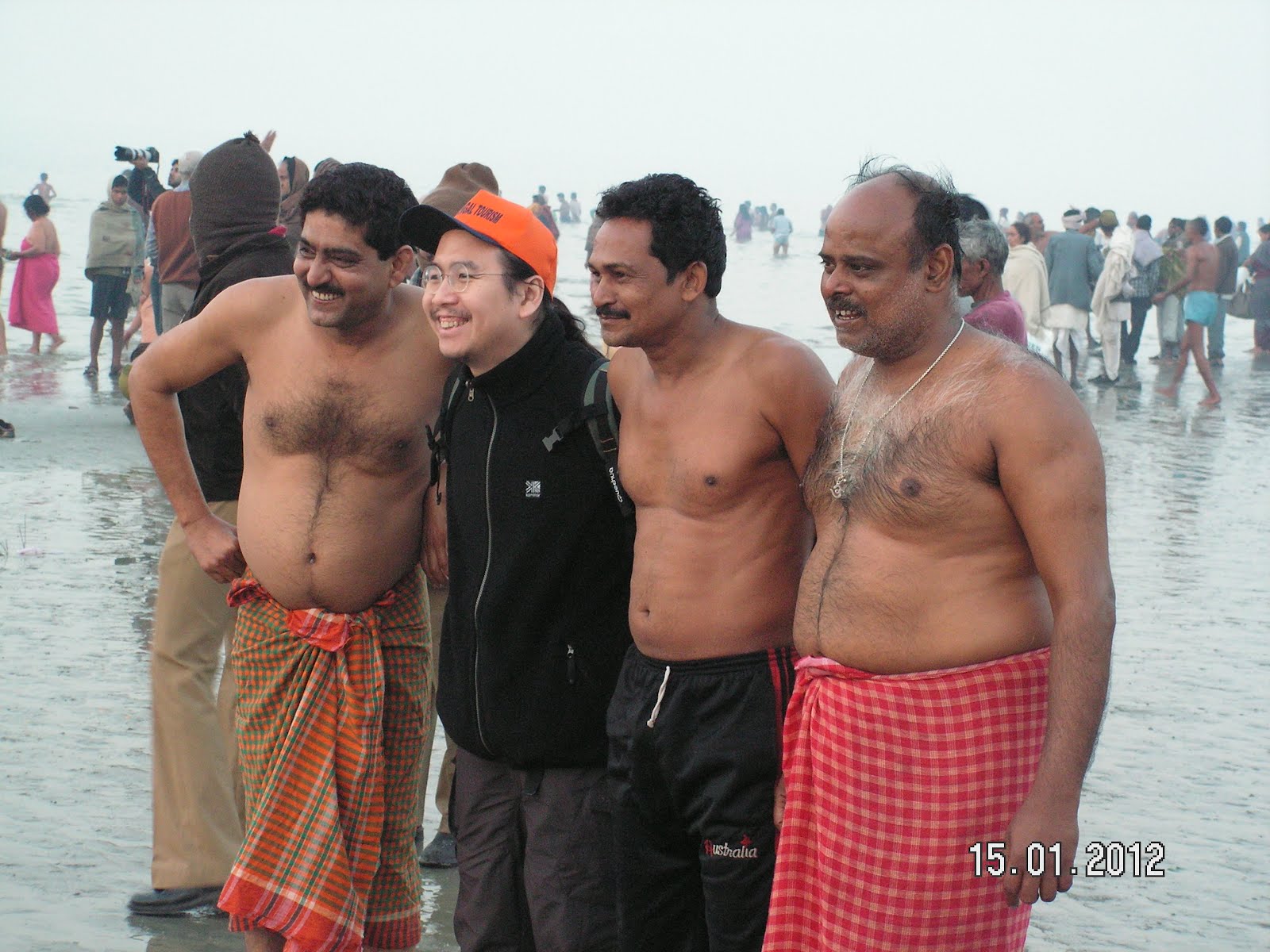
Coast Guard and Bharat Sevasram volunteers were relentless in their assignment of maintaining order. I saw the volunteers grabbing a few young boys and village women and landing a few blows of their baton on them. It turned out that they were loitering in the water and were a potential law and order problem. It is a ritual for some to throw away old clothes at the time of taking the bath- symbolizing a fresh new beginning. People also throw coins in the water, signifying donation of wealth. I later saw these boys trawling the sand beneath the water with a wire mesh- an innovative contraption to catch any coin which will be settled in the shallow bathing zone. A few East Asian looking tourists were conspicuous by their presence. They were evidently here for the experience and photography. A group of bath-ready Bengali pilgrims requested them for a photo-opportunity, which one of them happily obliged.


A newly-wed Bengali couple made for an amusing spectacle. The man was dressed in corduroy suit, his head wrapped tightly in a muffler and then capped with a woolen cap. He was posing like a peacock for the photographic pleasure of his wife, who herself adorned shoes with heels and a cap with an unusual peak that almost seemed to conceal a lunch box inside. A favorite "find-me-here" marker for the village groups seemed to be a pole with something unusual tied to the top. My favorite was one that a frail village woman was carrying, even in to the water- a packet containing three colorful plastic balls. This had to be the grass-root equivalent of a GPS system.

The men in the village groups played the role of dutiful custodian- holding the clothes and belongings of the womenfolk who went about offering prayers and then going in for their dip in the ocean, and also helping women dry their sarees. The headgear and expression of some men were particularly attractive to my camera.

The waves of humanity kept coming, some in processions grouped under banner of some religious organizations. Having captured the sights and sounds of Ganga Sagar to my heart content, I looked at the watch and decided it is time to leave in order to avoid getting caught up with this momentous crowd trying to return to the mainland soon. I started walking back. The road was now lined with beggars- several of them handicapped in some way or another. But what was disgusting is several of them were evidently with make-up, trying to garner sympathy by showing a gaping wound or a horrible infection. To make it doubly heart-breaking, they were crying relentlessly to catch attention. I had made up my mind to donate a certain amount of money and was carrying the pre-determined mount in a wad of currency notes. I managed to give to some legitimate-looking people in theearly morning, but during the return trip it seemed a hopeless task trying to identify the legitimate from the fakes. I rationalized with myself that my burden of sin was standing between me and the intended good deed. After the core area, I gave some money to an ascetic, who was taken by surprise at the unsolicited show of philanthropy but recovered to bless me profusely before I slipped out sheepishly from under his palm. It was time to pack up and leave. I thanked and conveyed my appreciation to the Maharaj at the Bharat Sevasram reception for the kindness and selflessness of the Institution, which made it possible for me and thousands of others to be part of Ganga Sagar.

The feel-good of the morning however evaporated completely when after a short walk to the bus stand I found that already tens of thousands of people were vying already for a transportation option to the ferry point 30 km away. The number of buses was horribly inadequate. The police barricade intended for crowd control made it worse, and the nerves of the volunteers and police were frayed after sleepless two days and this last major crowd situation staring them at their face. There were no pre-paid taxi in sight as well. Gauging the situation and fearing a stampede-like situation, I managed to shout my way out of the barricade and convinced a local hospital ambulance to give me a lift halfway to the ferry point. The kindness of the driver did not go unrewarded, but he richly deserved it as he saved me from a disastrous situation and my hookah and shell-art purchases from being crushed to bits. From where he dropped me, a footboard ride in a local bus took me to the ferry point. There again, had to navigate a situation when the crowd was seething in anger and agony at the frustrating wait for the gates to be opened which would allow them to board the next ferry. My secret back-up numbers for emergency call helped again- a call to the ADM and in charge of the ferry point helped draw the attention to the crowd situation and soon enough I found myself inside a huge LCD vessel, which is normally used to ferry buses and trucks across the river. After soaking up a crowd of few thousand of the in its belly, the giant vessel took us to the mainland. When it finally anchored to the Lot 8 jetty in Kakdwip, whoops of joy went up from among the passengers. The rest of the journey to Kolkata was uneventful. The body and mind seemed to have finally realized that they were put to severe stress in the last 36 hours, so they tried to shut down even in the bus. Only a warm shower and the relief of being back at home revived the mind later in the evening- body would take a day more to recover.

It was a momentous experience on several counts.

First of course was to be part of such a momentous occasion of mass expression of faith. It was nothing short of the month-long Kumbh Mela compressed to within a day. The positivity and the charged atmosphere of the event left a lasting impression. Second was the realization that human endurance is of a much higher order than we the urban bred and privileged population can fathom. The poor and often illiterate villagers had traveled for days in utterly crowded transport, carrying their belonging on their head, with only a vague idea of how to reach and no assurance of food and drink along the way. They completed the journey with a smile and chanting “Gaga Maiya ki Jai” all the way. Third, I felt enriched with the opportunity to interact with people from so many different parts of the country, each from a different social/religious/economic class. I learnt a few lessons of patience, endurance, coexistence, philosophy and devotion in this trip. Finally, the entire journey was like a survival skill workshop. I had to stay alert 24X7 to figure out my way in and out, to avoid being stranded or stampeded upon, to decide when to grin and bear and when to raise my voice and shout. It certainly made me a little more of a man. And confirmed again what I have been suspecting in the recent years ever since I started my tour of socio-religious events in different parts of India: a very large piece of ancient Bharat lies embedded and engrained within the modern and shining India.

Sunday, September 24, 2017

Romancing Railroads- Chicago to San Francisco on Amtrak

Part 2- People experience


I pity those who did not open themselves up to interacting with strangers.  I soaked up every bit of people experience that I could have, with the time left after camera and writing time.  The dining hall, smoke breaks and lounge cars were the places for interaction.  There was interest, respect and understanding when I talked about my country, culture and mythology, very little of which was known to them.  Bias, if any, was kept aside.  In at least one situation, even our biases were discussed with respect.  I met a grandfather-grandson duo; they could not convince the middle generation about rail travel but decided to do it by themselves.  Grandfather knew that cities in India have been renamed.  He told me that the image of rail travel in India that Americans have is people traveling on the roof of coaches.  I explained to him that there are rides options available over a wide spectrum- from free ride to tickets costing a few cents to Palace on Wheels- the high end options treat passengers like a King but at a price point which many average Americans will not be able to afford.  We also talked about the positive bias that many in India have that America is a land of milk and honey where dollar rains from the sky and where all is perfect.  Such simplistic imagery from both sides result from lack of knowledge about the two countries.  The discussion ended with a respectful understanding of each other’s position and a warm farewell handshake. 
On the first day, during breakfast I was seated with Charlotte from Pennsylvania.  She is a charming woman of 83 years- traveling with her daughter and great grand-daughter.  We chatted, and she allowed me to take her photograph for my blog.  She told me how extensively she traveled within the United States with her husband.  She also told me that she has six children, 25 grandchildren, 16 great grandchildren and 6 great-great-grand-children.  She survived a stroke, a heart bypass, cancer and is waiting for a cataract operation.  She is the center of her extended family, and carries forward her husband’s rule that grandchildren cannot be punished. 
My co-passenger Tom in nearby Roomette was a interesting fellow.  He is a retired air traffic controller who is now fed up with planes.  He travels with bagful of gadgets ad heart full of joviality.  It takes a while to realize that his apparent profanities are in the nature of good-natured bantering. He gets away with questions such as “Are you Gay?  These days you need to ask.  I am not”.  He loves to drink ad enjoys company of women.  He tipped the coach attendant handsomely soon after boarding, generously offered me the use of his wifi hotspot when I lamented that the train does not have on board wifi, spent most of his time in the Lounge Car making friends and drinking his heart out with them, few times in the day stumbled back to his room and crashed till  he was fresh enough to go drinking again,  diligently came down to smoke cigerettes at every smoke break station despite having a nicotine patch on him (he offered me one too, seeing him my mind questions the efficacy of the product), and introduced me to his “true soulmate” when I went to his room to make sure he packed all the things that he had scattered all over the room.  Me and his drinking partner helped him pack and get him out of the compartment just in time; though “soulmate” showed no apparent affection during departure and did not come down to bid him goodbye. The coach attendant was more worried about him, and searched his room when he de-boarded.  His sunglass was found, with which I ran to hand over long after we hugged and wished each other a safe journey.  The train conductor held the train even after “all aboard” shout till I completed the 200-meter dash.  During farewell, he told me that he is rich and famous, and I should look him upon in Google.  I told him I only care about the fact that he was a good man.  Undefined bonds are the signature of momentous Amtrak journeys.


Tom and I became smoke break buddy with Shawn, who worked as engineering draftsman in New York but lost his job.  Instead of sitting and home and ruing his bad luck, he has set out to see his great country.  He is going to Seattle, but he discarded the direct train from Chicago to go via San Francisco because this route is more scenic.
  

I met Patrick and his girlfriend, who were painting in the Lounge Car with rapt attention.  They permitted me to take photos and we chatted.  They are heading back to Colorado.  She teaches Yoga and Reiki there.  She wanted to come to India to do a course, but was persuaded by family to do a certificate course in Virginia instead. 
I met Elaine from Wisconsin.  She was knitting designs on wool in the Lounge Car.  She permitted me to take her photo.  She is traveling with parents and brother to visit relatives.  We talked about Kumbh Mela- the religious festival which us the largest human congregation on earth.  


I also met with two elderly sisters from Missouri who are doing two stretches of Amtrak to reach Seattle, from where they will take a cruise.  “We have been planning this for a long time”.  Part of our lunchtime conversation revolved around spices. 
I met a father who is traveling with his two young sons- trying to prepare them for extensive train rides in Europe.  They are headed to Glenwood Springs, Nevada for adventure sports. 


In our sleeper compartment, there was a group of boisterous elderly sisters who boarded from various locations- they are taking their mother for a vacation.
In one of the smoking stops, I had a great conversation with the train Conductor about the history and railroad heritage of some of the towns along the route of California Zephyr.  A town in Colorado is named Helper as the early settlers helped the goods trains to climb up the steep mountain slope by adding their own engines and pulling the trains. 
In the middle of all this conviviality, I learnt from train Conductor that two young passengers in their 20s were thrown out of train by the Amtrak Police in the middle of Nevada desert for “disruptive behavior”!!
The photos of people in this blog have been taken with their permission.  They are aware that the photos will be used in my travel blog.


Romancing Railroads- Chicago to San Francisco on Amtrak


Part 1- The Journey
You are doing it the right way- the train Conductor from Hawaii told me, when I was trying to take a selfie with him at the Grand Junction Station in Colorado and Shawn and Thomas ran in to photobomb my project.  He meant that making friends, knowing people and enjoying the journey is the core spirit of travel in Amtrak long distance trains.  We were talking about the past glory of Amtrak and the vibrancy of the railroad towns some decades ago. 


The station was about halfway in my journey on Amtrak’s Route 5- California Zephyr- between Chicago and San Francisco in June 2017.  The route is 2,447 miles long and takes 52 hours, departing Chicago daily at 2 pm.  A returning train Route 6 starts from Emeryville, CA daily at 9:22 am.   The train travels through 7 states, covering many of the most historic and scenic areas of America’s west.  Some of the stretches are accessible only on Amtrak (or on a Kayak).  It crosses two great mountain ranges- Rockies and Sierra Nevada.  It crosses two of America’s longest rivers- Missouri and Mississippi, and runs parallel to Colorado river for over 250 miles.  It crosses three time zones- Central, Mountain and Pacific time.  It serves two breakfasts, two lunches, two dinners to the passengers in its dining car- not counting the cafĂ© sales and coffee service.  It provides four categories of accommodation- sitting coach, cozy roomettes, spacious bedrooms and family room.  The rail route is ancient- when it was created in 1869, it made life easier for the fortune seekers heading west, many towards San Francisco for the gold rush.  The train is named after Zephyrus- Greek God of the west wind.  The train runs with 8-9 double decker coaches, some sleeper and some seating, and not counting the occasional privately hired coaches hitched on to the main train.  It stops for 33 stations along the way.  A small crew of 11 on-board staff works timelessly to make the journey memorable.  Train driver and conductor crew change once every 8 hours. 

Considering that the journey is long and I will possibly not do the trip again and again, I booked myself a Roomette.  A roomette is a coupe of two berths, with large window.  It has temperature control, charging point, reading light and music control (which does not work).  It is a cozy accommodation with curtain and door.  Being in the category of First Class Sleeper accommodation, it has special privileges, including free on board meal and beverages, towels and bed linen, evening turndown service, shower room and ample restrooms.  First Class passengers also get access to Metropolitan Lounge in Chicago Union Station and assistance with luggage transportation.  Two rows of roomettes are aligned on both sides of the upper deck in one side of a sleeper coach.  A typical sleeper class coach alignment looks like this (Diagram courtesy: www.craigmashburn.com)-Image result for amtrak sleeper coach layout diagram


Unlike in some countries such as India, Amtrak charges the full room or roomette to one person, irrespective of whether (s)he is traveling alone or in group of two.  So the cost difference for one or two person to travel in sleeper class is only marginally different.  The extra amount is payable towards the cost of food, which is included in the cost of the ticket for sleeper class passengers.  So while the sleeper class ticket costs about three times more than seating accommodation, the difference is partly offset by the cost of the six meals served on board, in addition to unlimited coffee in the mornings.  More importantly, the seating passengers mostly depend on the viewing lounge coach to enjoy the beauty of the route- if they manage to get a seat that is.  But the lounge coach has too much glass on all sides and creates reflection, which spoils the photographs.  The sleeper coach has several other advantages- 24 hr coach attendant who provides clean towels/turndown service/water; wake-up call before designated destination; changing room and shower facility; unlimited coffee and fruit juice from 6 am till 11 am.   


The easiest way to travel between Chicago O’Hare airport to Union Station is by the CTA Blue Line train.  It takes about 15 minutes to board from the domestic terminals, costs $5 and cuts the uncertainties of traffic by transporting you to the Clinton station in 45 minutes flat.  Union Station is 2 blocks away.  However, the escalator is very narrow and there are a few flights of stairs to climb, so if you have heavy bags then taxi may be a better option.  If you have big bags that need to be booked in the luggage van, you need to reach the Union Station , more than an hour in advance.  For Sleeper class passengers, it anyway makes sense to reach early- complimentary beverages and hors d oeuvre is served in the spacious Metropolitan Lounge for the waiting passengers.  If you need transportation assistance for traveling to the coach, that is arranged too.    

Upon reaching my assigned coach, I was greeted on the platform by Ms. T- our coach attendant.  She has a more formal name, but prefers to be called thus and passengers like it too.  My room was on the upper floor.  There is plenty of luggage space in the lower level, which alleviated my anxiety of not being able to check in my big bag since I reported less than 1 hour before scheduled departure.  After some excited walk about to feel the lay of the land, I settled down.  The first day’s travel was unimpressive.  For much of the day, the train goes through the small towns and then the vast agricultural lands of Illinois.  Important towns with stops were Naperville, Princeton and Galesburg.  The latter is also a smoking stop so passengers are allowed to alight and light up on the platform.  Galesburg was an important railroad town and it celebrates the heritage with a display of a Burlington steam engine just outside the platform.  Soon after, 180 miles from Chicago, our train crossed the Mississippi River which also forms the state boundary between Illinois and Iowa.  It is 2320 miles long and is the second longest river in the country.  When the sun had set on the first day at around 8 pm, the train was still ambling across the unkempt forest terrains of Iowa.  Major towns covered are Burlington, Mount Pleasant and Creston.  Meanwhile, dining car staff came and took my dinner reservation and handed over a time allotment slip.  I went in and was charmed by the dining car.  It was laid out in two sections, with the serving area in the middle and lower level.  There were a dozen tables laid out in the car, with four seats in each.  If group size is less than four, train staff put others to fill up the table.  Dinner is by appointment, lunch and breakfast is on first come first serve basis.  Seating is assigned, and if seats are full, the staff maintains a waitlist and call by name.  Being alone, I got a chance to sit with eight different traveler groups in the six meals over three days.  Each group was uniquely interesting.  More about them later.

First night dinner was a platter of seared shrimp served with rice and vegetable medley.  Dessert was strawberry cheesecake.  Choosing dishes from an attractive menu option for every meal was not a piece of cake!  While I was at dinner, my bed was turned down to make it ready for the night.  After some post dinner computer work, I went off to sleep.  There is very little track noise, at least in the upper level.   The gentle rocking only aids in sleep.  I slept well, and woke up when the day was breaking.  I was expecting a breathtaking scenery when I removed the curtains, but was disappointed to see rural Nebraska still.  The train was running late, and while the train was scheduled to enter Omaha in Nebrasaka at 11 pm and enter Colorado through Fort Morgan at 5 am, it was two hours behind schedule.  Omaha (500 mile from Chicago) became famous because Warren Buffet’s Berkshire Hathaway Corporation is based here; and when he comes to chair the company’s annual general meeting in May, over 40,000 businessmen descend on this small town.  Nebraska is very agrarian- I could see herds of cattle, large sprinklers and huge granaries.  I could not take pictures in the first two hours of the morning- my camera was nowhere to be found, and the backrests refused to go up to let me look under the bed.  Only when the coach attendant resumed duty at 7 am and worked her magic, the bed became seat again and the camera was duly found. 


Morning is a perfect time to say a little more about the facilities on board.  The toilets are reasonably spacious, clean, well-stocked with all kinds of paper and soap.  There are four in the sleeper coaches- three in lower level and one in upper.  These are larger and more comfortable than airline toilets, even in large intercontinental flights.  The Conductor rang an alert over the PA system that people should not put anything more than paper down the toilets- the coaches are built in the 1970s, and if a toilet gets clogged the whole train loses vacuum and everyone is stuck.  Fortunately that did not happen during my journey.  There is a large shower and changing room, which is always stocked with fresh towels and bath soaps.  The shower is efficient. 

Breakfast opens at 6:30 am.  If you do not get a seat in the first batch, be ready to wait out in the lounge car for about an hour.  This is a good segway to talk about the Lounge Car, which is adjoining the dining car and separates the sleeper coaches from the sitting coaches.  It is a great viewing gallery with large windows, extra glass on the roof, seating clusters of three with a small table in between.  There is a well--appointed cafĂ© in the lower level which serves snacks and alcoholic/soft beverages which can be consumed in the lounge.  There is also a lounge with dining room style layout- I think it is a swing space in case there are more passengers to feed.  But the tables were perfect for groups to pursue things they like.  I ordered Amtrak Signature Railroad French Toast, which is served with sausage.  My table-mate was Charlotte from Pennsylvania- a charming woman of 83 years- traveling with her daughter and great grand-daughter. 


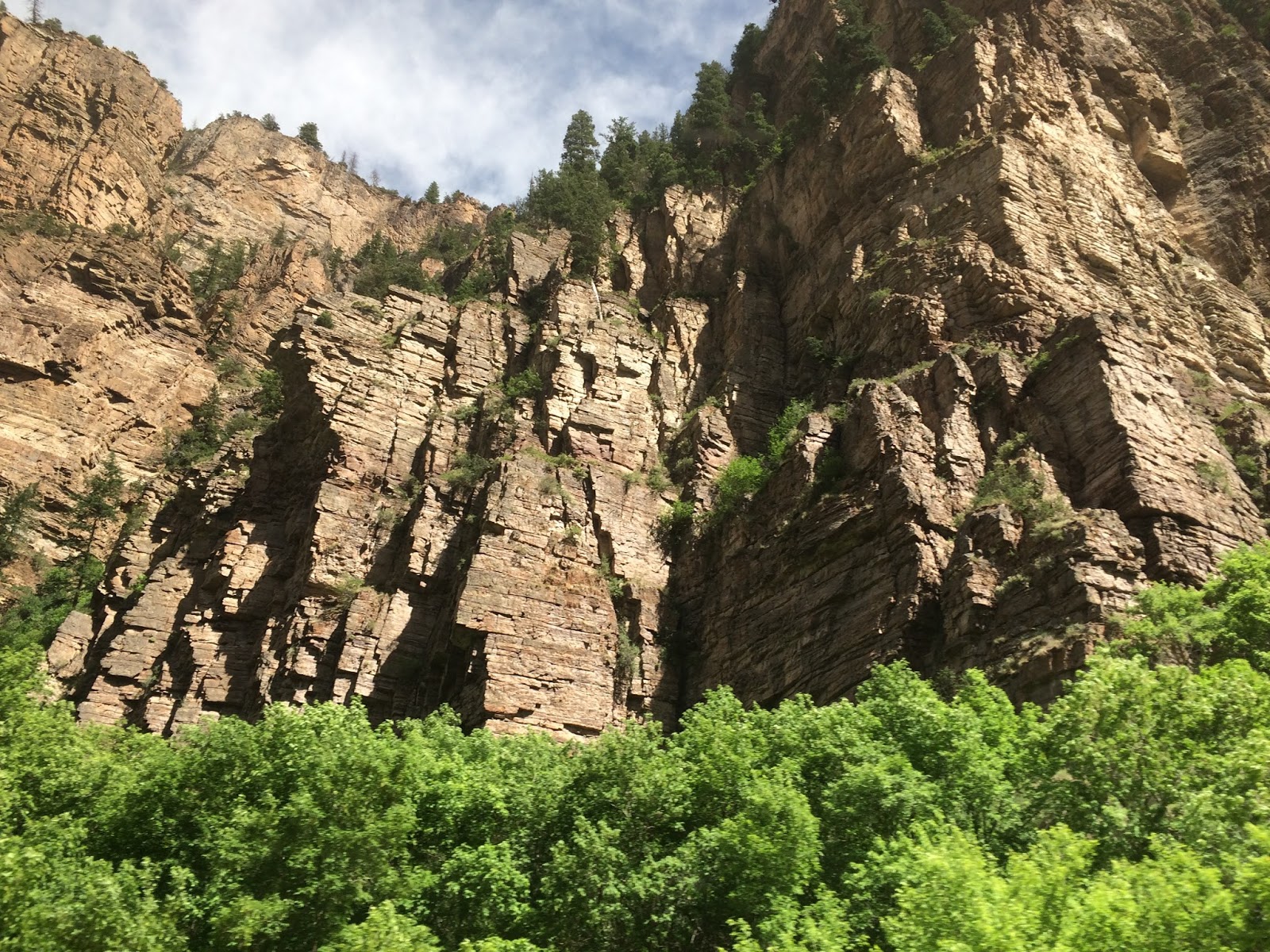
Almost as soon as I finished breakfast, the train stopped at Denver, Colorado.  It was 9:20 am, instead of the scheduled 07:15 am.  This is one of the longer stops where crew change, engine is refueled and windows are cleaned.  After lots of stretching, smoke break and photo sessions, “All Aboard” was announced and we started again.  The next 300 miles is a signature stretch of California Zephyr through the Rockies and along the gushing Colorado river.  Indeed, soon the train started climbing the Rocky Mountains and Colorado rushed in to the train.  In the next two hours, till Fraser Winter Park, I witnessed the steep Rocky Mountains and the gushing Colorado River.  The train passed through 31 tunnels, including the 6.2 mile Moffat Tunnel which transported us across the continental divide.  The train followed the Fraser River through the Fraser Canyon and then runs along the Colorado River for the next 235 miles.  This is one of the most scenic stretches of America that I have seen.  The Fraser Winter Park station in this stretch serves the ski resort nearby.  Between Fraser Winter Park and Glenwood Springs, CO (123 miles), the train passed through spectacular, steep-walled and splendidly remote Fraser Canyon, Gore Canyon and Glenwood Canyon.  I saw a few adventure sports groups riding motorboats and Kayaks on the whitewater rapids of the Colorado river.  Several families got off at Glenwood Springs.  The place is popular with vacation seekers- with ski resorts, biking and backpacking trails and whitewater rafting options.  The train then passed through a few other historic towns such as the mining town of New Castle and wild horse sanctuary city of De Beque for about 90 miles before reaching Grand Junction.  This is where the Gunnison and Colorado rivers meet.  The place is surrounded by mountains.  It was past 4:30 pm instead of the scheduled 1:53 pm.  The train was now getting progressively late. 


The delay however proved to be a boon in disguise.  I got to see America’s wild west in the golden light of the setting sun.  It also helped that my clock was turned back by an hour to Pacific from Mountain time as soon as the train crossed from Colorado to Utah.   The last lap of the train in Colorado and first foray in to Utah was through nature’s playground- the Ruby Canyon.  Wind and water treated the red sandstone as their canvas- creating beautiful landscape with smooth texture mountains in myriad shapes.  The canyon runs for 25 miles between Colorado and Utah till Thompson Springs.  The only access to the canyon apart from rafting is along the rail tracks traversed by California Zephyr.  It became dark soon after the train crossed the canyon.  The list of stops along Utah had places with interesting names such as Green River and Helper.  The latter got its name apparently because apparently the locals used to add “helper” engines to west-bound goods trains to that the trains could negotiate the slope reaching up to Soldier Summit at 7000 feet.  The biggest station in Utah is of course Salt Lake City, which we crossed in the dead of the night. 


Lunch on day 2 was Chicken, Bacon and Cheddar Quesadilla.  I opted for one of the three ACAT (Amtrak Culinary Advisory Team) inspired dishes listed in the menu- vegetarian Asian noodle bowl, followed by vanilla pudding.  The lunch service was relatively poor.  There is no appointment for lunch- I missed the first batch by a whisker and had to wait for nearly an hour till they finished.  That seemed pretty long for a two-course meal.  The few staff serving meals worked hard, but the pressure was starting to tell on their performance.  My table-mate at lunch was served a dish she did not order for.    
The next morning knocked on my window when the train was approaching Winnemucca station in Nevada.  This is a classic cowboy town where apparently the National Senior Pro Rodeo Finals, the Ranch Hand Rodeo Weekend and Mule Show take place.  It is also a designated smoking stop.  After this, the train crossed vast stretches of open space and followed the Truckee river till it reached Sparks and then Reno.  Growing from a small gold mining settlement, Reno economy grew rapidly based on Nevada’s decision to legalize gambling in 1931.     
 The train soon crossed in to California.  I was beginning to lean back in to my seat, assuming that the best is over and I will now pass through familiar terrain.  But California Zephyr surprised me yet again.  Soon after crossing Truckee and Stanford Flats stations, the train started to climb up again.  It was climbing over the Donner Pass to the peak of the Sierra Mountains.  In winter, the Donner Lake area sees over 30 feet of snow.  A tunnel through Mt. Judah is at an elevation of over 7,000 feet.  There are several ski resorts in the area.  At some stretches, the train track was 1,500-2,000 feet above the American River valley on the left side.  The train then had s steep climb-down between Cape Horn and Colfax. 


After crossing the Sierras, from Sacramento till Emeryville through Davis, Martinez and Richmond was sedate.  The last lap along the shore of the San Pablo Bay and then along the San Francisco Bay was very scenic.  We alighted at Emeryville over 2 hours behind scheduled time, and had a seamless transfer to the San Francisco Fisherman’s Wharf on board Amtrak Thruway Bus service.  It was sheer delight to see my friend and his family waiting to receive me at the Wharf.


This was a momentous trip on may counts.  The time investment- nearly 60 hours- was most un-American and un-touristy.  My co-passengers were all American citizens; many of them retired (some ages ago and some never worked); grandfathers and great-grandmothers traveling with family; unemployed adventurous ones; and short distance travelers.  I had memorable interaction with several of them.  The traveler camaraderie was awesome.  The interactions were laced with respectful curiosity about each other.  A separate blog regarding my people interaction will be posted.  The unknowns while planning this trip were many.  Indian travel agents and even tourism promotion agencies have very little idea of Amtrak routes and vacation packages.  Without first hand and anecdotal experience, it is not easy to make the choice and lock the payment.  The cost was high.  My friend had offered me a plane ticket at less than half the cost and one-tenth of the time.  But despite all this, the returns of the trip was sweet and memorable.  I encourage tourists to include Amtrak travel in their itinerary.  There is no better way to see the heart of America and the soul of Americans than traveling on Amtrak.